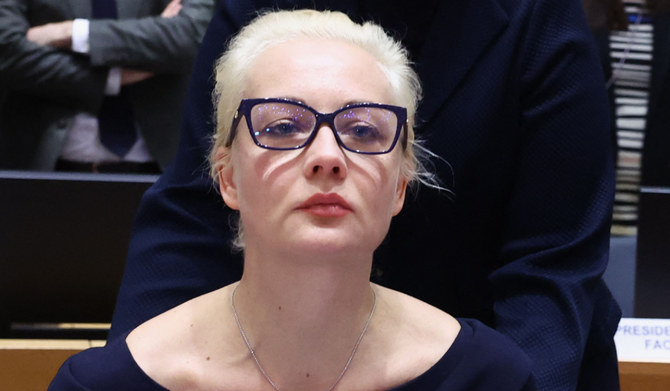
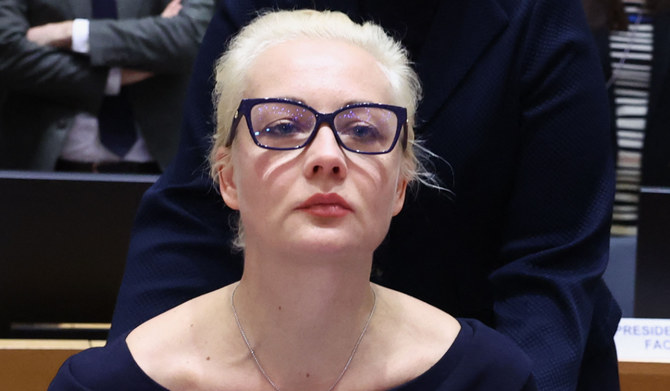
WARSAW: Yulia Navalnaya on Monday vowed to continue her husband Alexei Navalny’s fight after his death in a Russian prison last week, for which she blamed the Kremlin.
She spoke as the Kremlin said it had no details about his death, while his mother Lyudmila was denied access to his body for a third day.
Navalnaya’s address came shortly before she met EU foreign ministers in Brussels, where she had been invited after the death of her husband triggered Western outrage.
“I will continue the work of Alexei Navalny. I will continue to fight for the freedom of our country,” Navalnaya said. “And I call on you to stand by me.”
Navalnaya, an economist, stood by her husband as he galvanized mass protests in Russia, flying him out of the country when he was poisoned before defiantly returning to Moscow with him in 2021, knowing he would be jailed.
The announcement she will replace Navalny is a momentous and unpredictable turn for Russia’s exiled and beleaguered opposition, left leaderless after Navalny’s death.
Russia will hold a presidential election on March 15-17 in which Putin has no real challengers, with most the opposition exiled, behind bars or dead.
“Vladimir Putin killed my husband Alexei Navalny,” Navalnaya said on his Youtube channel, adding he died “after three years of torment and torture.”
“Putin took from me the most valuable thing that I had, the closest and most loved person. But Putin also took Navalny from you,” the 47-year-old said.
Russia’s prison service said on Friday that Navalny had died “after a walk” in the IK-3 prison colony in the Arctic Yamal region.
Kremlin spokesman Dmitry Peskov refused to say how Putin — who has not commented on the death — reacted to his main opponent dying.
He also said the Kremlin had no results from an investigation into the death.
“At the moment, the results of the investigation have not been released, they are unknown,” Peskov said.
He decried Western statements blaming the Kremlin for Navalny’s end as “absolutely unacceptable.”
Navalny’s team however accused Russian authorities of trying to cover up “murder.”
“Investigators told Alexei’s mother and lawyers that they are not handing over the body and in the next 14 days they will conduct a chemical analysis, an investigation,” Navalny spokeswoman Kira Yarmysh said in a YouTube broadcast.
“I’ll say it again: Navalny’s body is being hidden to hide the traces of the murder. This 14-day ‘chemical analysis’ is an outright lie and mockery,” she said in a subsequent statement on social media site X, the former Twitter.
Navalny’s allies said his mother Lyudmila was on Monday again denied access to a morgue in the Russian Far North for a third day in a row.
Navalny had continued even from behind bars to call on Russians to fight the government, calling on them “not to be afraid.”
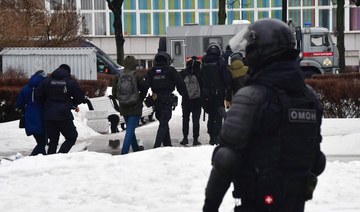
Across Russia, mourners have laid flowers in memory of Navalny at monuments to victims of Soviet-era repression and hundreds of people have been detained.
In Moscow, AFP reporters saw a steady stream of people bring flowers to two monuments on Monday.
At one known as the “Wall of Grief,” a woman stood and cried, with a heavy police presence nearby.
“One for all,” read a note left by mourners, quoting a slogan Navalny often used at protests.
Another monument close to the headquarters of Russia’s security service was visited by French ambassador to Moscow Pierre Levy.
Outside Russia, Russian emigres held vigils in European cities.
In Kazakhstan — another country where many Russians fled — Russian rock legend Yuri Shevchuk performed a song in honor of Navalny on Sunday.
“Alexei Navalny who spoke to us, Russians, about freedom and who reminded us all that we could be free in the best sense of the word,” Shevchuk told a crowd, according to Russian independent media.
In Washington, US President Joe Biden said he was studying more sanctions against Moscow.
“We already have sanctions, but we are considering additional sanctions, yes,” said Biden, who has already directly blamed Putin and his “thugs” for Navalny’s death.
Several European countries including Spain and Germany have summoned Russian diplomats, and the EU called for an independent “international investigation” into the Kremlin foe’s death.
Earlier, EU foreign policy chief Josep Borrell pledged to hold Putin to account for Navalny’s death after meeting his widow.
The EU has already imposed heavy sanctions on Moscow, including on Putin, over the invasion of Ukraine. Officials concede it will be difficult to take significant further action.
The EU in a statement called for an independent “international investigation” into the Kremlin foe’s death and threatened sanctions.