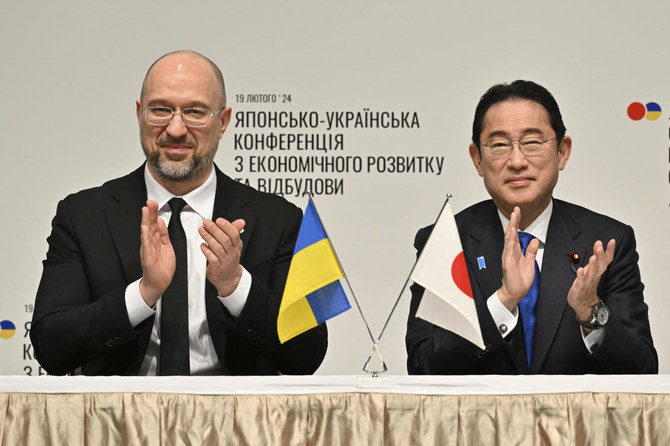
TOKYO: Japanese Prime Minister Fumio Kishida on Monday pledged his country’s long-term engagement in Ukraine’s reconstruction, calling it a future investment, as Japan stressed its commitment to supporting the war-torn country ahead of the two-year anniversary of Russia’s invasion.
In his keynote speech at a conference Japan co-organized with the Ukrainian government and business organizations, Kishida said Japanese public and private cooperation will be a long-term partnership based on inclusivity, humanitarianism as well as technology and knowledge. More than 50 cooperation deals were signed by Japanese and Ukrainian government agencies and companies.
Kishida stressed the importance of investment across industries for the future of that country’s development and ensuring that the support caters to Ukraine’s needs.
Support for Ukraine’s reconstruction is about “investing in the future,” Kishida said. “The war in Ukraine is still going on at this very moment and the situation is not easy. The promotion of economic reconstruction, however, is not only an investment for the future of Ukraine but also investing in Japan and the whole globe.”
Ukraine’s Prime Minister Denys Shmyhal, who heads headed his country’s delegation of more than 100 people, expressed thanks for the encouragement and said that “today is the new start of cooperation between the two countries.”
He said “Ukraine is not just rebuilding, we are generating new rules of the game, new approaches,” he said. All eyes are on Ukraine, and “dictators and potential invaders” are also turning their eyes to see how Russia’s violation of the international law is seen and how the world will react to it.
About 300 people and 80 companies are to attend from the two countries, Japanese officials have said.
The Japan-Ukraine Conference for Promotion of Economic Growth and Reconstruction is co-organized by the Japanese and Ukrainian governments, Japan’s powerful business organization Keidanren, and Japan External Trade Organization, or JETRO.
The two sides issued a joint communique, stating Japan’s long-term support in helping Ukraine achieve economic stability. The two countries also noted the importance of maintaining tough sanctions against Russia. Japan also announced the start of talks toward revising a bilateral investment pact and easing of travel restrictions for Japanese business visitors to Ukraine.
Japan hopes the conference will build momentum for international support for Ukraine as the war drags on and attention has diverted to the Gaza situation.
The conference is largely about reconstruction and investment in Ukraine, but it’s also about Japan’s national security.
Kishida repeatedly said that “Ukraine today could be East Asia tomorrow,” and it is crucial for Japan to advocate its objection to Russia’s invasion and to the one-sided change of the status quo by force. Its support for Ukraine comes amid fear of China’s increasingly assertive military actions in the region.
“It is extremely important that we demonstrate our solidarity to Ukraine in our uniquely Japanese way,” Foreign Minister Yoko Kamikawa told reporters Friday.
Japan’s $12.1 billion contribution to Ukraine over the past two years is mostly financial and humanitarian as its military equipment provisions are limited to non-lethal weapons, and much smaller compared to $111 billion the United States has provided in weapons, equipment, humanitarian assistance.
Japan’s government has chosen seven target areas — including removal of mines and debris; improvement of humanitarian and living conditions; farming; biochemical manufacturing; digital and information industry; infrastructure in power and transportation sectors; and anti-corruption measures.
Japan, in cooperation with other Group of Seven members, hopes to link the Tokyo conference to a separate Ukraine reconstruction conference to be held in Germany in June.


![]()

Japan hosts Ukraine reconstruction conference to showcase its support for the war-torn country
Short Url
https://arab.news/2e378
Japan hosts Ukraine reconstruction conference to showcase its support for the war-torn country
- More than 50 cooperation deals were signed by Japanese and Ukrainian government agencies and companies


Latest updates


© 2026 SAUDI RESEARCH & PUBLISHING COMPANY, All Rights Reserved And subject to Terms of Use Agreement.