

Sudan’s Army claims first major advance

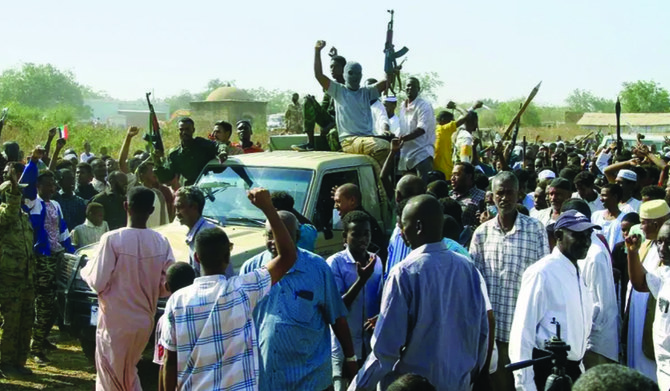
Supporters of the Sudanese popular resistance, which backs the army, raise their weapons in Gedaref town on Jan. 16. (AFP)
Short Url
Updated 18 February 2024
Follow

Sudan’s Army claims first major advance

  • The RSF maintains control of areas in the east of Omdurman as well as the wide Ombada district that connects the capital to the western regions, and residents say it has snipers stationed along key routes

DUBAI: The Sudanese Army has claimed its first major advance in 10 months of war, regaining control of part of the city of Omdurman from the Rapid Support Forces.
The army said late on Friday it had succeeded in connecting its two main bases in the city, prompting celebrations among soldiers and local residents.
The Rapid Support Forces denied the army had advanced. “The army has turned to propaganda as it is on the verge of defeat,” the RSF media office said in a statement.
The RSF has been fighting the army for control of Sudan since April in a war that has killed thousands, displaced almost 8 million, and sparked warnings of famine.
Soon after war broke out, the RSF took control of most of the capital Khartoum, its sister cities Bahri and Omdurman, and most of the territory in the western Kordofan and Darfur regions.
The army held on to most of its bases in the capital but had not made major advances until the start of the year, when residents reported it was making greater use of drones.
That appeared to help the army push out of its strongholds around bases in the north and south of the city and create a band of control across the length of the capital.
The RSF maintains control of areas in the east of Omdurman as well as the wide Ombada district that connects the capital to the western regions, and residents say it has snipers stationed along key routes.
Despite a two-week internet blackout, images emerged from the city showing civilians and soldiers celebrating.
Residents of Omdurman, Khartoum and other cities say the RSF has forced them out of their homes, looted belongings, and raped women.
The force is accused of crimes against humanity, war crimes, and ethnic cleansing in West Darfur state by the US
The army, which has carried out a broad campaign of air strikes, is also accused of war crimes. The army and the RSF deny the accusations. The RSF says rogue actors will be brought to justice.
In the Fiteihab district, which has seen food stocks dwindle under the RSF’s siege of the nearby army engineering corps base, one resident said trucks had started entering.
“We are finally starting to regain some hope,” he said.
Sudanese aid worker Shakir Elhassan and his family were among millions forced to flee their homes and former lives after war broke. Some 10 months later, he is one of many voices in the sector warning of a devastating humanitarian crisis that could soon spiral into famine.
“The needs are unprecedented,” the communications manager at Care International said, deploring a lack of global attention. “There is a huge gap in medicines, food,” he said, from the east of the country after what he described as 10 days without internet. Elhassan fled the capital Khartoum in July, joining his wife and three children who had already sought refuge 180 km further south in the town of Wad Madani.


Israeli police kill Bedouin man during raid in southern Israel, local official says

Updated 58 min 48 sec ago
Follow

Israeli police kill Bedouin man during raid in southern Israel, local official says

  • The shooting of 36-year-old Muhammed Hussein Tarabin threatened to worsen the already strained relations between the Israeli government and the country’s Bedouin minority

TEL AVIV: Israeli police shot and killed a Bedouin Arab man during an overnight raid in his village in southern Israel, according to media reports and a local official.
The shooting of 36-year-old Muhammed Hussein Tarabin threatened to worsen the already strained relations between the Israeli government and the country’s Bedouin minority.
Israeli police have been conducting a large-scale operation in the village of Tarabin for the past week in what they describe as a crackdown on local crime.
Talal Alkernawi, the mayor of the nearby town of Rahat, confirmed the man’s death.
Israeli police said they opened fire on a man who had “endangered” forces during an arrest raid.
The Israeli news site Haaretz cited relatives as saying Tarabin, whose family name shares the name of the village, was in his home.
In a video statement, Tarabin’s 11-year-old son, Hussein, said that men in uniform came to their house at night. He heard shots and saw his father’s body lying on the ground.
Israel’s far-right National Security Minister Itamar Ben-Gvir, who oversees the police force, expressed support for the police. “Anyone who endangers our police officers and fighters must be neutralized,” he posted on X.
Prime Minister Benjamin Netanyahu said Sunday that the country would do everything to prevent the Negev desert in southern Israel from becoming the “wild south”. He congratulated Ben-Gvir on leading the initiative and said he would visit the region in the coming days.
Israel’s more than 200,000 Bedouin are the poorest members of the country’s Arab minority, which also includes Christian and Muslim urban communities. Israel’s Arab population makes up roughly 20 percent of the country’s 10 million people. While they are citizens with the right to vote, they often suffer discrimination and tend to identify with Palestinians in the occupied West Bank and the Gaza Strip.
The Bedouin sector has grappled with crime and poverty, and about one-third of its members live in villages that the Israeli government considers illegal. Israel says it is trying to bring order to a lawless area, but Bedouin leaders accuse the government of neglect, trying to destroy their way of life or pushing to relocate them to less desirable areas.
Residents say police have made around two dozen arrests in the village of Tarabin over the past week. Nati Yefet, a spokesman for the regional council of unrecognized villages in the area, said most have been quickly released.
“They’re looking for people, crime-related things, but they didn’t find anything,” Yefet said. He accused Ben-Gvir of intensifying the raids in the run-up to elections expected later this year.
Marwan Abu Frieh, of the Arab rights group Adalah, said Israel has stepped up house demolitions in recent years, leaving thousands of residents without shelter and worsening the plight of communities often denied basic services.