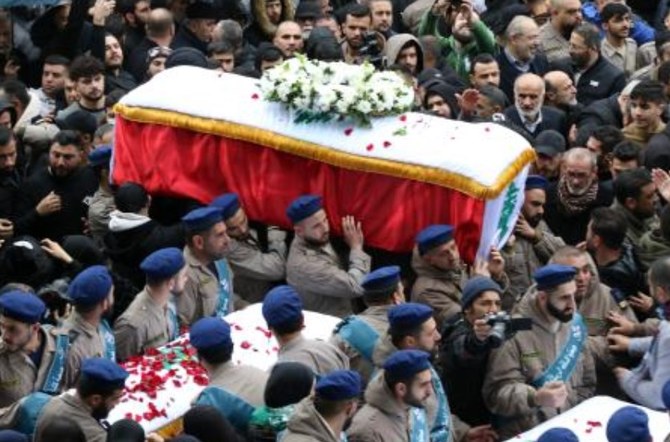
BEIRUT: The residents of Nabatiyeh took to the streets on Saturday to hold funerals for the seven civilians who were killed on Wednesday when Israeli rockets struck a residential building in the southern city.
A representative of the speaker of the parliament attended the funerals, which were held in the courtyard of the city mosque.
Sheikh Abdel Hussein Sadiq, imam of Nabatiyeh, said during the funeral: “The innocent blood that was shed unjustly and savagely in a safe home in Nabatiyeh — which included a father, five women, and two children — proves the deliberate intention of the Israeli enemy to crush all human values and international conventions and laws.”
Elsewhere, hostilities between Hezbollah and the Israeli army continued on Saturday. Hezbollah announced the “targeting of the Baranit Barracks with a Falaq-1 missile, causing a direct hit.”
The Israeli Army carried out successive airstrikes on the outskirts of Beit Lif, Ramyah, and Aita Al-Shaab, and missile strikes on the outskirts of Aitaroun in the Bint Jbeil district. The Hamoul-Naqoura area and the outskirts of Alma Al-Shaab were subjected to artillery shelling.
A spokesman for the Israeli Army said its planes “attacked Hezbollah infrastructure in Jabal Blat and a military building in Bint Jbeil.”
Amos Hochstein, US envoy for energy affairs, said the US is trying to “keep the conflict in southern Lebanon at the lowest possible level.”
In a statement to CNBC, Hochstein stressed the “need for residents of southern border towns and villages to return to their homes, as well as residents on Israel’s northern border.”
Hochstein met with Lebanon’s caretaker Prime Minister Najib Mikati during the ongoing Munich Security Conference.
“The situation on the border between the two countries changed after Oct. 7, and we will have to do a lot to support the Lebanese Army and build the economy in southern Lebanon. This will require international support from the Europeans and the Gulf states, and I hope to see their support in the coming phase,” Hochstein said.
Hochstein told Al-Arabiya TV: We are working quietly to end the conflict on the Lebanese border and prevent the war from expanding, which will not be in anyone’s interest.”
In other news, media reports stated that the French company Total had not signed contracts for gas and oil extraction in blocks 8 and 10 of Lebanese territorial waters. The signing deadline set by the Cabinet passed on Friday.
A source in Lebanon’s Ministry of Energy said: “The dispute with the consortium (which includes Qatar Energy and Italy’s Eni) is due to Total’s refusal to shorten the deadline for seismic surveys and drilling in Block 8 and Block 10. Total wants to continue this process until 2027, while the Lebanese side insists that this process be completed within a year and a half.”
Attorney Christina Abi Haidar told Arab News that those terms were “unjust to Lebanon because Total requested a year to determine if they would begin drilling an exploratory well.”
Abi Haidar said: “The Lebanese Cabinet requested better conditions for both parties before signing the contract. It is important to note that Total still holds the license to drill in Block 9. The company drilled one well, which was found to be non-commercial, and refused to drill a second one.”
Abi Haidar continued: “What happened is beneficial for Lebanon. Why should a French company be the sole owner of the licenses for all the blocks in our waters? Let others participate in the third licensing round.”


![]()

Israel-Hezbollah hostilities continue amid funerals for victims in Lebanon
Short Url
https://arab.news/wac97
Israel-Hezbollah hostilities continue amid funerals for victims in Lebanon
- Hostilities between Hezbollah and the Israeli army continued on Saturday
- The Israeli Army carried out successive airstrikes on the outskirts of Beit Lif, Ramyah, and Aita Al-Shaab


Latest updates




Recommended


© 2026 SAUDI RESEARCH & PUBLISHING COMPANY, All Rights Reserved And subject to Terms of Use Agreement.