Israeli attacks in southern Lebanon kill 6 members of Hezbollah, ally

1 / 2
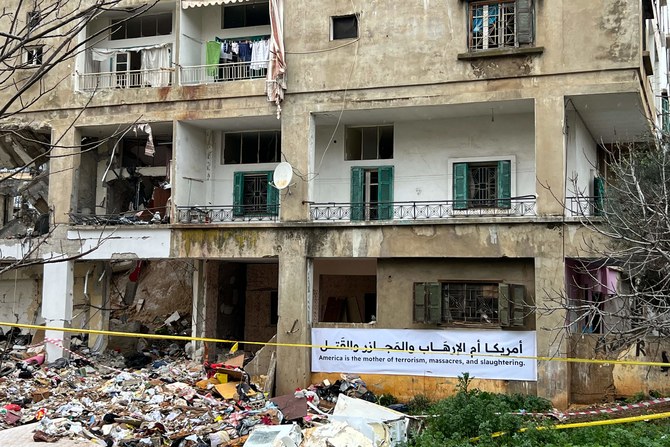
A banner hangs on the side of a building that was damaged by an Israeli air raid two days earlier in Lebanon's southern city of Nabatieyh on February 16, 2024. Israeli strikes on targets in south Lebanon killed five fighters from Hezbollah and the allied Amal movement, the groups said on February 16, adding to an uptick in violence causing international alarm. (AFP)
2 / 2
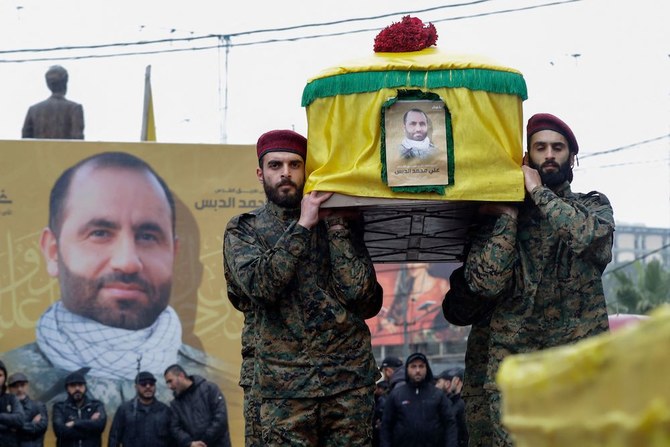
Hezbollah militants and supporters attend the funeral of Ali al-Debs, one of the militant group's commanders killed by an Israeli air raid two days earlier, in Lebanon's southern city of Nabatieyh on February 16, 2024. (AFP)
Short Url
Updated 16 February 2024
Follow

Israeli attacks in southern Lebanon kill 6 members of Hezbollah, ally

  • PM Mikati says Israel’s killing of civilians is a ‘crime against humanity’
  • Nasrallah: Israel will pay price for shedding  blood of our women and children

BEIRUT: Six Hezbollah and Amal Movement members were killed in an Israeli shelling early Friday morning in southern Lebanon.

Israeli warplanes raided the towns of Qantara, Deir Seryan and the vicinity of Wadi Saluki.

The raid on a house in Qantara killed three Amal Movement members: Ali Hassan Issa from the town of Jibchit, Mohammed Hussein Said from the town of Qsaybeh and Qassem Nizar Berro from the town of Charqiyeh.

Meanwhile, Hezbollah mourned two of its members: Mustafa Khodr Qassir from the town of Deir Qanoun En Nahr and Mohammed Ali Darwiche from the town of Srebbine in southern Lebanon.

The Israeli army acknowledged through its spokesman that on Thursday night, “we attacked a military building and infrastructure belonging to the Hezbollah organization in the village of Qantara.”

Israeli media reported that “the internal front in the north has decided to close roads on the northern border to traffic following the Israeli army’s assessment of the situation, and in anticipation of a response by Hezbollah.”

Hezbollah targeted the Kiryat Shmona barracks at midnight on Thursday with Falaq-1 missiles in response to the massacre committed by the Israeli army in the cities of Nabatiyeh and Al-Sowanah two days ago.

The Civil Defense announced that after continuing search-and-rescue operations and comprehensive field surveys at the site of the building partially destroyed by the Israeli drone in Nabatiyeh on Wednesday evening, they retrieved a total of 11 civilian bodies, transported two wounded to Nabatiyeh Governmental Hospital, and extinguished a fire that broke out inside the targeted building.

While families held funeral processions in the southern villages, Israeli raids continued on Aita Al-Shaab, Beit Lif and Bint Jbeil.

Hostile operations continued for the second consecutive day within the rules of engagement adopted since Hezbollah opened the southern front “to support the Gaza Strip,” meaning south of the Litani River.

This comes after both parties violated these rules two days ago, with the Israeli side targeting Lebanese civilians in the area north of the Litani River, and Hezbollah targeting Safed with its operations.

Commenting on the Nabatiyeh attack, Hezbollah chief Hassan Nasrallah said: “The enemy went too far in killing civilians. Its goal is to put pressure on the resistance to stop, because all pressure since Oct. 7 was aimed at stopping the southern front. The answer to the massacre must be to continue and escalate the action.”

He added: “Targeting the Kiryat Shmona settlement with dozens of Katyusha rockets and a number of Al-Falaq missiles is an initial response.

“The Israeli enemy will pay the price for shedding the blood of our women and children in Nabatiyeh and Al-Sowanah.” 

In response to the Israeli defense minister’s threat to the capital, Beirut, Nasrallah said: “It seems that he has forgotten that the resistance possesses a tremendous and accurate missile capability that allows its hand to extend from Kiryat Shmona to Eilat.”

A Lebanese security source said: “The Israeli Army is focusing its hostile operations on cutting off Hezbollah’s supply routes with fire and blocking off the roads connecting the border villages to each other.”

The source noted: “Completely uninhabited areas are witnessing unprecedented destruction of homes and infrastructure. The Israeli army deals with anything moving in the area as a target.”

Israeli reconnaissance planes continue to fly over southern Lebanon, reaching the course of the Litani River.

In a speech delivered during the opening session of the 60th Munich Security Conference, caretaker Prime Minister Najib Mikati affirmed that “Lebanon will continue to adhere to all UN resolutions.”

He said: “Israel should implement these resolutions, stop its hostilities in southern Lebanon and its violation of the Lebanese sovereignty, and withdraw from all occupied Lebanese territory.”

Mikati questioned “the steps taken by the international community to stop this ongoing hostility.”

He said: “Only two days ago, a family of seven, including children and women, was targeted in southern Lebanon. Killing and targeting innocent children, women and elderly people are crimes against humanity.”

Mikati emphasized that “periodic wars and conflicts in the Middle East, along with their global repercussions, will not end without a two-state solution and the establishment of an independent and sovereign Palestinian State.”

Mikati called on “international actors to support peace-making efforts, help to prevent and resolve conflicts, and protect civilians from harm.”

Caretaker Foreign Minister Abdallah Bou Habib instructed Lebanon’s permanent representative to the UN to file a complaint before the UN Security Council on Friday.

This came after “the Israeli raid that targeted a residential building in Nabatiyeh, killing 11, including women and children, and causing extensive damage to the building, in addition to a second raid targeting the house of Lebanese citizen Jalal Mohsen in the Souaneh village, killing his wife and his two children.”

The complaint emphasized that “Israel’s deliberate and direct targeting of civilians in their houses is a violation of the international humanitarian law and a war crime in which all those involved are directly and indirectly subject to international responsibility.”

The complaint added: “The attacks also violated Lebanon’s sovereignty and the security of its territory and citizens, and defied all UN resolutions compelling Israel to stop its violations of Lebanese sovereignty and put an end to its occupation of Lebanese territories, including the Resolution 1701.

“What is concerning is that this escalation comes at a time when international efforts and diplomatic moves intensify to diffuse the situation, and while Lebanon reiterates its rejection of the war and provides a road map for sustainable security in the south.

“This prompts us to urge the international community to exert pressure on Israel to curb its ongoing escalating hostilities and stop the Israeli aggression against Lebanon and its people, in order to avoid the expansion of the conflict and a full-scale destructive regional war that will be difficult to contain.”


Syrian army pushes into Aleppo district after Kurdish groups reject withdrawal

Updated 10 January 2026
Follow

Syrian army pushes into Aleppo district after Kurdish groups reject withdrawal

  • Two Syrian security officials told Reuters the ceasefire efforts had failed and that the army would seize the neighborhood by force

ALEPPO, Syria: The Syrian army said it would push into the last Kurdish-held district of Aleppo ​city on Friday after Kurdish groups there rejected a government demand for their fighters to withdraw under a ceasefire deal.
The violence in Aleppo has brought into focus one of the main faultlines in Syria as the country tries to rebuild after a devastating war, with Kurdish forces resisting efforts by President Ahmed Al-Sharaa’s Islamist-led government to bring their fighters under centralized authority.
At least nine civilians have been killed and more than 140,000 have fled their homes in Aleppo, where Kurdish forces are trying to cling on to several neighborhoods they have run since the early days of the war, which began in 2011.

HIGHLIGHTS

• Standoff pits government against Kurdish forces

• Sharaa says Kurds are ‘fundamental’ part of Syria

• More than 140,000 have fled homes due to unrest

• Turkish, Syrian foreign ministers discuss Aleppo by phone

ِA ceasefire was announced by the defense ministry overnight, demanding the withdrawal of Kurdish forces to the Kurdish-held northeast. That would effectively end Kurdish control over the pockets of Aleppo that Kurdish forces have held.

CEASEFIRE ‘FAILED,’ SECURITY OFFICIALS SAY
But in a statement, Kurdish councils that run Aleppo’s Sheikh Maksoud and Ashrafiyah districts ‌said calls to leave ‌were “a call to surrender” and that Kurdish forces would instead “defend their neighborhoods,” accusing government forces ‌of intensive ⁠shelling.
Hours ​later, the ‌Syrian army said that the deadline for Kurdish fighters to withdraw had expired, and that it would begin a military operation to clear the last Kurdish-held neighborhood of Sheikh Maksoud.
Two Syrian security officials told Reuters the ceasefire efforts had failed and that the army would seize the neighborhood by force.
The Syrian defense ministry had earlier carried out strikes on parts of Sheikh Maksoud that it said were being used by the Kurdish-led Syrian Democratic Forces (SDF) to launch attacks on the “people of Aleppo.” It said on Friday that SDF strikes had killed three army soldiers.
Kurdish security forces in Aleppo said some of the strikes hit a hospital, calling it a war crime. The defense ministry disputed that, saying the structure was a large arms depot and that it had been destroyed in the resumption of strikes on Friday.
It ⁠posted an aerial video that it said showed the location after the strikes, and said secondary explosions were visible, proving it was a weapons cache.
Reuters could not immediately verify the claim.
The SDF is ‌a powerful Kurdish-led security force that controls northeastern Syria. It says it withdrew its fighters from ‍Aleppo last year, leaving Kurdish neighborhoods in the hands of the Kurdish ‍Asayish police.
Under an agreement with Damascus last March the SDF was due to integrate with the defense ministry by the end of 2025, ‍but there has been little progress.

FRANCE, US SEEK DE-ESCALATION
France’s foreign ministry said it was working with the United States to de-escalate.
A ministry statement said President Emmanuel Macron had urged Sharaa on Thursday “to exercise restraint and reiterated France’s commitment to a united Syria where all segments of Syrian society are represented and protected.”
A Western diplomat told Reuters that mediation efforts were focused on calming the situation and producing a deal that would see Kurdish forces leave Aleppo and provide security guarantees for Kurds who remained.
The diplomat ​said US envoy Tom Barrack was en route to Damascus. A spokesperson for Barrack declined to comment. Washington has been closely involved in efforts to promote integration between the SDF — which has long enjoyed US military support — and Damascus, with which the ⁠United States has developed close ties under President Donald Trump.
The ceasefire declared by the government overnight said Kurdish forces should withdraw by 9 a.m. (0600 GMT) on Friday, but no one withdrew overnight, Syrian security sources said.
Barrack had welcomed what he called a “temporary ceasefire” and said Washington was working intensively to extend it beyond the 9 a.m. deadline. “We are hopeful this weekend will bring a more enduring calm and deeper dialogue,” he wrote on X.

TURKISH WARNING
Turkiye views the SDF as a terrorist organization linked to the outlawed Kurdistan Workers’ Party and has warned of military action if it does not honor the integration agreement.
Turkish Foreign Minister Hakan Fidan, speaking on Thursday, expressed hope that the situation in Aleppo would be normalized “through the withdrawal of SDF elements.”
Though Sharaa, a former Al-Qaeda commander who belongs to the Sunni Muslim majority, has repeatedly vowed to protect minorities, bouts of violence in which government-aligned fighters have killed hundreds of Alawites and Druze have spread alarm in minority communities over the last year.
The Kurdish councils in Aleppo said Damascus could not be trusted “with our security and our neighborhoods,” and that attacks on the areas aimed to bring about displacement.
Sharaa, in a phone call with Iraqi Kurdish leader Masoud Barzani on Friday, affirmed that the Kurds were “a fundamental part ‌of the Syrian national fabric,” the Syrian presidency said.
Neither the government nor the Kurdish forces have announced a toll of casualties among their fighters from the recent clashes.