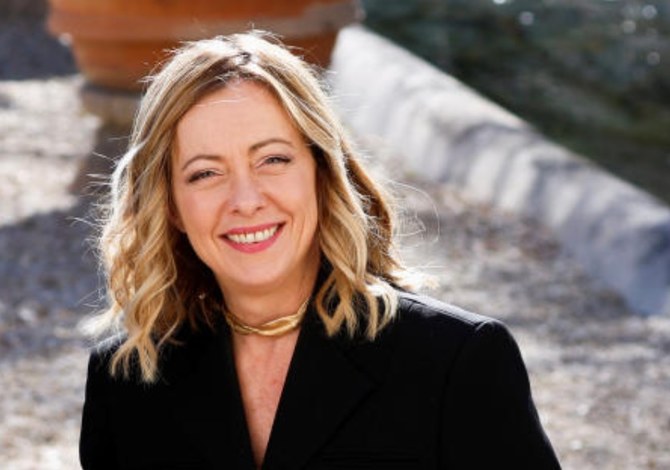
Italian PM: Sudan war creating new migrant crisis

Italian Prime Minister Giorgia Meloni told ministers in Rome: “Sudanese refugees are no longer stopping in Egypt but heading for Libya and from there coming to us.” (Reuters)
Short Url
Updated 17 February 2024
Follow

Italian PM: Sudan war creating new migrant crisis

  • ‘Sudanese refugees are no longer ¬stopping in Egypt but heading for Libya and from there coming to us’: Giorgia Meloni
  • Conflict has displaced almost 8m people since last April

LONDON: Italy is reporting an influx of Sudanese refugees who are fleeing the civil war in their country and crossing the Mediterranean Sea, The Times reported.
Prime Minister Giorgia Meloni told ministers in Rome: “Sudanese refugees are no longer stopping in Egypt but heading for Libya and from there coming to us.”
The conflict in Sudan — which began last April — has displaced almost 8 million people. About 1.6 million have fled to African countries including the Central African Republic, Chad, Ethiopia and South Sudan, with about 450,000 moving north into Egypt.
But Libya’s lack of governance and proximity to Egypt has seen many migrants opt to depart for Europe from the country’s coastline.
Last year, most migrants arriving in Italy via the Mediterranean crossed via Tunisia, but this year Libya took the lead, with Meloni saying: “The coast around Tripoli is ¬seeing an increase in departures.”
Almost 6,000 Sudanese arrived in Italy in 2023. The situation is compounded by the decriminalization of people-trafficking in Niger — a key migration hub in Africa.
The same northward migration trend seen in Africa is mirrored in Europe, with refugees and migrants moving north from arrival points in Italy to countries such as France and the UK.
Last month, Meloni urged support for a government plan to invest in African states as a buffer against migration.
Italy is also awaiting Albania’s approval of a deal that will see thousands of migrants temporarily housed in the Balkan state while their asylum applications are processed.


Sequestered Suu Kyi overshadows military-run Myanmar election

Updated 11 January 2026
Follow

Sequestered Suu Kyi overshadows military-run Myanmar election

  • Suu Kyi’s reputation abroad has been heavily tarnished over her government’s handling of the Rohingya crisis

YANGON: Ousted Myanmar leader Aung San Suu Kyi has been siloed in military detention since a 2021 coup, but her absence looms large over junta-run polls the generals are touting as a return to democracy.

The Nobel Peace Prize laureate was once the darling of foreign diplomats, with legions of supporters at home and a reputation for redeeming Myanmar from a history of iron-fisted martial rule.

Her followers swept a landslide victory in Myanmar’s last elections in 2020 but the military voided the vote, dissolved her National League for Democracy party and has jailed her in total seclusion.

As she disappeared and a decade-long democratic experiment was halted, activists rose up — first as street protesters and then as guerrilla rebels battling the military in an all-consuming civil war.

Suu Kyi’s reputation abroad has been heavily tarnished over her government’s handling of the Rohingya crisis.

But for her many followers in Myanmar, her name is still a byword for democracy, and her absence on the ballot, an indictment it will be neither free nor fair.

The octogenarian — known in Myanmar as “The Lady” and famed for wearing flowers in her hair — remains under lock and key as her junta jailers hold polls overwriting her 2020 victory. The second of the three-phase election began Sunday, with Suu Kyi’s constituency of Kawhmu outside Yangon being contested by parties cleared to run in the heavily restricted poll.

Suu Kyi has spent around two decades of her life in military detention — but in a striking contradiction, she is the daughter of the founder of Myanmar’s armed forces.

She was born on June 19, 1945, in Japanese-occupied Yangon during the final weeks of WWII.

Her father, Aung San, fought for and against both the British and the Japanese colonizers as he sought to secure independence for his country.