Tech giants sign pact against AI-made political deepfakes

1 / 2
An activist of Tehreek-e-Insaf (PTI) party listens to Pakistan's former Prime Minister Imran Khan's speech on a phone, in Zaman Park in Lahore on May 13, 2023. (AFP/File)
2 / 2
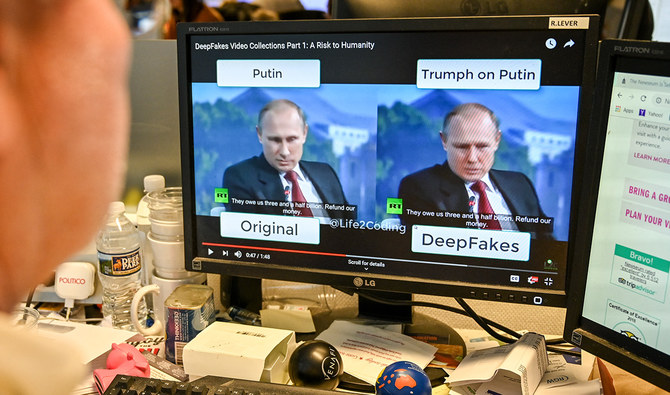
A AFP journalist views a video on January 25, 2019, manipulated with artificial intelligence to potentially deceive viewers, or "deepfake" at his newsdesk in Washington, DC. (AFP/File)
Short Url
Updated 17 February 2024
Follow

Tech giants sign pact against AI-made political deepfakes

  • In Pakistan, the party of former prime minister Imran Khan has used AI to generate speeches from their jailed leader
  • Last month, a robocall impersonation of President Biden urged people to not cast ballots in the New Hampshire primary

MUNICH: Tech giants including Meta, Microsoft and TikTok signed a pledge Friday to crack down on AI content intended to deceive voters ahead of crucial elections around the world this year.

The accord commits the companies including Google and OpenAI to develop ways to identify, label and control AI-generated images, videos and audio that aim to mislead voters.

“I think you need all the players from the source of the generation to the actual consumption by the user involved and that’s why I think having everybody, 20 companies sign up to this is so impactful,” Nick Clegg, president of global affairs at Meta, told AFP.

Among the 20 signatories of the deal, presented on the sidelines of the Munich Security Conference in Germany, were also X, formerly known as Twitter, as well as Snap, Adobe, LinkedIn, Amazon and IBM.

Under the agreement, AI-generated content could be given a watermark or tagged in the metadata at source, although the signatories acknowledged that “all such solutions have limitations.”

The tech companies also said they would also work together to develop ways to “detect and address” deceptive election material on their platforms.

Such content could, for example, be annotated to make it clear it is AI generated.

Meta, Google and OpenAI have already agreed to use a common watermarking standard that would tag images generated by their AI applications, such as OpenAI’s ChatGPT, Microsoft’s Copilot or Google’s Gemini (formerly Bard).

The pledge comes as big tech companies are under considerable pressure over fears that AI-powered applications could be misused in a pivotal election year.

The European Commission vice president for values and transparency, Vera Jourova, who attended the presentation in Munich, said she was pleased the tech companies “agree the technology can pose a risk to democracy.”

Governments “could not blame big tech for everything,” however, Jourova said.

“We also have some job to do on our side,” she said, with the EU preparing for elections to the European Parliament in June.

Recent examples of convincing AI deepfakes have only heightened worries about the easily accessible technology.

Last month, a robocall impersonation of US President Joe Biden pushed out to tens of thousands of voters urged people to not cast ballots in the New Hampshire primary.

In Pakistan, the party of former prime minister Imran Khan has used AI to generate speeches from their jailed leader.


Pakistan PM gives 48 hours to draft fuel-saving plan as global oil prices surge

Updated 4 sec ago
Follow

Pakistan PM gives 48 hours to draft fuel-saving plan as global oil prices surge

  • Government warns against hoarding after sharp fuel price hike amid Middle East tensions
  • PM wants provinces to enforce anti-profiteering measures and prevent public exploitation

ISLAMABAD: Prime Minister Shehbaz Sharif has asked his administration to formulate a strategy for fuel conservation and austerity in government affairs within 48 hours after a sharp rise in global oil prices pushed the country to increase domestic fuel rates, a senior minister said on Saturday.

The directive comes a day after the government raised petrol and diesel prices by Rs55 ($0.20) per liter, citing a surge in international energy prices triggered by escalating conflict in the Middle East after Israel and the United States launched attacks on Iran. The situation has rattled global oil markets and threatened key shipping routes.

Pakistan’s Information Minister Ataullah Tarar said Sharif had instructed officials to urgently prepare a practical plan aimed at reducing fuel consumption and promoting austerity across government institutions.

“The prime minister has given 48 hours to formulate an actionable strategy on savings, austerity and simplicity in government affairs,” he said in a social media post on X.

Tarar said Finance Minister Muhammad Aurangzeb and Petroleum Minister Ali Pervaiz Malik had also been tasked with consulting the country’s four provincial chief ministers to coordinate measures against fuel hoarding and ensure strict enforcement of government directives.

He informed the ministers had been asked to ensure that speculation and profiteering in fuel markets were prevented, adding that authorities would take strict action against violators.

“The prime minister has directed that no leniency be shown to elements involved in exploiting the public,” he said, warning that licenses of those petrol pumps violating government orders could be revoked.

Tarar also urged the public not to pay attention to rumors regarding petroleum supplies or pricing, saying the government and relevant ministries would continue to release verified information as the situation evolves.

He said Pakistan was not alone in facing rising energy costs, noting that many countries were grappling with similar pressures due to volatility in global oil markets.

Pakistan relies heavily on imported fuel to meet its energy needs and is particularly vulnerable to global price shocks, which can quickly push up inflation and strain the country’s fragile external accounts.