

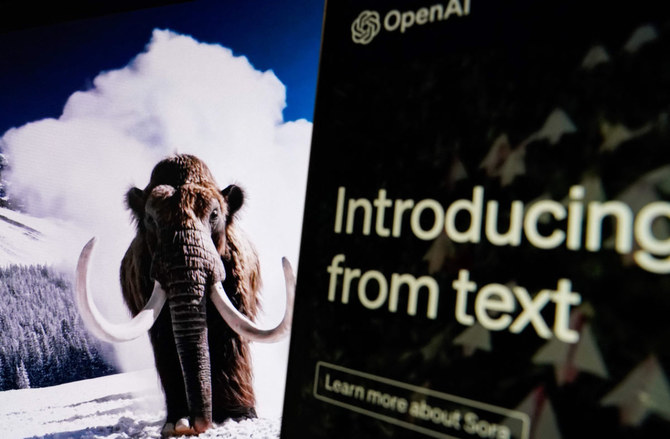

PARIS: A new artificial intelligence tool that promises to create short videos from simple text commands has raised concerns along with questions from artists and media professionals.
OpenAI, the creator of ChatGPT and image generator DALL-E, said Thursday it was testing a text-to-video model called “Sora” that can allow users to create realistic videos with simple prompts.
The San Francisco-based startup says Sora can “generate complex scenes with multiple characters, specific types of motion, and accurate details of the subject and background,” but admits it still has limitations, such as possibly “mixing up left and right.”
Here are early reactions from industries that could be affected by the new generative artificial intelligence (AI) tool:
Examples of Sora-created clips on OpenAI’s website range widely in style and subject, from seemingly real drone footage above a crowded market to an animated bunny-like creature bouncing through a forest.
Thomas Bellenger, founder and art director of Cutback Productions, has been carefully watching the evolution of generative AI image generation.
“There were those who felt that it was an unstoppable groundswell that was progressing at an astonishing rate, and those who just didn’t want to see it,” said Bellenger, whose France-based company has created large scale visual effects for such touring musicians as Stromae and Justice.
He said the development of generative AI has “created a lot of debate internally” at the company and “a lot of sometimes visceral reactions.”
Bellenger noted that Sora has yet to be released, so its capabilities have yet to be tested by the public.
“What is certain is that no one expected such a technological leap forward in just a few weeks,” Bellenger said. “It’s unheard of.”
He said whatever the future holds, they’ll “find ways to create differently.”
Video game creators are equally likely to be impacted by the new invention, with reaction among the sector divided between those open to embracing a new tool and those fearing it might replace them.
French video game giant Ubisoft hailed the OpenAI announcement as a “quantum leap forward” with the potential to let players and development teams express their imaginations.
“We’ve been exploring this potential for a long time,” a Ubisoft spokesperson told AFP.
Alain Puget, chief of Nantes-based studio Alkemi, said he won’t replace any artists with AI tools, which “only reproduce things done by humans.”
Nevertheless, Puget noted, this “visually impressive” tool could be used by small studios to produce more professionally rendered images.
While video “cut scenes” that play out occasionally to advance game storylines are different from player-controlled action, Puget expects tools like Sora to eventually be able to replace “the way we do things.”
Basile Simon, a former journalist and current Stanford University researcher, thinks there has been “a terrifying leap forward in the last year” when it comes to generative AI allowing realistic-looking fabrications to be rapidly produced.
He dreads the idea of how such tools will be abused during elections and fears the public will “no longer know what to believe.”
Julien Pain of French TV channel FranceInfo’s fact-checking program “Vrai ou Faux” (True or False) says he’s also worried about abuse of AI tools.
“Until now, it was easy enough to spot fake images, for example by noticing the repetitive faces in the background,” Pain said.
“What this new software does seems to be on another level.”
While OpenAI and US tech titans may promote safety tools, such as industry-wide watermarks that reveal AI-created imagery, “what about tomorrow’s competitors in China and Russia?,” he posited.
The Fred & Farid agency, which has collaborated with the Longchamp and Budweiser brands and where a studio dedicated to AI was opened in early January, anticipates that “80 percent of brand content will be generated by artificial intelligence.”
“Creative genius” will no longer be limited by production skills thanks to generative AI tools, one enthusiast contended.
Stephanie Laporte, chief executive and founder of the OTTA advertising and influencer agency, believes the technology will “force the industry to evolve.”
She also anticipates ad companies with lean budgets will resort to AI tools to save money on workers.
A possible exception, she believes, is the luxury segment, where brands are “very sensitive to authenticity” and “will probably use AI sparingly.”


