Pakistan slides 11 places on global democracy index, enters ‘authoritarian regime’ category

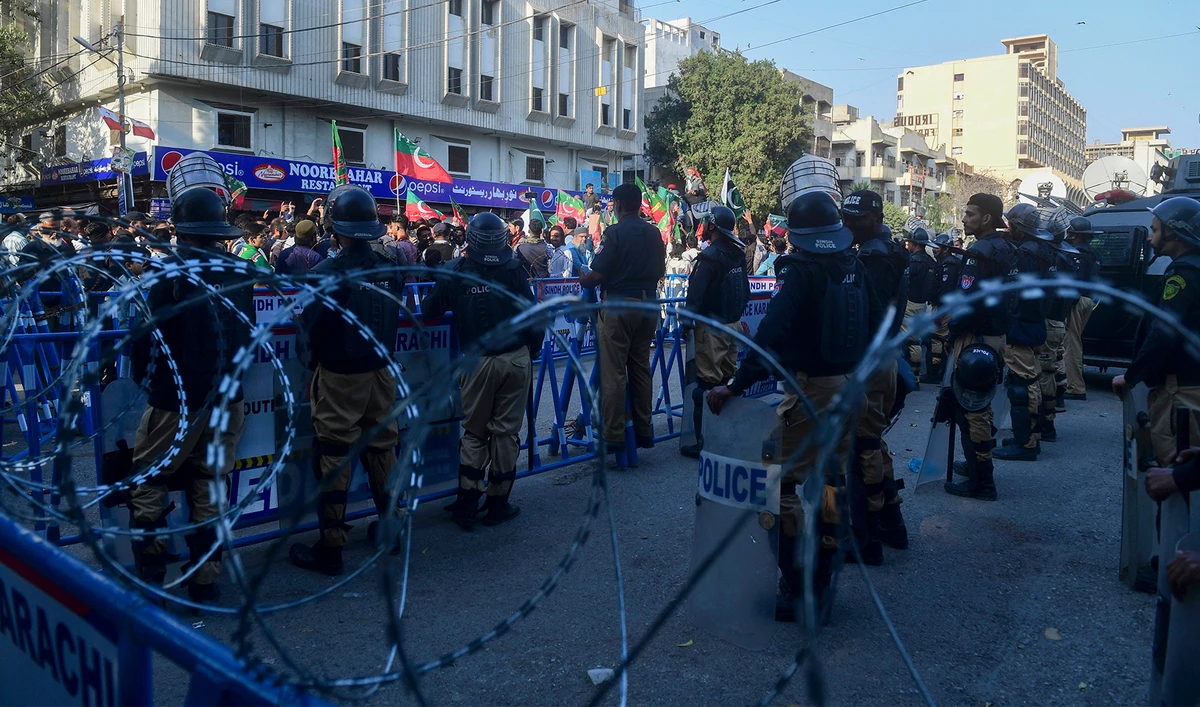
Supporters of Khan's Pakistan Tehreek-e-Insaf (PTI) party protest against the alleged skewing in Pakistan's national election results, in Karachi on February 11, 2024. (AFP)
Short Url
Updated 16 February 2024
Follow

Pakistan slides 11 places on global democracy index, enters ‘authoritarian regime’ category

  • The index maintained by The Economist says elections in Pakistan will not lead to ‘more democracy’ due to ‘state repression’
  • Pakistan is the only Asian country that has been downgraded and reclassified from a ‘hybrid regime’ to an ‘authoritarian regime’

ISLAMABAD: Pakistan witnessed a significant decline in its ranking on a major democracy index released this week which classified it as an “authoritarian regime” after factoring in a range of developments last year as the country prepared for the February 8 general elections.

According to the Economist Intelligence Unit’s latest index, there was a general deterioration in the quality of democracy across the world in 2023, with only eight percent of the global population living in “full democracy.”

However, Pakistan, which was previously viewed as a “hybrid regime” fell down by 11 places in the global ranking and entered a wholly new category.

“Pakistan registered the greatest deterioration of any country in the region — its score fell by 0.88 to 3.25, resulting in a fall of 11 places in the global ranking table, to 118th,” said the Economist’s Democracy Index 2023. “Alongside meddling in the electoral process and government dysfunction, the independence of the judiciary has been severely curtailed.”

“Pakistan is the only Asian country to be downgraded, having been reclassified from a ‘hybrid regime’ to an ‘authoritarian regime,’” it added.

The index maintained that the military was an important power broker in Pakistan, adding that it used its influence to undermine former prime minister Imran Khan’s Pakistan Tehreek-e-Insaf (PTI) party.

It also recalled that Khan had been indicted on corruption charges and incarcerated in August.

“This impaired his ability to rally his party or be an effective leader despite his popularity, especially among urban Pakistanis,” it added. “The military suppressed protests over Mr.Khan’s incarceration and sought to try civilians under martial law for supporting the PTI leader. As a result of official harassment and intimidation of senior PTI members, many defected to the ruling party.”

The Economist also maintained that Pakistani elections would not lead to “more democracy” since the opposition forces in the country were subject to “state repression.”
Pakistan’s JF-17 fighter jet draws ‘strong interest’ at Riyadh defense exhibition

Updated 29 min 30 sec ago
Follow

Pakistan’s JF-17 fighter jet draws ‘strong interest’ at Riyadh defense exhibition

  • Jets showcased as Pakistan seeks to expand defense exports
  • Interest in JF-17 has heightened after May 2025 conflict with India 

ISLAMABAD: Pakistan’s JF-17 Thunder fighter jet has drawn “strong interest” at the World Defense Exhibition in Riyadh, Pakistan’s state broadcaster said on Sunday, as Islamabad promotes the aircraft to international buyers at one of the region’s largest defense industry events.

The exhibition brings together defense officials, manufacturers and military delegations from dozens of countries, offering a platform for arms exporters to showcase equipment and pursue new contracts amid heightened global and regional security concerns.

Saudi Arabia has sought to position Riyadh as a regional hub for defense and aerospace exhibitions, using such events to foster partnerships and attract international manufacturers as part of broader diversification efforts. 

Last year Islamabad signed a mutual defense pact with Riyadh and is reportedly discussing another defense agreement involving Saudi Arabia and Turkiye, although details have not been made public.

“At the World Defense Exhibition in Riyadh, the Pakistan Air Force’s JF-17 Thunder has attracted strong interest from visitors and defense experts, standing out among fighter jets displayed by the US, Saudi Arabia and other countries,” state broadcaster Pakistan Television reported.

Islamabad is attending the exhibition in the backdrop of talks with at least 13 countries, six to eight of which are in an advanced stage, for deals involving JF-17 jets made jointly with China as well as training aircraft, drones, and weapons systems, according to recent media reports. 

Interest in the JF-17 jets has been bolstered by its operational visibility following the Pakistan-India military confrontation in May 2025, which Pakistani officials and defense analysts have cited as reinforcing the aircraft’s combat credibility.

Islamabad has increasingly positioned the JF-17 as a cost-effective multirole combat aircraft for countries seeking alternatives to high-end Western fighter jets. The aircraft is already in service with several foreign air forces and remains central to Islamabad’s defense export strategy.

Countries engaged in talks include Sudan, Saudi Arabia, Indonesia, Morocco, Ethiopia, and Nigeria as well as the government in eastern Libya led by Khalifa Haftar. Discussions on JF-17s and other weapons with Bangladesh and Iraq have been publicly acknowledged by Pakistan’s military, although more details have not been made public.

Almost all the potential buyers are Muslim-majority nations, like Pakistan. Many are from the predominantly Muslim Middle East, where Pakistan has historically been a security provider.

Separately, Pakistan’s Defense Minister Khawaja Asif met his Saudi counterpart, Khalid bin Salman bin Abdulaziz Al Saud, at the sidelines of the event. 

Asif congratulated the Saudi leadership and the defense minister on the “successful and splendid” organization of the World Defense Show, state broadcaster Radio Pakistan reported. 

“He described this global defense event as an important milestone in promoting defense cooperation in the region,” Radio Pakistan said.