

Pakistan slides 11 places on global democracy index, enters ‘authoritarian regime’ category

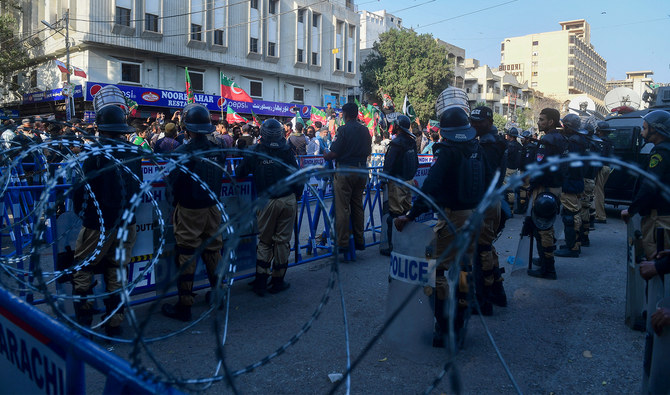
Supporters of Khan's Pakistan Tehreek-e-Insaf (PTI) party protest against the alleged skewing in Pakistan's national election results, in Karachi on February 11, 2024. (AFP)
Short Url
Updated 16 February 2024
Follow

Pakistan slides 11 places on global democracy index, enters ‘authoritarian regime’ category

  • The index maintained by The Economist says elections in Pakistan will not lead to ‘more democracy’ due to ‘state repression’
  • Pakistan is the only Asian country that has been downgraded and reclassified from a ‘hybrid regime’ to an ‘authoritarian regime’

ISLAMABAD: Pakistan witnessed a significant decline in its ranking on a major democracy index released this week which classified it as an “authoritarian regime” after factoring in a range of developments last year as the country prepared for the February 8 general elections.

According to the Economist Intelligence Unit’s latest index, there was a general deterioration in the quality of democracy across the world in 2023, with only eight percent of the global population living in “full democracy.”

However, Pakistan, which was previously viewed as a “hybrid regime” fell down by 11 places in the global ranking and entered a wholly new category.

“Pakistan registered the greatest deterioration of any country in the region — its score fell by 0.88 to 3.25, resulting in a fall of 11 places in the global ranking table, to 118th,” said the Economist’s Democracy Index 2023. “Alongside meddling in the electoral process and government dysfunction, the independence of the judiciary has been severely curtailed.”

“Pakistan is the only Asian country to be downgraded, having been reclassified from a ‘hybrid regime’ to an ‘authoritarian regime,’” it added.

The index maintained that the military was an important power broker in Pakistan, adding that it used its influence to undermine former prime minister Imran Khan’s Pakistan Tehreek-e-Insaf (PTI) party.

It also recalled that Khan had been indicted on corruption charges and incarcerated in August.

“This impaired his ability to rally his party or be an effective leader despite his popularity, especially among urban Pakistanis,” it added. “The military suppressed protests over Mr.Khan’s incarceration and sought to try civilians under martial law for supporting the PTI leader. As a result of official harassment and intimidation of senior PTI members, many defected to the ruling party.”

The Economist also maintained that Pakistani elections would not lead to “more democracy” since the opposition forces in the country were subject to “state repression.”


Pakistan reviews austerity measures amid Middle East crisis, urges strict nationwide implementation

Updated 11 March 2026
Follow

Pakistan reviews austerity measures amid Middle East crisis, urges strict nationwide implementation

  • Deputy Prime Minister Ishaq Dar chairs review meeting of austerity steps
  • Officials briefed on salary cuts, school closures, four‑day week, petrol conservation

ISLAMABAD: Pakistan’s government on Wednesday assessed progress on a sweeping set of austerity measures introduced to mitigate the country’s economic strain from sharply rising global oil prices and supply disruptions linked to the ongoing war in the Middle East.

Prime Minister Shehbaz Sharif this week announced a series of austerity steps, including a four‑day work week for government offices, requiring 50  percent of staff to work from home, cutting fuel allowances for official vehicles by half, grounding up to 60  percent of the government fleet and closing all schools for two weeks to conserve fuel amid the global oil crisis.

The measures were unveiled in response to global oil market volatility triggered by the conflict involving the United States, Israel and Iran, which has disrupted supply routes such as the Strait of Hormuz and pushed crude prices sharply higher, straining Pakistan’s heavily import‑dependent energy sector.

“The meeting stressed the importance of strict and transparent adherence to the austerity measures, promoting fiscal responsibility and prudent use of public resources,” Deputy Prime Minister and Foreign Minister Senator Mohammad Ishaq Dar said in a statement.

He was chairing a meeting of the Committee for Monitoring and Implementation of Conservation and Additional Austerity Measures, constituted under the directions of the PM, bringing together federal and provincial officials to review execution of the broad cost‑cutting plan. 

Dar emphasized the government’s commitment to enforcing the PM’s austerity steps nationwide. The committee’s review also covered reductions in departmental expenditure, deductions from salaries of senior officials earning over Rs. 300,000 ($1,120), and coordination with provincial administrations to ensure uniform implementation of the plan.

Participants at the meeting reiterated that all ministries and divisions must continue strict monitoring and reporting, with transparent oversight mechanisms, as Pakistan navigates the economic pressures from the prolonged Middle East crisis and its fallout on global energy and trade markets.