

Ex-general Prabowo Subianto set to win Indonesian presidential race

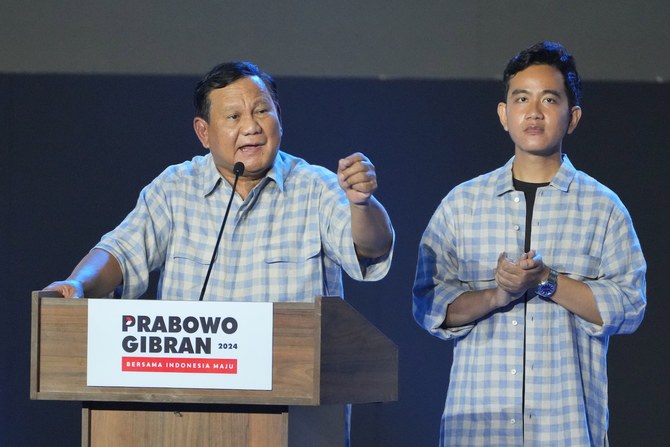
Indonesian Defense Minister and presidential candidate Prabowo Subianto, left, speaks to supporters and members of his campaign team alongside his running mate, Gibran Rakabuming Raka in Jakarta, on Feb. 14, 2024. (AP)
Short Url
Updated 15 February 2024
Follow

Ex-general Prabowo Subianto set to win Indonesian presidential race

  • Early results showed Subianto winning nearly 60 percent of the vote
  • His running mate is the eldest son of incumbent leader Joko Widodo

Jakarta: Indonesian Defense Minister Prabowo Subianto is set to win the country’s presidential race after early results showed him winning more than half of the votes cast in the world’s biggest single-day election. 

Nearly 205 million Indonesians were registered to vote across more than 820,000 polling stations throughout the vast archipelago on Wednesday. 

Unofficial tallies showed the 72-year-old former special forces commander and former son-in-law of Indonesia’s late dictator Suharto winning nearly 60 percent of the votes, making him likely to clinch a decisive single-round win. 

These early results are based on samples of ballots taken by private, government-registered pollsters and have been accurate in previous elections, as official counts are not expected for a few weeks and the new president will take office later in October. 

“Based on our quick count data, we have concluded at the moment that the winner is Prabowo Subianto and Gibran Rakabuming Raka, but of course, we need to wait for the official data from the General Elections Commission,” Saidiman Ahmad, program manager at pollster Saiful Mujani Research and Consulting, told Arab News. 

Subianto’s running mate to become president is incumbent leader Joko Widodo’s eldest son, whose candidacy became possible after a contentious ruling by the Constitutional Court. The court at the time of the decision was headed by Widodo’s brother-in-law, Anwar Usman. 

With an approval rating of about 80 percent, Widodo, who presided over steady growth and relative stability during his 10 years in office, held sway over the Indonesian voters under a political science theory known as economic voting, Ahmad said. 

“Under this theory, people who are satisfied with the government will be drawn to figures or parties that are perceived to represent the current administration, and I think with the political maneuvers that Widodo has done in the last few months, it shows implicitly that there’s closeness to the Prabowo-Gibran pair,” he said. 

Subianto himself is a polarizing figure in Indonesia. He has been accused of human rights violations in East Timor and involvement in the kidnapping and torture of pro-democracy activists in 1997 and 1998. He was once banned from entering the US because of his human rights record. 

This election season has raised concerns that Indonesia is in danger of sliding back toward its authoritarian past under Suharto, who held power from 1965 to 1998, in the period of Indonesian history known as “New Order.”

“The victory of Prabowo Subianto as an election winner may come as a warning for many in Indonesia, especially for civil society organizations and pro-democracy figures, because this is concerning, the return of a figure that represents the authoritarian rule of New Order,” Ahmad said. 

Andreas Harsono, Indonesia researcher at Human Rights Watch, told Arab News that democracy in Indonesia was already backsliding under Widodo. 

“Now, Jokowi opened a door to the darkness of the New Order period. Jokowi helped rebrand Prabowo from an aggressive general to a cute grandfather,” Harsono said, alluding to Subianto’s campaign strategy that often portrayed him as a cuddly grandpa. 

“Whatever the outcome of the Indonesian election, the importance of human rights issues and respect for democracy will still be front and center for the Indonesian people. Prabowo and Gibran, of course, also Gibran’s father President Jokowi, need to be transparent and straightforward on these issues.”


Senate to question military leaders on Trump’s National Guard deployments

Updated 7 sec ago
Follow

Senate to question military leaders on Trump’s National Guard deployments

  • Hearing expected to feature tough questioning for Pentagon leaders over the legality of the deployments
  • National Guard deployments in some places were done over the objections of mayors and governors
WASHINGTON: Senators for the first time are poised to question military leaders over President Donald Trump’s use of the National Guard in American cities, an extraordinary move that has prompted legal challenges as well as questions about states’ rights and the use of the military on US soil.
The hearing Thursday before the Senate Armed Services Committee is expected to feature tough questioning for Pentagon leaders over the legality of the deployments, which in some places were done over the objections of mayors and governors.
The hearing will bring the highest level of scrutiny to Trump’s use of the National Guard outside of a courtroom since the deployments began and comes a day after the president faced another legal setback over his muscular use of troops in larger federal operations.
Trump has justified the use of the military in American cities by saying the National Guard is needed to support federal law enforcement, protect federal facilities and combat crime.
Democratic Sen. Tammy Duckworth, D-Illinois, said she had threatened to hold up the annual defense bill if Republican leadership continued to block the hearing, which she said is long overdue.
“Donald Trump is illegally deploying our nation’s service members under misleading if not false pretexts,” Duckworth told The Associated Press.
Duckworth, a combat veteran who served in the Illinois National Guard, said domestic deployments have traditionally involved responding to major floods and tornadoes, not assisting immigration agents who are detaining people in aggressive raids.
Duckworth said she has questions for the military about how Trump’s deployments are affecting readiness, training and costs. She also wants to know if Guard members will have legal protections if an immigration agent wrongfully harms a civilian.
“I’m deeply concerned that our nation’s military is being put in jeopardy by these policies,” Duckworth said.
The hearing comes two weeks after two West Virginia National Guard members deployed to Washington were shot just blocks from the White House in what the city’s mayor described as a targeted attack. Spc. Sarah Beckstrom died a day after the Nov. 26 shooting, and her funeral took place Tuesday. Staff Sgt. Andrew Wolfe is still hospitalized in Washington.
Meanwhile, a federal judge in California on Wednesday ruled that the Trump administration must stop deploying the California National Guard in Los Angeles and return control of the troops to the state.
US District Judge Charles Breyer in San Francisco granted a preliminary injunction sought by California officials, but also put the decision on hold until Monday. The White House said it plans to appeal.
Trump called up more than 4,000 California National Guard troops in June without Gov. Gavin Newsom’s approval to further the Trump administration’s immigration enforcement efforts.
The move was the first time in decades that a state’s National Guard was activated without a request from its governor and marked a significant escalation in the administration’s efforts to carry out its mass deportation policy. The troops were stationed outside a federal detention center in downtown Los Angeles where protesters gathered and later sent on the streets to protect immigration officers as they made arrests.
The number had dropped to several hundred by late October. The 100 or so California troops that remain in Los Angeles are guarding federal buildings or staying at a nearby base and are not on the streets with immigration enforcement officers, according to US Northern Command.
Trump also had announced National Guard members would be sent to Washington, D.C., Illinois, Oregon, Louisiana and Tennessee. Other judges have blocked or limited the deployment of troops to Portland, Oregon, and Chicago, while Guard members have not yet been sent to New Orleans.