

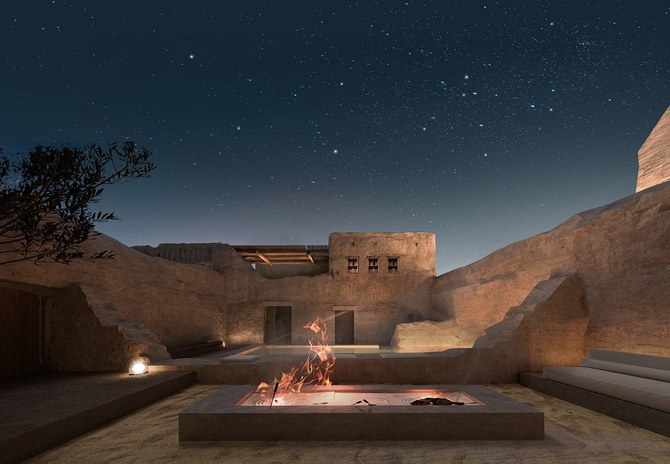

DUBAI: Building a hotel from scratch is tough, but Egyptian architect Shahira Fahmy faced an even bigger challenge: reconstructing an existing archaeological site — Dar Tantora The House Hotel in AlUla Old Town historical village.
Fahmy, who has worked on projects in Europe and the Middle East, is a three-time recipient of Harvard fellowships for her ground-breaking and award-winning architectural work: an LOEB fellowship at the Graduate School of Design GSD; a Hutchins fellowship at W. E. B. Du Bois Research Institute at the Graduate School of Arts and Sciences FAS; and a Berkman Klein fellowship at Harvard’s Law School.

Shahira Fahmy was selected by The Royal Commission for AlUla to turn multiple old mud-brick buildings into the boutique hotel. (Supplied)
She has been hailed as an “Architect Building the Arab Future,” and featured in the book “100 Women: Architects in Practice” by Monika Parrinder, Naomi House, Tom Ravenscroft and Harriet Harriss, published by the Royal Institute of British Architects.
Fahmy was selected by The Royal Commission for AlUla to turn multiple old mud-brick buildings into the boutique hotel.

Fahmy was selected by The Royal Commission for AlUla to turn multiple old mud-brick buildings into the boutique hotel. (Supplied)
“I was dealing with heritage. It’s an (ancient) Islamic city, so, it’s an archaeological ruin. I was not working on empty land without context in the desert or near the mountains,” Fahmy told Arab News. “You have context, where buildings are built between stones, mud bricks and farms. You are restoring something that already exists.”
It was no easy task, then, but Fahmy and her team embraced it, dedicating themselves to the project and completing it in just six months. The hotel opened its doors to guests on Jan. 21.

Fahmy and her team restored 30 buildings in total. (Supplied)
“We molded on the bricks on site. All the mud bricks were made from local materials, looking at what was existing, and how we could (replicate) it today,” Fahmy said. “There were stones. The ground was generally stone. That was the structure of the building and the buildings were two floors. It was a city of two stories.”
Fahmy and her team restored 30 buildings in total. The architect said the early inhabitants in the city used the ground floor as a workplace and to meet with family and friends, while the first floor was for bedrooms and bathrooms.

‘Once you enter this 12th-century room, you are transported into another place completely,’ the architect said. (Supplied)
“That’s how we laid out the 30 rooms of Dar Tantora,” she said. “Once you enter this 12th-century room, you are transported into another place completely. The whole hotel is candlelit. We have minimal electricity.
“(The inhabitants) used to use cross-ventilation for optimal airflow, with one window higher than the other and one larger, so we have replicated that too,” she added. “They kept cool on terraces, so our rooms are terraced.”
People who lived in the city 800 years ago whitewashed the interior walls and adorned them with red and blue murals, Fahmy said. Her team managed to preserve the existing designs in collaboration with the archaeological team.

Fahmy and her team worked with local artisans and researchers, alongside a team from Egypt. (Supplied)
“They also had no electricity, but here we had to compromise for the sake of our guests,” Fahmy explained. “The rooms have Wi-Fi, one outlet for charging your phone, one socket in the bathroom for shaving or for a hairdryer, but that’s it. The food for guests is cooked on wood fires.”
Fahmy and her team worked with local artisans and researchers, alongside a team from Egypt who came from Siwa to help on this project, as they had experience of working with mud bricks and palm materials.
Some of the hotel’s many paintings were created by a group of young local artists.

For Fahmy, visiting the site after its completion gave her “a beautiful feeling.” (Supplied)
“We wanted people who knew how to paint on wood, because all the doors — not only the walls — used to have drawings and paintings on them too,” she said. “We also sourced a few items from Al-Dirah Art School. They did a lot of research, which helped us a lot. They created a palette of what the colors of AlUla are. They did a lot of work on the pigmentations and the colors that the people in Old Town used to paint with.”
For Fahmy, visiting the site after its completion gave her “a beautiful feeling.”
“It’s even more beautiful when people start using the spaces and you start hearing feedback,” she said. “We all work towards this point when you see it filled with people and you see how they’ve activated it.”


