

ITFC, Djibouti sign $90m Murabah deal to secure energy supply 

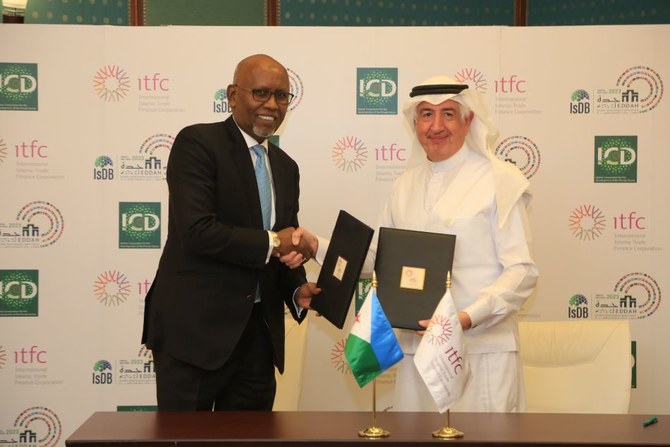
The latest deal was signed between Djibouti’s Economy and Finance Minister Ilyas Moussa Dawaleh and ITFC CEO Hani Salem Sonbol. Supplied.
Short Url
Updated 13 February 2024
Follow

ITFC, Djibouti sign $90m Murabah deal to secure energy supply 

RIYADH: The International Islamic Trade Finance Corp. has signed a $90 million Murabah agreement with Djibouti to secure energy supply through the import of petroleum products.

The International Hydrocarbons Co. of Djibouti, also known as SIHD, will serve as the executing agency.

ITFC, a member of the Islamic Development Bank, and the Republic of Djibouti have enjoyed a longstanding relationship with a total of $1.6 billion approved by the corporation in favor of the country, with 33 operations targeting the energy and health sectors.

The latest deal was signed between Djibouti’s Economy and Finance Minister Ilyas Moussa Dawaleh and ITFC CEO Hani Salem Sonbol.

“The financing facility aims to support SIHD’s mandate of securing energy supply through the importation of petroleum products that is essential for electricity generation to boost all the sectors of the economy,” said a press release issued on Tuesday. 

This initiative fosters intra-OIC trade, as the petroleum products will be sourced mainly from other member countries of the Organization of Islamic Cooperation.

ITFC interventions in Djibouti reflect the commitment to supporting the country’s economy, starting with the energy sector and extending its positive impact to vital areas like services, manufacturing, and agriculture. This operation underlines ITFC’s commitment to fulfilling UN SDG 7, “Energy for All.”

Commenting on the agreement, ITFC CEO Sonbol stated: “This financing will promote positive impact on the level of human and economic development and is expected to further strengthen the strategic cooperation between ITFC and Djibouti in the energy sector.”

The agreement also aligns with the $600 million three-year framework agreement signed in May 2023 between ITFC and Djibouti.


Saudi Arabia raises $1.5bn in November sukuk issuance: NDMC 

Updated 7 sec ago
Follow

Saudi Arabia raises $1.5bn in November sukuk issuance: NDMC 

RIYADH: Saudi Arabia’s National Debt Management Center has raised SR5.83 billion ($1.55 billion) through its latest sukuk issuance, maintaining monthly offerings above the $1 billion mark. 

The November total represents a 22.7 percent decline from October, when the Kingdom raised SR7.54 billion. Saudi Arabia issued SR8.03 billion in September and SR5.31 billion in August, extending a trend of strong activity in the domestic debt market.  

Sukuk are Shariah-compliant financial instruments similar to bonds, granting investors a share of an issuer’s underlying assets and adhering to Islamic finance principles that prohibit interest-based transactions. 

According to NDMC, the November issuance was divided into five tranches. The first tranche was valued at SR700 million and is set to mature in 2027. The second amounted to SR1.37 billion, maturing in 2029, while the third tranche, worth SR180 million, will expire in 2032.  

The fourth portion, valued at SR197 million, is due in 2036, while the last tranche due in 2039 was valued at SR3.38 billion. 

Saudi Arabia’s debt market has expanded rapidly in recent years, with fixed-income instruments drawing increased attention as rising global interest rates reshape investor demand. 

This comes as the Gulf Cooperation Council sukuk outstanding climbed 12.7 percent to $1.1 trillion by the end of the third quarter of 2025, according to a recent Fitch Ratings report. 

The US-based credit rating agency said debt capital market activity in the GCC is expected to remain strong into 2026, supported by a healthy pipeline of anticipated issuances.      

The report noted that sukuk issuances increased 22 percent year on year in the first nine months of this year, accounting for 40 percent of total GCC DCM outstanding. Sukuk also outpaced bond growth, which expanded 7.2 percent year on year.