

Indian farmers ready for mass protests over crop prices

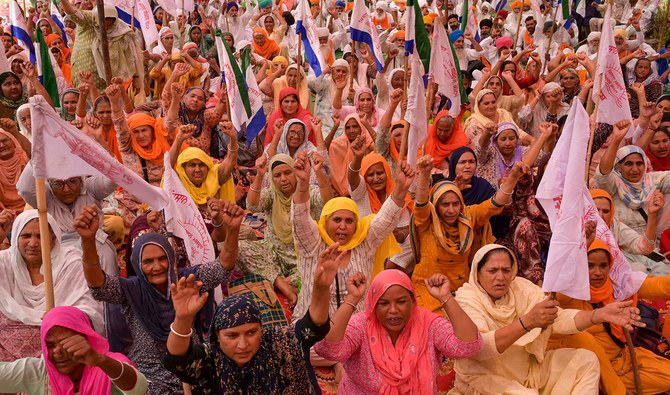
Farmers shout slogans as they protest against the state government to demand canal water for irrigation, in Amritsar on May 29, 2023. (AFP/File)
Short Url
Updated 12 February 2024
Follow

Indian farmers ready for mass protests over crop prices

  • Farmers in India have political heft due to their sheer numbers and the threat of renewed protests comes ahead of national polls
  • Two-thirds of India’s 1.4-billion population draw their livelihood from agriculture, accounting for nearly a fifth of the country’s GDP

NEW DELHI: Indian police erected barricades and banned public gatherings Monday ahead of threatened protests by thousands of farmers demanding minimum crop prices in a bid to stop them from marching on parliament.

Long convoys of tractors gathered on borders between the capital New Delhi and neighboring Haryana state, with police using a fearsome blockade of metal spikes, barriers and cement blocks to close key highways.

Farmers have called for a “Delhi Chalo,” or “March to Delhi,” echoing protests in January 2021 when farmers breached barricades and marched into the city on Republic Day.

Farmers in India have political heft due to their sheer numbers, and the threat of renewed protests comes ahead of national elections likely to begin in April.

Two-thirds of India’s 1.4-billion population draw their livelihood from agriculture, accounting for nearly a fifth of the country’s GDP, according to government figures.

“Farmers from across the country are prepared to march on Delhi starting Tuesday if the government doesn’t meet our demands,” Swaran Singh Pandher, leader of a nationwide farmers’ association told AFP.

As well as a fixed minimum crop price, other demands include pensions and the writing off of loans.

Police in Delhi have banned public gatherings of more than five people.

Protests by farmers against agricultural reform bills in November 2020 lasted for more than a year, forming the biggest challenge to Prime Minister Narendra Modi’s government since it came to power in 2014.

Tens of thousands of farmers then set up makeshift camps, with at least 700 people killed during the protests.

In November 2021, a year after protests began, Modi pushed through parliament the repeal of three contentious laws that farmers claimed would let private companies control the country’s agriculture sector.

Government ministers are expected to meet with farming leaders on Monday to talk the protesters down.

Thousands of Indian farmers die by suicide every year because of poverty, debt and crops affected by ever more erratic weather patterns caused by climate change.

Samyukta Kisan Morcha (SKM), a key farmers’ association, expressed its “strong discontent and anger” at police action to block protests, but said it was not taking part in the planned march on Tuesday.

It instead called for strikes on Friday to press for their demands.

“The efforts to suppress the people’s protest will be in vain,” SKM said in a statement.


Pakistan, ADB sign $730 loan agreements to boost SOE reforms, energy infrastructure

Updated 25 December 2025
Follow

Pakistan, ADB sign $730 loan agreements to boost SOE reforms, energy infrastructure

  • Both sign $330 million Power Transmission Strengthening Project and $400 million SOE Transformation Program loan agreements
  • Economic Affairs Division official says Transmission Project will secure Pakistan’s energy future by strengthening national grid’s backbone

KARACHI: Pakistan and the Asian Development Bank (ADB) on Thursday signed two loan agreements totaling $730 million to boost reforms in state-owned enterprises (SOEs) and energy infrastructure in the country, the bank said.

The first of the two agreements pertains to the SOE Transformation Program worth $400 million while the second loan, worth $330 million, is for a Power Transmission Strengthening Project, the lender said. 

The agreements were signed by ADB Country Director for Pakistan Emma Fan and Pakistan’s Secretary of Economic Affairs Division Humair Karim. 

“The agreements demonstrate ADB’s enduring commitment to supporting sustainable and inclusive economic growth in Pakistan,” the ADB said. 

Pakistan’s SOEs have incurred losses worth billions of dollars over the years due to financial mismanagement and corruption. These entities, including the country’s national airline Pakistan International Airlines, which was sold to a private group this week, have relied on subsequent government bailouts over the years to operate.

The ADB approved the $400 million loan for SOE reforms on Dec. 12. It said the program seeks to improve governance and optimize the performance of Pakistan’s commercial SOEs. 

Karim highlighted that the Power Transmission Strengthening Project will enable reliable evacuation of 2,300 MW from Pakistan’s upcoming hydropower projects, relieve overloading of existing transmission lines and enhance resilience under contingency conditions, the Press Information Department (PID) said. 

“The Secretary emphasized that both initiatives are transformative in nature as the Transmission Project will secure Pakistan’s energy future by strengthening the backbone of the national grid whereas the SOE Program will enhance transparency, efficiency and sustainability of state-owned enterprises nationwide,” the PID said. 

The ADB has supported reforms by Pakistan to strengthen its public finance and social protection systems. It has also undertaken programs in the country to help with post-flood reconstruction, improve food security and social and human capital. 

To date, ADB says it has committed 764 public sector loans, grants and technical assistance totaling $43.4 billion to Pakistan.