

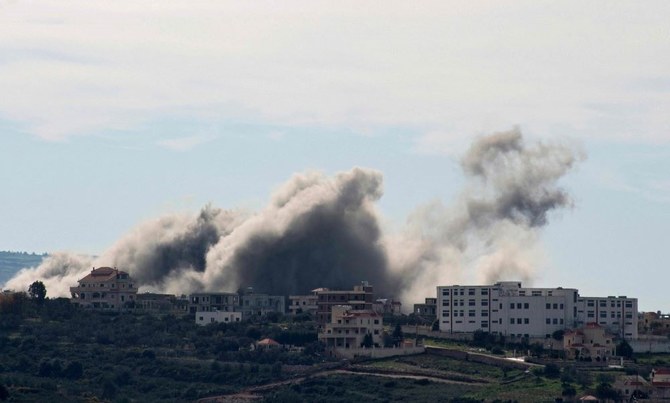
Israel intensifies attacks on southern Lebanon

Smoke billows from the southern Lebanese village of Tayr Harfa, near the boder with Israel, following an Israeli airstrike, Feb. 12, 2024. (AFP)
Short Url
Updated 12 February 2024
Follow

Israel intensifies attacks on southern Lebanon

  • Two Hezbollah fighters and two Palestinian fighters are killed, and several others are injured in Israeli raids on southern Lebanon
  • Saad Hariri meets Mikati in Beirut and marks the 19th anniversary of his father’s assassination on Wednesday

BEIRUT: Israel intensified its attacks on southern Lebanon on Monday. A residential house in the border town of Maroun Al-Ras was targeted during a raid, resulting in the deaths of four individuals.

A security source said that the target was Hezbollah’s official in the town.

Israel increased its targeting of Hezbollah’s leaders in the field. A car near the Bint Jbeil Governmental Hospital was hit by an Israeli drone targeting Hezbollah official Mohammed Abd Al-Rasoul Alawiya. Although Alawiya managed to survive, there were casualties in the attack whose identities remained undisclosed.

Hezbollah mourned Mohammed Baqir Hassan Bassam from the town of Ainata and Ali Ahmed Muhanna from the town of Maroun Al-Ras.

Hezbollah typically discloses the identities of its killed members, but it never discloses the identities or number of its injured members.

An Israeli raid targeted a house owned by the Ataya family in the town of Tair Harfa, killing two people, who were said to be Palestinians.

Israeli fighter jets conducted multiple airstrikes on the town of Khiam and the surrounding areas of Kafr Kila, Adissa, and Taybeh. Occasional Israeli artillery bombardment was reported in the forests of Labouneh and the outskirts of Al-Dhahira town.

Hezbollah carried out various attacks on Sunday. They targeted spy equipment at the Ruwaisat Al-Alam site in the Kafr Shuba hills and the occupied Lebanese Shebaa Farms, as well as a group of soldiers in Jabal Nadhar. They also attacked a group of Israeli soldiers in the Tahihat triangle and spy equipment at the Al-Abad site.

The total number of Hezbollah operations from Oct. 8 to Feb. 11 has reached 1,013.

On Sunday night, villages in the western and central sectors felt a tense calm after a series of violent artillery shelling and raids. One of these attacks targeted a house in Shihin, resulting in the death of two members of the Amal Movement: Mohammed Rabie Al-Masry from the town of Al-Mansouri in Tyre, and Hassan Ali Farroukh from Anqoun in Sidon. Several people were also injured during these incidents.

“If the US wants to stop the war, why is it, until this moment, providing Israel with all the ammunition it needs?” stated the head of Hezbollah’s parliamentary bloc, MP Mohammed Raad, during an event held by the party.

“The battle between the Israeli army and Hamas will take forever and a day if the army is not deterred. The Israeli prime minister is escaping forward by insisting on moving on with the war to avoid going to prison.”

Raad said the Israeli army’s “attacks on Lebanon were a twist on the usual when they targeted Hezbollah members in Nabatieh, Jadra, and Harouf. This has no effect on the balance of power whatsoever.

“The Israeli army will never be able to impose its conditions on us. It has to be deterred until things get stabilized and move towards slowing down the pace of escalation. This is not impossible but will take a little longer,” Raad added.

After he decided to suspend his involvement in political activities two years ago and left Lebanon, former Prime Minister Saad Hariri flew back to Beirut on Sunday night and held his first meeting on Monday with caretaker PM Najib Mikati.

Some see the move as an indication of Hariri’s reinvolvement in political activities.

Hariri will be commemorating on Wednesday the 19th anniversary of the assassination of his father, late PM Rafik Hariri.

The Future Movement was absent from the political arena after Hariri’s decision. However, for the past couple of days, it invited its followers from various regions to head to Martyrs’ Square in Beirut for a commemoration ceremony that will be held in front of Hariri’s shrine in the heart of the Lebanese capital.

Photos of Hariri and the blue banner of the Future Movement were raised in the streets of Beirut, Tripoli, and Sidon, in addition to placards calling on Hariri to return to politics.


Gaza ceasefire enters phase two despite unresolved issues

Updated 8 sec ago
Follow

Gaza ceasefire enters phase two despite unresolved issues

  • Under the second phase, Gaza is to be administered by a 15-member Palestinian technocratic committee operating under the supervision of a so-called “Board of Peace,” to be chaired by Trump

JERUSALEM: A US-backed plan to end the war in Gaza has entered its second phase despite unresolved disputes between Israel and Hamas over alleged ceasefire violations and issues unaddressed in the first stage.
The most contentious questions remain Hamas’s refusal to publicly commit to full disarmament, a non-negotiable demand from Israel, and Israel’s lack of clarity over whether it will fully withdraw its forces from Gaza.
The creation of a Palestinian technocratic committee, announced on Wednesday, is intended to manage day-to-day governance in post-war Gaza, but it leaves unresolved broader political and security questions.
Below is a breakdown of developments from phase one to the newly launched second stage.

Gains and gaps in phase one

The first phase of the plan, part of a 20-point proposal unveiled by US President Donald Trump, began on October 10 and aimed primarily to stop the fighting in the Gaza Strip, allow in aid and secure the return of all remaining living and deceased hostages held by Hamas and allied Palestinian militant groups.
All hostages have since been returned, except for the remains of one Israeli, Ran Gvili.
Israel has accused Hamas of delaying the handover of Gvili’s body, while Hamas has said widespread destruction in Gaza made locating the remains difficult.
Gvili’s family had urged mediators to delay the transition to phase two.
“Moving on breaks my heart. Have we given up? Ran did not give up on anyone,” his sister, Shira Gvili, said after mediators announced the move.
Israeli Prime Minister Benjamin Netanyahu said efforts to recover Gvili’s remains would continue but has not publicly commented on the launch of phase two.
Hamas has accused Israel of repeated ceasefire violations, including air strikes, firing on civilians and advancing the so-called “Yellow Line,” an informal boundary separating areas under Israeli military control from those under Hamas authority.
Gaza’s Hamas-run health ministry said Israeli forces had killed 451 people since the ceasefire took effect.
Israel’s military said it had targeted suspected militants who crossed into restricted zones near the Yellow Line, adding that three Israeli soldiers were also killed by militants during the same period.
Aid agencies say Israel has not allowed the volume of humanitarian assistance envisaged under phase one, a claim Israel rejects.
Gaza, whose borders and access points remain under Israeli control, continues to face severe shortages of food, clean water, medicine and fuel.
Israel and the United Nations have repeatedly disputed figures on the number of aid trucks permitted to enter the Palestinian territory.

Disarmament, governance in phase two

Under the second phase, Gaza is to be administered by a 15-member Palestinian technocratic committee operating under the supervision of a so-called “Board of Peace,” to be chaired by Trump.
“The ball is now in the court of the mediators, the American guarantor and the international community to empower the committee,” Bassem Naim, a senior Hamas leader, said in a statement on Thursday.
Trump on Thursday announced the board of peace had been formed and its members would be announced “shortly.”
Mediators Egypt, Turkiye and Qatar said Ali Shaath, a former deputy minister in the Ramallah-based Palestinian Authority, had been appointed to lead the committee.
Later on Thursday, Egyptian state television reported that all members of the committee had “arrived in Egypt and begun their meetings in preparation for entering the territory.”
Al-Qahera News, which is close to Egypt’s state intelligence services, said the members’ arrival followed US Middle East envoy Steve Witkoff’s announcement on Wednesday “of the start of the second phase and what was agreed upon at the meeting of Palestinian factions in Cairo yesterday.”
Shaath, in a recent interview, said the committee would rely on “brains rather than weapons” and would not coordinate with armed groups.
On Wednesday, Witkoff said phase two aims for the “full demilitarization and reconstruction of Gaza,” including the disarmament of all unauthorized armed factions.
Witkoff said Washington expected Hamas to fulfil its remaining obligations, including the return of Gvili’s body, warning that failure to do so would bring “serious consequences.”
The plan also calls for the deployment of an International Stabilization Force to help secure Gaza and train vetted Palestinian police units.
For Palestinians, the central issue remains Israel’s full military withdrawal from Gaza — a step included in the framework but for which no detailed timetable has been announced.
With fundamental disagreements persisting over disarmament, withdrawal and governance, diplomats say the success of phase two will depend on sustained pressure from mediators and whether both sides are willing — or able — to move beyond long-standing red lines.