

Egypt’s foreign minister heads to Slovenia to boost relationship

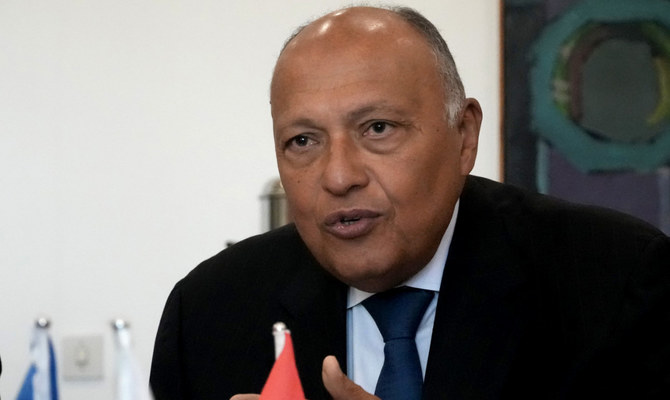
Egyptian Foreign Minister Sameh Shoukry. (AP)
Short Url
Updated 12 February 2024
Follow

Egypt’s foreign minister heads to Slovenia to boost relationship

  • The visit comes as part of the “qualitative shift witnessed in bilateral relations in recent years,” an official Egyptian statement said

CAIRO: Egyptian Foreign Minister Sameh Shoukry left for Slovenia on Sunday to lead his country’s delegation at a meeting of the two nations’ Joint Ministerial Committee for Economic Cooperation.

Ahmed Abu Zeid, spokesman for the ministry, said Shoukry would discuss with senior Slovenian officials various matters regarding bilateral relations and ways to enhance them.

Shoukry will also hold discussions with his Slovenian counterpart Tanja Fajon on a number of regional and international issues of common interest, most notably the Palestinian issue on which Slovenia has adopted supportive positions clearly demonstrated since the beginning of the Gaza crisis.

Shoukry will also meet Slovenian President Natasa Pirc Musar, Prime Minister Robert Golob, and Slovenia’s minister of economy and tourism, within the framework of coordination on ways to support and enhance bilateral cooperation.

The visit comes as part of the “qualitative shift witnessed in bilateral relations in recent years,” an official Egyptian statement said.

Slovenia’s president visited Egypt in December 2016 and the visit proved an important milestone in strengthening cooperation between the two countries.

Shoukry received a call from Fajon in June last year and the parties discussed economic and trade cooperation, and ways to develop it.

Slovenia and Egypt signed an agreement to establish diplomatic relations in 1992.


Security, economic and political partnerships in the spotlight at first Jordan-EU Summit

Updated 11 sec ago
Follow

Security, economic and political partnerships in the spotlight at first Jordan-EU Summit

  • Event reflects international confidence in Jordan as a reliable partner in efforts to address security threats, advance peace initiatives, and expand cooperation, analysts say
  • Timing is significant, expert says, given the region faces overlapping crises and threats that place security and defense cooperation at the heart of Jordanian-European relations

AMMAN: The inaugural Jordan-EU Summit underlined the depth of the country’s strategic partnership with Europe, officials and experts said, and confirmed the pivotal role Jordan plays in regional security, political stability and economic cooperation.

Analysts told the Jordan News Agency that Thursday’s summit took place at a sensitive moment for the region, but reflected international confidence in Jordan as a reliable partner in efforts to address cross-border security threats, advance peace initiatives, and expand cooperation in trade, investment and development.

Bashir Al-Dajeh, an expert in security and strategy, said the timing of the summit was significant, given the region is facing overlapping crises and transnational threats that place security and defense cooperation at the heart of Jordanian-European relations.

Jordan’s strategic location positions it on the front lines of efforts to tackle illegal migration, organized crime, drug and arms smuggling and cross-border terrorism, he added. The country has hosted more than 3.5 million refugees over the past decade without compromising its security infrastructure, he noted.

Jordan’s effective border controls were helping to curb irregular migration to Europe and disrupting the plans of extremist groups and trafficking networks, Al-Dajeh said, which was directly benefiting regional and European security.

Khaled Abu Hassan, a member of the Jordanian parliament, said the country’s foreign policy under King Abdullah had reinforced its influence, in the region and internationally, particularly its firm stance in support of the Palestinian cause and a two-state solution to the conflict with Israel.

He said the summit reaffirmed Jordan’s political influence in the shaping of regional balances and advancement of efforts to achieve a just and comprehensive peace. The timing of the meeting also demonstrated the resilience of the nation in managing multiple regional and domestic challenges.

Abu Hassan also highlighted the economic aspects of the summit, including the announcement of a Jordan-EU economic conference in April, as a sign of the international recognition of Jordan’s political and economic role.

Economist Mufleh Aql said the high-level summit reflected a shared desire for a broadening of cooperation to encompass politics, trade, security and renewable energy, and Jordan was well-placed to benefit from access to the EU’s large markets, technology and investment opportunities.

The country could benefit from increased exports, technology transfers and financing for major infrastructure projects in sectors such as water, transport and energy, he added, and in return offer the EU skilled human capital amid labor shortages in Europe.

EU support for Jordan’s positions on issues such as Jerusalem, regional stability, energy and migration further strengthens the partnership, Aql said. Jordan also already benefits from EU grants, concessional loans and exports of agricultural, pharmaceutical and chemical products to European markets, he noted.