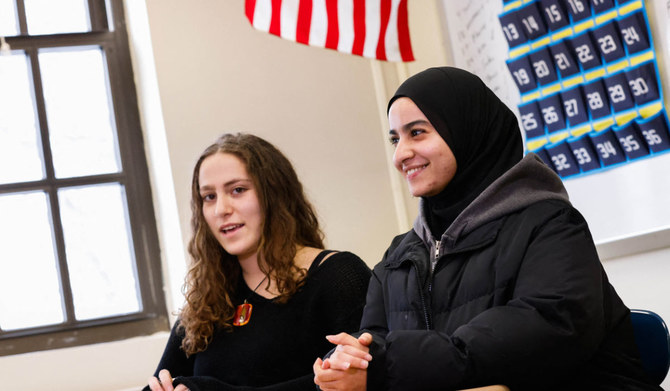

TEANECK, United States: They are only teenagers, but a pair of New Jersey high school students — one Jewish and one Muslim — are tackling an issue much bigger than themselves, bridging divides in their suburb shaken by the Israel-Hamas war.
The effort originated soon after the October 7 attacks by Hamas and Israel’s invasion of Gaza, when Rawda Elbatrawish, 17, took to Instagram to pitch an educational event.
“I was originally going to do a protest, but I decided to do a dialogue instead,” recalled Elbatrawish, who is Muslim.
Liora Pelavin, 15, a fellow student at Teaneck High School, and a Jew, quickly responded and helped to pull together an initial session for the end of October.
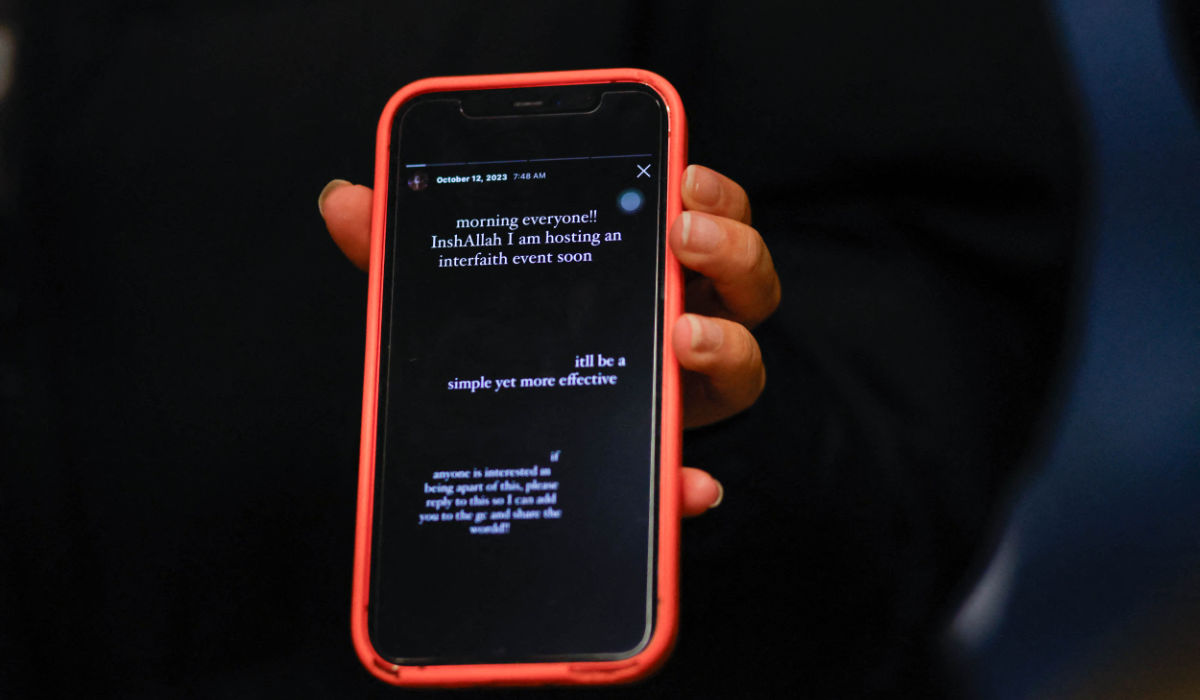
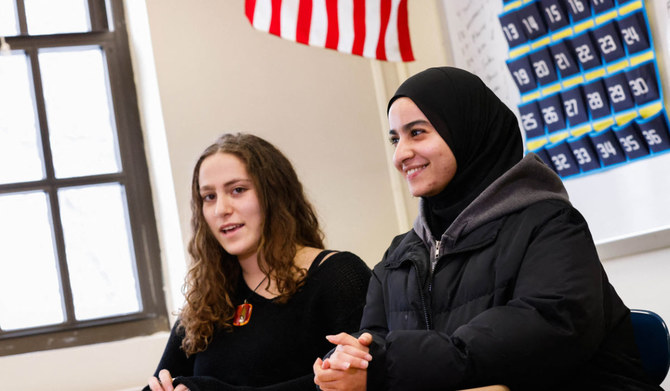
Rawda Elbatrawish shows the original post for an open invitation for a meeting, at the Teaneck High School in Teaneck New Jersey on January 19, 2024. (AFP)
The unexpected success of that first meeting led to a second, larger one, and the girls since have enjoyed support — but also faced some derision — from their traditionally tolerant town.
Elbatrawish had expected the initial meeting would draw perhaps 10 people, but soon realized “we were getting way more than we can hold,” she said — about 60 in all.
Despite the strong turnout, the girls were not overly optimistic about the outcome of the meeting.
“We had a lot of people telling us that this was not going to do anything, and honestly we didn’t think it would either,” said Pelavin. “We wanted to try something out.”
Located less than 10 miles (16 kilometers) from Manhattan, about 40 percent of Teaneck’s population of around 40,000 is Jewish. It also has a sizable Muslim community.
Mutual respect between religions has long been the tradition in the area, said Noam Sokolow, who has run the local Noah’s Ark delicatessen for 35 years.
In 2006, Teaneck elected an Orthodox Jew as mayor, and four years later, voted in a Muslim.
The city is known for having racially desegregated its schools in 1964, the first white-majority US community to do so voluntarily.
Yassine Elkaryani, a resident who moved to the United States from Morocco, feels a sense of welcome in the city.
“I love the community,” Elkaryani said. “There is no inherent problem between Jews and Muslims in Teaneck.”
But since Hamas’s unprecedented attack on October 7 and Israel’s subsequent invasion of Gaza, “the whole community has changed and divided,” said Sokolow, who said he has endured “harassing” phone calls.
In mid-October, the Teaneck City Council approved a resolution in support of Israel, enacting the measure as pro-Palestinian protesters rallied outside.
And in November, classmates of Elbatrawish and Pelavin rallied in solidarity with Gaza in a demonstration authorized by Teaneck education officials.
Despite the divisions, the teens pressed on, enlisting police officers and medical staff to help ensure security at their first meeting.
“I think we approached in a pretty safe manner that allowed everyone to feel comfortable,” recalled Elbatrawish.
Participants, all 25 and under, were required to attest that they would not engage in personal attacks or shouting.
The two organizers split the attendees into smaller groups to discuss several questions, such as: What is your reaction to October 7? And what do you want to understand from the others participating in this group?
The smaller groups then reported back to the room.
“We had some people tell us that there was some stuff that their table was saying that made them feel very uncomfortable and made them feel that they strongly disagreed with it,” said Elbatrawish.
“And we felt that that was really good to hear because they felt comfortable enough to bring that opinion in.”
The event went well enough that the teens decided to keep going, opening a second session in November to adults. The girls distributed fliers at local synagogues and mosques; more than 70 people attended.
“I was actually really scared that day,” Elbatrawish recalled, while adding that “it kind of went better than I expected.”
While much of the feedback has been positive, Pelavin has gotten online blowback from some in the Jewish community, including from people who say “she doesn’t represent us, stuff like that.”
Pelavin, who embraces her Jewish identity, has learned to not read social media comments.
“There was a point where some of the people in the town were not really accepting of me,” she said.
Elbatrawish, a senior who is in the midst of applying for college, said she was a “bit scared” of taking on the Israel-Hamas conflict, but views the initiative as “necessary.”
Other communities throughout New Jersey have since reached out to Elbatrawish and Pelavin to ask for advice about hosting similar meetings.
Pelavin said the next step is to recruit peers to run the group’s social media accounts and manage other tasks to be able to facilitate future meetings.
“We’ve been doing all the jobs,” she said, adding, “I think we have to learn how to ask for help.”