LAHORE: The leader of an ultra-right Pakistan party infamous for sometimes bloody anti-blasphemy agitation has vowed a comeback after its vote share evaporated in elections last week.
Blasphemy is a charged topic in Muslim-majority Pakistan where the faintest whisper of a slight toward the Prophet Muhammad (peace be upon him) can embolden lynch mobs.
Saad Hussain Rizvi’s Tehreek-e-Labbaik Pakistan (TLP) party rode the issue to emerge as the largest religious force in 2018 polls, but its prominence was all but eroded in last week’s national and provincial elections.
Analysts say the death of Rizvi’s charismatic father, who founded the party, and a loss of patronage from Pakistan’s powerful generals cost them dearly.
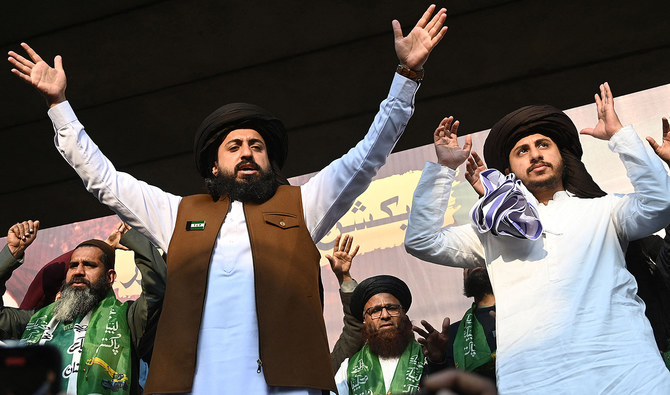
Speaking to supporters in the center of cultural capital Lahore on Saturday, Rizvi said the enemies of Islam had stopped his party.
“This rigging has taken place because we speak about rights, and we talk about a faith that those with power in this world do not accept,” he told AFP.
When asked if he could fill his father Khadim Hussain Rizvi’s shoes, he responded matter-of-factly.
“Bringing people onto the streets, and bringing people out to vote was not a problem for TLP in the past and it is not a problem now.”
The crowd of 2,000 people there to hear him speak — though enthusiastic — was a far cry from the tens of thousands that used to hang on to his father’s every word.
“Khadim Rizvi had the kind of leadership and charisma that his son does not have,” Arafat Mazhar, who works on blasphemy law reform, told AFP.
He added that religion had dropped down the pecking order in elections defined by “anti-establishment politics,” as Pakistan battles a massive economic crisis and an erosion of trust in institutions.
TLP has its ideological roots in Barelvi Islam — a mainstream sect traditionally seen as moderate but for which blasphemy is a red line.
It first began making waves in 2016, when protesting the execution of Mumtaz Qadri, a bodyguard who assassinated the governor of Punjab province over his stance on blasphemy.
Analysts say its street power was tapped by the military a year later to reduce the voter base of Nawaz Sharif’s center-right party, which had fallen foul of the generals.
“There were suspicions at the time that certain elements within intelligence agencies were encouraging them to destabilize the government,” public policy analyst Ahmed Bilal said.
“That element may no longer be there.”
The party went rogue following its electoral success, orchestrating violent anti-Sweden and anti-France protests after incidents of Qur’an burning and satirical cartoons of the Prophet Muhammad (peace be upon him) in those countries.
Six years on, Sharif is back in favor and his successor Imran Khan in jail in the see-saw world of Pakistan politics — reducing TLP’s utility.
Five years ago TLP bagged more than two million votes to become the fifth-largest party in the country — ahead of more established religious groups.
Thursday’s polls were less successful for all of Pakistan’s religious parties, however, leading Rizvi to call on supporters to come out and protest Saturday.
His party had been tipped to gain more electoral seats, but Mazhar said its appeal only exists in times of perceived crisis.
“If there is not an imagined threat around the prophet or religion in the country then when it comes to governance people don’t want them in power,” he said.
“It’s only through anxiety-inducing politics that they can get votes.”
Rizvi insists they will be back.
From atop a makeshift stage on the back of a truck, he proclaimed: “You have the power, we have God.”


![]()

Votes erode for Pakistani ultra-right party
Short Url
https://arab.news/zwxuq
Votes erode for Pakistani ultra-right party
- Tehreek-e-Labbaik Pakistan rode the blasphemy issue to become Pakistan’s largest religious force after 2018 polls
- TLP vows a comeback after the party failed to make a dent in Pakistan’s 2024 general elections
Latest updates


© 2026 SAUDI RESEARCH & PUBLISHING COMPANY, All Rights Reserved And subject to Terms of Use Agreement.