Saudi authors in spotlight at New Delhi World Book Fair

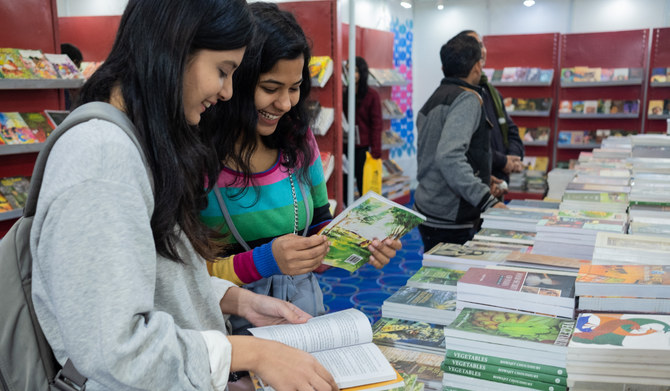
Indian visitors look at books at the New Delhi World Book Fair on Jan. 5, 2019. (AFP file phot)
Short Url
Updated 09 February 2024
Follow

Saudi authors in spotlight at New Delhi World Book Fair

  • 25 delegates from Saudi Arabia to showcase Kingdom’s literary heritage
  • India’s second-oldest book festival runs from Feb. 10-18

NEW DELHI: Saudi Arabia will be in the spotlight at the New Delhi World Book Fair as guest of honor of its 2024 edition starting in the Indian capital on Saturday.

Hosted at Pragati Maidan, the festival was inaugurated in 1972 and is India’s second oldest after the Kolkata Book Fair.


Organized by the National Book Trust, India’s apex publishing body under the Ministry of Education, this year’s festival has been themed “Multilingual India — a living tradition” to showcase the country’s linguistic diversity.

It will run from Feb. 10 to 18, featuring more than 1,000 publishers from India and around the world.

Yuvraj Malik, director of the National Book Trust India, told Arab News that 25 delegates from Saudi Arabia would be presenting the Kingdom’s literary heritage as the book fair’s honorary guest.

“Saudi Arabia holds the position of guest of honor at NDWBF 2024. The 25-member Saudi delegation will showcase literature, language, culture, and heritage,” he said.

“Saudi Arabia’s exhibition will feature a diverse range of books, authors, and cultural elements.”

Dr. Abdullatif Al-Wasel, publishing general manager of the Saudi Literature, Publishing, and Translation Commission, told reporters during a press conference ahead of the event that the Saudi delegates were looking forward to the book fair.

“This has been a long-awaited event for us to participate in,” he said, adding that it was also “very important” for the Kingdom that the fair was taking place in India, as bilateral ties had been steadily gaining prominence since Crown Prince Mohammed bin Salman’s visit to New Delhi in 2019 and the signing of many memoranda of understanding, including in cultural affairs.

“When you’re talking about the relationship between Saudi and India, it’s not only economics, it’s not only business and commercial, it extends to all aspects of life, social, culture,” Al-Wasel said.

“The participation this year comes to commemorate this, and to officiate these MoUs ... One of the things that we’re working on is to activate cultural relations between India and Saudi Arabia.”


Australia to deploy long-range reconnaissance plane to Gulf

Updated 59 min 33 sec ago
Follow

Australia to deploy long-range reconnaissance plane to Gulf

  • The government says there are about 115,000 Australian nationals across the Middle East, of whom about 2,600 have returned home.

SYDNEY: Australia will deploy a long-range military reconnaissance plane to the Gulf to protect civilians, Prime Minister Anthony Albanese said Tuesday.
An E-7A Wedgetail aircraft and supporting defense force personnel will be sent for an initial period of four weeks to help “protect and secure the airspace above the Gulf,” Albanese told a news conference.
Australia also plans to provide advanced, medium-range air-to-air missiles to the United Arab Emirates “in response to a request,” the prime minister said.
The UAE, in which there are an estimated 24,000 Australians, has shot down more than 1,500 rockets and drones fired by Iran in reprisal following US-Israeli strikes, he said.
Albanese said he decided to send the advanced radar surveillance plane to the Gulf following a discussion with UAE President Mohammed bin Zayed Al Nahyan.
“The first priority of my government is, and always will be, to keep Australians safe,” the prime minister said.
“Helping Australians means also helping the UAE and other Gulf nations to defend themselves against what are unprovoked attacks,” he added.
“My government has been clear that we’re not taking offensive action against Iran, and we’ve been clear that we are not deploying Australian troops on the ground in Iran.”
The government says there are about 115,000 Australian nationals across the Middle East, of whom about 2,600 have returned home.
“Significant challenges remain, and further work is underway to support those still seeking to leave,” Albanese said.
Australia said last week it had deployed a heavy transport plane and a fuel transport plane to the Middle East as part of plans to get its citizens out of the region.
Canberra has been careful to make clear that its forces are not engaging in offensive operations against Iran.
On Friday, Albanese revealed that Australian military personnel were aboard an American submarine that sank an Iranian navy ship off Sri Lanka.
The personnel were on the submarine as part of training arrangements under AUKUS, a multi-decade defense pact with Britain and the United States, he said, stressing that they did not take part in the attack.