

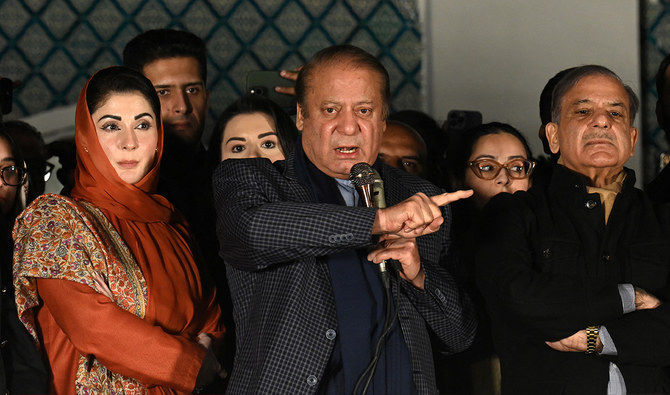

LAHORE/ISLAMABAD: The Pakistan Tehreek-e-Insaf (PTI) party of Imran Khan said on Friday it had “absolutely no interest” in an offer by prime ministerial hopeful Nawaz Sharif to form a coalition government after his party did not win enough seats to rule alone following general elections on Thursday.
Speaking to a charged crowd of a few thousand supporters from the balcony of his party office in the eastern city of Lahore, his political heartland, Sharif, a three-time former prime minister, struck a conciliatory note. Admitting that his party alone did not have the seats needed, he called on all parties, including independents, most of whom are backed by his archrival Khan, to come together and rule through a coalition set-up.
Thursday’s vote and Sharif’s announcement on Friday were the culmination of an especially contentious election season in which allegations of military meddling took center-stage, casting a shadow over a historic event that marked only the country’s third-ever democratic transition of power. The army, which has ruled for over three decades of Pakistan’s history since independence in 1947, strongly denies interfering in political affairs.
Ahead of the vote, Sharif was seen as a frontrunner in the election due to what was widely believed to be the backing of the army that had smoothed the way for his return to Pakistan after four years in self-imposed exile to lead his Pakistan Muslim League-Nawaz (PML-N) in national polls. Both deny this.
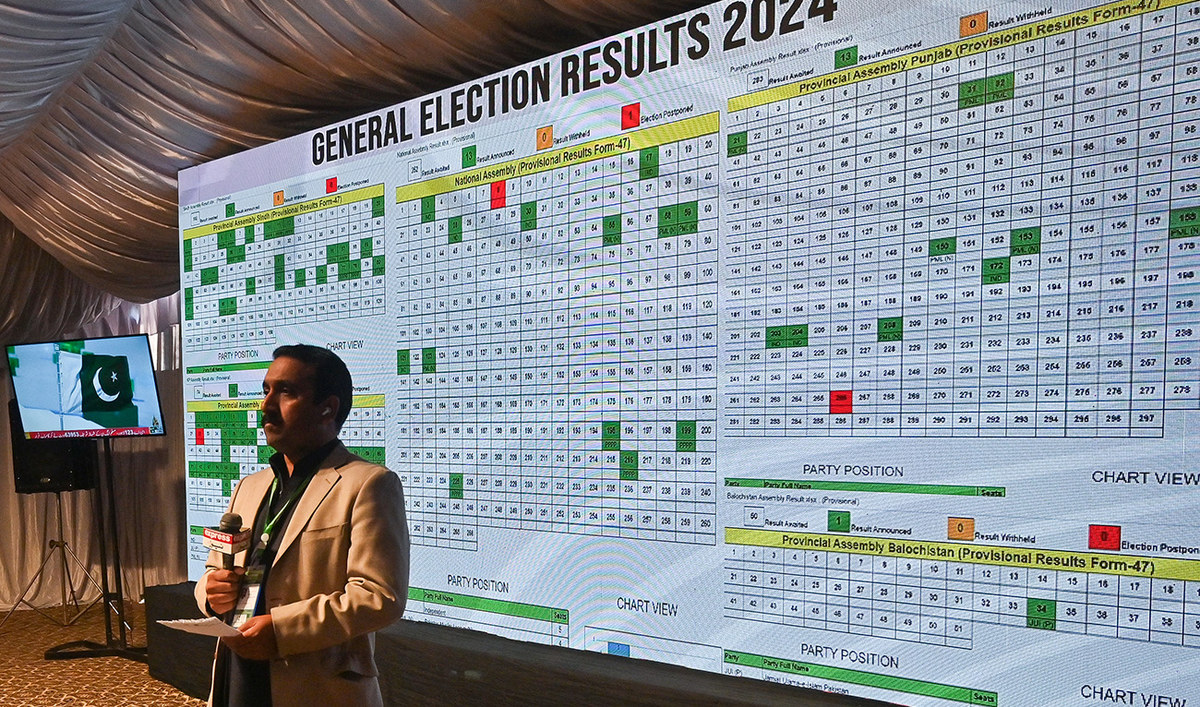
But as the results of the vote trickled in late into the evening on Friday, it was clear that the PML-N had only bagged 69 out of 241 seats counted so far from 265 total seats in the National Assembly, while independent candidates affiliated with Khan’s PTI had 96 wins. Behind them both was the Pakistan People’s Party (PPP) with 52 seats, led by the rising star of national politics, Bilawal Bhutto-Zardari, the son of assassinated former PM Benazir Bhutto.
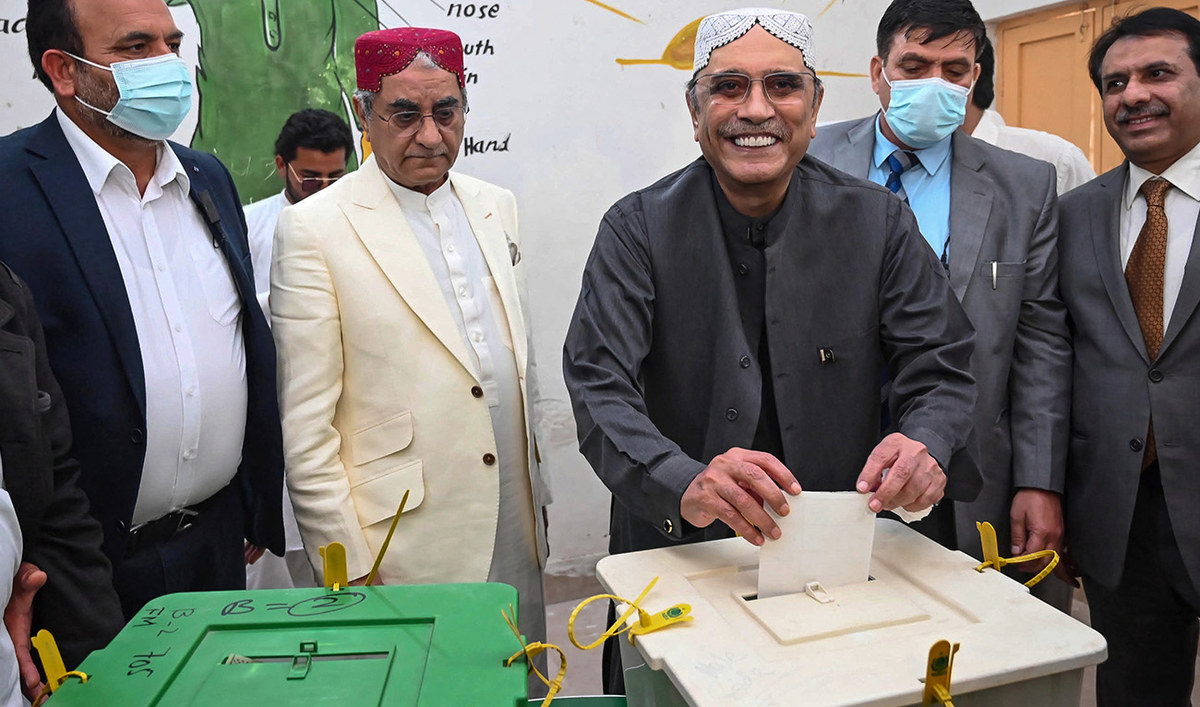
Pakistan's former President Asif Ali Zardari (3R) of Pakistan Peoples Party (PPP) casts his ballot to vote during the country's national elections at a polling station in NawabShah of Sindh province on February 8, 2024. (AFP)
“We don’t have that much majority to make government alone, so we ask the allied parties who have been successful in this election, we invite them that they participate with us and we make the government together,” Sharif said in his first address after the elections.
Appearing cordial, he said the PML-N respected the mandate of all parties.
“Whoever has got the mandate, we respect it with all our hearts, whether they are a party or an individual person, an independent candidate, and we invite them, that in order to take this wounded Pakistan out of difficulties, come and sit with us … It is important that all other parties sit down and together form one government.”
But a spokesperson for the PTI, Raoof Hassan, told Arab News, the party was “absolutely not interested” in Sharif’s offer of a coalition set-up:
“We are not going to form any alliance or coalition with them. They are not trustworthy people.”
“NO CLEAR WINNER”
With no party meeting the requirement of winning 133 seats, a simple majority, out of 265 National Assembly seats, the days ahead are likely to see political feuding and possible horse trading as the PML-N and the PPP — in their battle to hold sway over parliament where the most important decisions require a two-thirds majority — scramble to form alliances with independents and smaller parties.
In his speech on Friday, Sharif said he had appointed his brother Shehbaz Sharif, also a former prime minister, to meet with leaders from other parties, including the PPP, the Muttahida Qaumi Movement (MQM) and the Jamiat Ulema-e-Islam-F, to discuss a coalition government. He did not name the PTI.
Though the temptation to jump Khan’s ship and join another party forming the government will be high and could make the independents a political wild card in the coming days, PTI-backed candidates have repeatedly said they will not join the mainstream parties but return into the fold of Khan’s party once it wins back its bat symbol, of which it was stripped ahead of the elections.
The party had lost its symbol because the election commission said it did not hold intra-party elections, a legal requirement to run in polls as a party, forcing all its candidates to run as independents, each with a distinct symbol.
Supporters of Former Prime Minister Nawaz Sharif' party 'Pakistan Muslim League-N' celebrate their party victory in the initial results of the country's parliamentary election, in Lahore, Pakistan, Friday, Feb. 9, 2024. (AFP)
PTI’s Hassan told reporters on Friday new intra-party elections would be held within a fortnight.
“We don’t expect this hop-chop sort of government to last very long,” PTI senior leader Zulfi Bukhari and close Khan aide told Arab News, speaking about a possible future coalition government led by the PML-N.
“Whatever [government] they’re going to form, there will be disputes and fights among each other … So, it’s going to hold zero credibility with zero public support and meaning they won’t be able to take any meaningful decisions for the betterment of the country.”
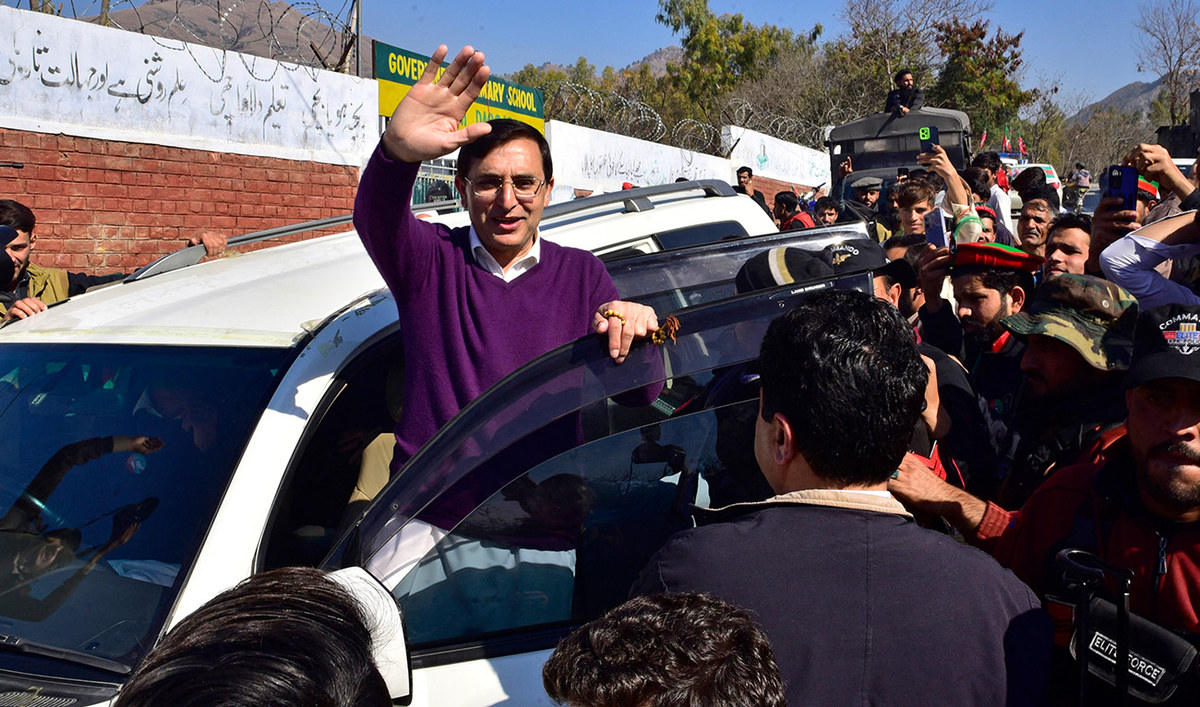
Pakistan Tehreek-e-Insaaf (PTI) party's chairman and barrister Gohar Ali Khan (L) waves to supporters after casting his ballot to vote during Pakistan's national elections, in Buner on February 8, 2024. (AFP)
“KEY CHALLENGES”
Meanwhile, a delay in the full release of official election results even 24 hours after polling closed has led to widespread concerns about rigging and raised questions about the credibility of the vote. The government has ascribed the delay to the suspension of mobile phone services, imposed as a security measure ahead of Thursday’s election, but opponents, especially the PTI, say it was done to manipulate counting.
In the run-up to the polls, Khan’s PTI had complained of a widening crackdown against the party, including not being allowed to campaign freely. Khan himself was missing from Thursday’s vote as he has been in jail since August last year and is also disqualified from running for public office for ten years.
The former premier, already jailed in one corruption case, was convicted in three back-to-back cases a week before the election and faces dozens of other legal challenges, including one case in which he is accused of ordering violent attacks on military installations on May 9, 2023, which could entail the death sentence. Khan says all the cases were politically motivated to sideline him and his party from elections.
Analysts have widely questioned the legitimacy of an election that Khan, arguably the country’s most popular politician, was not allowed to contest. And after the polls, they fear the absence of a clear winner could mean more uncertainty for a country where political temperatures have been excruciatingly high since Khan was ousted in a parliamentary vote of no-confidence in April 2022.
The country has also been grappling for months with a seemingly intractable economic crisis that has left millions disillusioned.
The Pakistani economy is currently beset by record high inflation, falling foreign exchange reserves, a depreciating currency, low consumer confidence and slow growth caused by tough reforms carried out to meet the conditions of a last-gasp $3 billion bailout from the International Monetary Fund (IMF) approved last year.
One of the key challenges for any new government will be negotiating a new bailout program with the IMF after the ongoing deal expires in three weeks. Another will be tackling rising militancy.
The election season itself was particularly bloody, with several attacks on rallies, election offices and candidates in the last few weeks while 16 people were killed in violence on polling day itself.
But political analysts Tahir Naeem Malik urged calm and reconciliation between all political stakeholders.
“Election results necessitate political stakeholders to sit together and negotiate regarding the next set up,” he told Arab News. “It will be hard for the weak coalition government to initiate major economic reforms and fight the upsurge of militancy.”
But PML-N supporters outside Sharif’s Lahore office said they hoped he would be the “answer” to Pakistan’s problems, especially on the economic front.
“I came here to see Nawaz Sharif with great happiness and excitement. God willing, Nawaz Sharif will come in government and he will give laptops to young people and make their future bright,” Mohibullah, who had traveled from the mountainous Gilgit region hundreds of miles away for a glimpse of his leader, told Arab News, as loud speakers blared PML-N anthems in the background and fireworks went off.
“All the young people who are leaving the country, god willing after Nawaz Sharif forms government, they won’t leave and will make a bright future here.”
Supporter Samra Nazeer, who volunteers as a coordinator for the party’s activities in Lahore, said she had personally observed in this election that “people love Nawaz Sharif.”
“Just like his last three tenures [as PM] when Pakistan was prospering,” she said, “for a fourth time also people have high hopes.”
Additional reporting by Aamir Saeed in Islamabad


