

Pakistan says 16 killed in 56 incidents of violence on election day 

1 / 2
2 / 2
A policeman frisks a man as he arrives to cast his ballot to vote during Pakistan's national elections, at a polling station in Quetta on February 8, 2024. (AFP)
Short Url
Updated 09 February 2024
Follow

Pakistan says 16 killed in 56 incidents of violence on election day 

  • Three soldiers, two paramilitary Levies troops, seven police officers and four civilians, including two children, among dead
  • Interior minister says delay in election results was caused by communication problems due to mobile network shutdown 

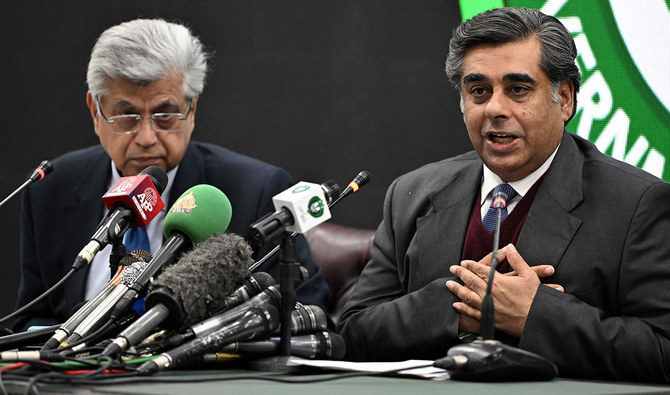
ISLAMABAD: Pakistani Interior Minister Dr. Gohar Ejaz said on Friday 16 people were killed in 56 incidents of violence during general elections a day earlier, justifying the closure of mobile phone networks on polling day as a requirement to ensure the security of millions of voters.

Around 650,000 security personnel were deployed on the streets and at polling booths across Pakistan to secure general elections on Feb. 8, in which 128 million registered voters were expected to vote. 

On the morning of Thursday, just minutes before polls opened, the government shut down mobile phone services and temporarily shut its borders with neighbors Iran and Afghanistan. 

The government said the measures were taken as the run-up to elections was marred by attacks on rallies, election offices and candidates. Just a day before the election, 28 people were killed in a number of attacks in the Balochistan and Khyber Pakhtunkhwa provinces. 

“Despite stringent security measures, 56 incidents occurred yesterday [Thursday] resulting in 16 casualties, and causing injuries to 54 others,” Ejaz told reporters in Islamabad. 

Three soldiers, two paramilitary Levies troops, seven police officers and four civilians, including two children, were among the dead. 

“We had to take the difficult decision of suspending mobile phone services across the country to disallow terrorists the means to communicate, coordinate, and conduct terrorist operations,” he said, explaining that mobile devices were instrumental in initiating the trigger mechanisms for modern explosive devices, causing mass deaths. 

“There were credible reports of terrorist entities such as the Tehreek-I-Taliban Pakistan (TTP), Daesh, and foreign-sponsored militant organizations in Balochistan, among others, trying to create a serious law and order situation by attacking law enforcement agencies and civilians to shake the confidence of the nation and dissuade them from exercising their democratic right,” the interior minister said.

“The decision to close mobile and Internet signals was not taken lightly, knowing it would draw criticism from various quarters, but we prioritized the safety of human lives above all else.” 

He said election authorities had no role in the decision to close mobile networks, which was taken by security agencies.

Unusual delays in the vote counts on Thursday were due to a suspension of mobile phone services, the minister said. 

“The lack of communication was the result of precautionary measures taken to ensure foolproof security, but the situation is now satisfactory, and it is expected that the results will continue to come at rapid pace now,” he added.

A total of 265 seats were contested in Thursday’s election. Supporters of jailed former Prime Minister Imran Khan had the edge on Friday in official and unofficial election results from over 100 seats.


Pakistan invites Bangladesh’s new prime minister for official visit in post-election outreach

Updated 7 sec ago
Follow

Pakistan invites Bangladesh’s new prime minister for official visit in post-election outreach

  • Planning minister Ahsan Iqbal attends swearing-in in Dhaka, proposes reviving regional cooperation
  • Islamabad offers scholarships, connectivity and academic exchanges to expand bilateral ties with Dhaka 

ISLAMABAD: Pakistan has formally invited Bangladesh’s newly elected prime minister, Tarique Rahman, to visit Islamabad, its information ministry said on Wednesday after senior minister Ahsan Iqbal met the new premier in Dhaka following the oath-taking ceremony.

The outreach signals a cautious attempt by the two South Asian nations to improve relations decades after the 1971 war that led to Bangladesh’s independence from Pakistan, with diplomatic engagement historically limited and economic links underdeveloped compared with regional potential.

After former Bangladeshi prime minister Sheikh Hasina was ousted during the 2024 political upheaval and fled to India, relations between Dhaka and Islamabad began to normalize after years of near-frozen contact. For over a decade under Hasina’s Awami League government, Bangladesh had aligned closely with India and kept Pakistan at diplomatic arm’s length. 

The political shift in Dhaka — culminating in the 2026 election victory of the Bangladesh Nationalist Party (BNP) led by Tarique Rahman — created space for engagement, including the relaunch of direct flights, high-level political and military exchanges, technical cooperation and business ties. The reset reflects broader regional dynamics: Bangladesh diversifying its diplomacy beyond India, and Pakistan seeking economic partnerships in South Asia amid a geo-economic foreign policy push.

“Planning Minister Ahsan Iqbal conveyed a formal invitation from the Prime Minister of Pakistan to Prime Minister Tarique Rahman to undertake an official visit to Pakistan at a mutually convenient date,” a Pakistani information ministry statement said, quoting Iqbal who represented Islamabad at the oath taking. 

“The two leaders discussed avenues to reinvigorate bilateral relations and enhance regional cooperation.”

The two sides discussed expanding cooperation in education, research and digital governance, including a proposed “Pakistan–Bangladesh Knowledge Corridor” to promote academic partnerships and student exchanges.

Islamabad said it had allocated 500 scholarships for Bangladeshi students, with 75 already traveling to Pakistan for higher education, and proposed closer coordination between national data and statistics institutions in both countries.

Officials also discussed improving direct flight connectivity to boost trade, tourism and business links, as well as cooperation in small and medium-sized industries and technology-enabled services.

The statement added that both sides supported stronger cultural engagement, including joint celebrations next year marking the 150th birth anniversary of philosopher-poet Muhammad Iqbal.

Both countries reaffirmed their commitment to strengthening ties and promoting regional stability and economic cooperation, the statement added.