

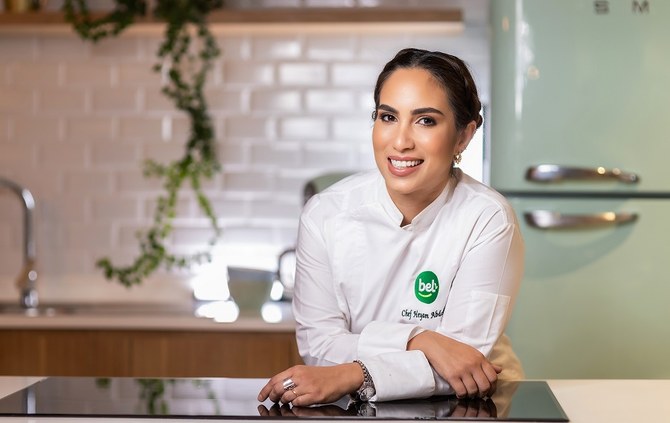

DUBAI: Saudi chef Heyam Abdelhadi, better known as Chef Himi, currently serves as the executive chef at Bel Middle East, which markets several brands including Kiri, La Vache Qui Rit, Babybel, and Boursin. She is responsible for recipe creation, training and live demonstrations, among other tasks.
Abdelhadi trained in the south of France, but it was in the US where her career really flourished. Having moved to the States with her husband, Abdelhadi became a mother for the first time, and during this transformative period, she came up with the idea of specialized cooking classes tailored to mothers with young children.

Abdelhadi trained in the south of France, but it was in the US where her career really flourished. (Supplied)
The classes provided a nurturing space for mothers to explore their cooking skills, with a harmonious balance between culinary pursuits and motherhood. They also allowed her to combine two of her passions: cooking and building communities.
When the family moved north to Canada, Abdelhadi opened her own restaurant, Madame Levant, bringing a taste of the Middle East to Toronto.
Here, Abdelhadi discusses the importance of preparation and the challenge of souffle, and shares a khushaf cheesecake recipe.
Q: When you started out what was the most common mistake you made?
A: Underestimating the importance of meticulous preparation. I’ve learned that attention to detail, from ingredient measurements to precise cooking times, is paramount for delivering consistently excellent dishes.
What’s your top tip for amateur chefs?
Invest in a good knife and good cookbooks.
What one ingredient can instantly improve any dish?
Salt. No matter how much umami or spices you try to add to a dish, you always need the right amount of salt to bring out the flavors.
When you go out to eat, do you find yourself critiquing the food? Or are you able to switch off and enjoy the meal?
I do pay attention to details when dining out, and can really express my disappointment if the meal was not up to the expected standard. You can really tell when there is care and love behind the dishes or if they were made without any soul.
What’s your favorite cuisine when you go out to eat?
Farm-to-table restaurants are always attractive to me, especially in places that are known for great agriculture. Otherwise, fusion cuisines where the chef showcases great creativity and execution.
What’s your go-to dish if you have to cook something quickly at home?
Air-fried salmon en papillote on a base of seasonal greens, marinated with honey, citrus slices, salt and pepper. I usually eat clean, and I find it to be one of the least time-consuming meals, full of nutrition and flavor.
What customer request most annoys you?
While I value customer preferences, excessive modifications to a dish can be challenging. It’s essential to strike a balance between accommodating individual tastes and preserving the integrity of the dish.
What’s your favorite dish to cook and why?
I absolutely love making khushaf cheesecake. It’s like taking regular cheesecake and giving it a local twist. The creaminess of the cheese, sweetness from qamar al-deen syrup, and a bit of crunch from almonds — it’s a delightful combo. It’s my way of blending our traditional flavors with a classic favorite, making it perfect for any gathering. It's all about adding a special touch to something familiar and turning it into a tasty experience.
What’s the most difficult dish for you to get right?
Mastering the perfect soufflé has always presented a challenge. The delicate balance of aeration, timing, and precise temperature control demands constant attention and practice.
As a head chef, what are you like?
I believe in maintaining a positive and collaborative kitchen environment. While I emphasize discipline and high standards, I prefer a constructive approach to teaching and guiding my team. Clear communication and mutual respect contribute to a motivated and efficient kitchen.
Chef Himi’s khushaf cheesecake recipe
INGREDIENTS
For the crust: 1 cup (170g) Graham cracker crumbs; ¼ cup slivered almonds; ¼ cup pine nuts; 2 tbsp sugar; 1 tbsp brown sugar; 7 tbsp melted butter
For the filling: 25 Kiri squares (roughly 400g of another brand of cream cheese); 120g sugar; 200g Greek yoghurt; 150ml whipping cream; 1½ tsp vanilla extract; 1⁄8 tbsp salt; 2 eggs; 25g corn starch; ½ cup diced fried fruits; Qamar Al-Deen syrup; 1 Kiri square (roughly 17g of another brand of cream cheese)
INSTRUCTIONS
For the crust:
1. Preheat the oven to 150°.
2. Process the crust ingredients together.
3. Pour the crumbs into a pan and press the mixture down firmly.
For the filling:
1. Stir the Kiri cream cheese until it becomes smooth.
2. Add the sugar, then the yoghurt, vanilla extract and salt, and stir together.
3. Lightly beat the eggs one at a time and add. Then add the chopped dried fruits.
4. Pour the mixture over your crust.
5. Bake for 75 minutes at 160°, then allow to cool to room temperature.
6. Refrigerate overnight.
7. When you are ready to serve, heat the syrup in a pan, allow to cool, then mix in the final Kiri square.
8. Pour the syrup on top and garnish with pine nuts and dried fruits. Serve.


