Pakistani army says played ‘pivot role’ in ensuring peaceful elections

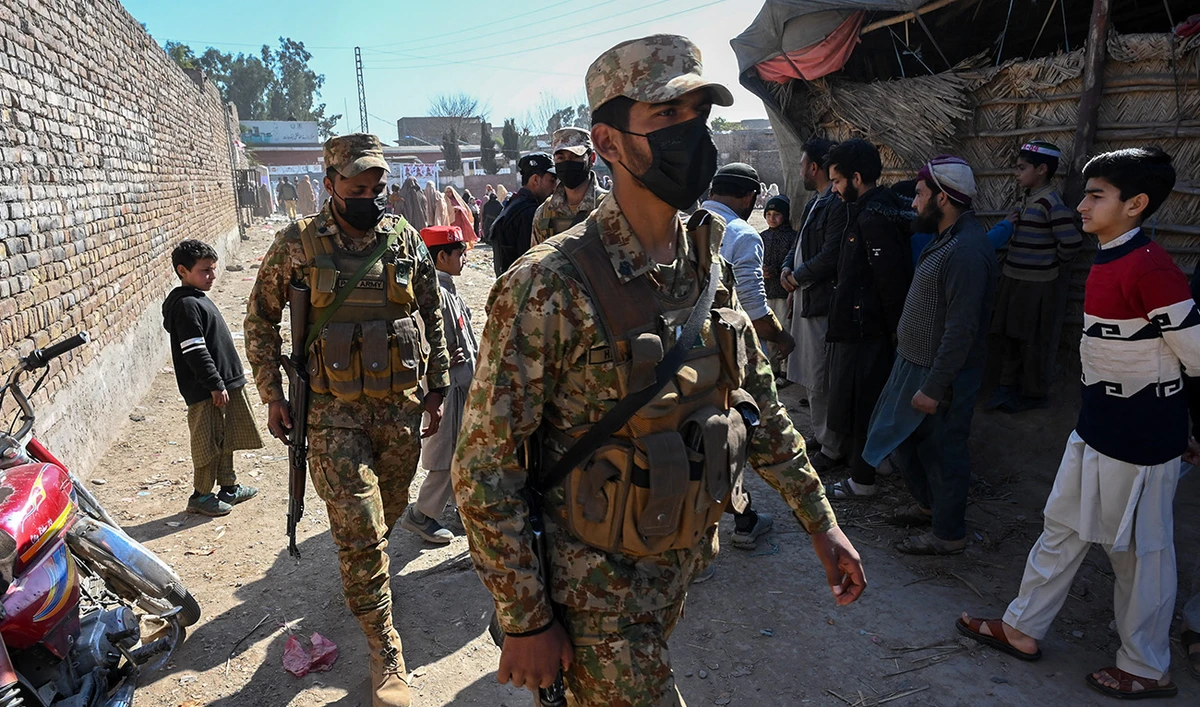
Pakistani army personnel patrol outside a polling station during Pakistan's national elections in Peshawar on February 8, 2024. (AFP)
Short Url
Updated 08 February 2024
Follow

Pakistani army says played ‘pivot role’ in ensuring peaceful elections

  • The army says in a statement it fought against militants trying to disrupt general elections in Pakistan
  • It hopes that its sacrifices will pave the way for the realization of the democratic aspirations of people

ISLAMABAD: Pakistan’s armed forces said they played a pivotal role along with the law enforcement agencies in the peaceful conduct of the general elections in an official statement on Thursday, hoping it would strengthen the political system in the country and help its people realize their democratic aspirations.
The army has ruled Pakistan directly for more than 30 years and continues to influence its politics even when not in power. This is in spite of its claims that it does not meddle in the country’s political affairs, though nearly all major political parties have criticized it for playing a dominant role in the making and breaking of Pakistani governments in recent years.
In a statement issued shortly after the polling process came to an end in the country, the military’s media wing, Inter-Services Public Relations (ISPR), congratulated the nation on participating in the national polls that it said were largely violence-free.
“With the deployment of 137,000 army personnel and civil armed forces at approximately 6,000 selected most sensitive polling stations and over 7800 QRFs [Quick Response Forces], a safe and secure environment for the public was ensured,” the ISPR said.
The armed forces’ statement highlighted that nearly 50 militant attacks occurred, predominantly in the Balochistan and Khyber Pakhtunkhwa provinces, aiming to disrupt the electoral process.
Despite these challenges, Pakistani soldiers remained resolute, effectively maintaining peace and security across the country.
Consequently, these efforts led to the unfortunate loss of 10 uniformed personnel and injuries to 39 others.
“Gratitude is owed to other law enforcement agencies that worked hand in hand with the armed forces to safeguard the democratic process,” the ISPR added. “It is our fervent hope that our sacrifices would not be in vain and this election will serve as a catalyst for further strengthening democracy in Pakistan, and that it will pave the way for the realization of the aspirations of the people of Pakistan.”
The statement noted the armed forces would continue to uphold peace and security in the country and stand ready to provide unwavering support in safeguarding the democratic traditions of Pakistan.
Islamabad steps up vehicle checks to boost security as 166,000 cars get electronic tags

Updated 4 sec ago
Follow

Islamabad steps up vehicle checks to boost security as 166,000 cars get electronic tags

  • Authorities say over 3,000 vehicles registered in past 24 hours as enforcement intensifies
  • Extended service hours introduced to push full compliance with digital monitoring system

ISLAMABAD: Authorities in the Pakistani capital have intensified enforcement against vehicles without mandatory electronic tags with more than 166,000 cars now registered, according to data released on Sunday evening, as Islamabad moves to strengthen security and digital monitoring at key entry and exit points.

The Islamabad Capital Territory (ICT) administration introduced the electronic tagging system late last year as part of a broader effort to regulate traffic, improve record-keeping and enhance surveillance in a city that hosts the country’s main government institutions, foreign missions and diplomatic enclaves.

Under the system, vehicles are fitted with electronic tags that can be read automatically by scanners installed at checkpoints across the capital, allowing authorities to identify unregistered vehicles without manual inspections. Vehicles already equipped with a motorway tag, or m-tag, are exempt from the requirement.

“A total of 166,888 vehicles have successfully been issued M-Tags so far, including 3,130 vehicles in the last 24 hours,” the ICT administration said, according to the Excise Department.

Officials said readers installed at checkpoints across Islamabad are fully operational and are being used to stop vehicles still without tags, as enforcement teams carry out checks across the city.

To facilitate compliance, authorities have expanded installation facilities and extended operating hours. The Excise Department said m-tag installation is currently available at 17 booth locations, while select centers have begun operating beyond normal working hours.

According to Director General Excise Irfan Memon, m-tag centers at 26 Number Chungi and 18 Meel are providing services round the clock, while counters at Kachnar Park and F-9 Park remain open until midnight to accommodate motorists unable to visit during daytime hours.

Officials said the combination of enforcement and facilitation was aimed at achieving full compliance with minimal disruption, adding that operations would continue until all vehicles operating in the capital are brought into the system.

The enforcement drive builds on a wider push by the federal government to integrate traffic management, emergency response and security monitoring through technology-driven “safe city” initiatives. Last month, Interior Minister Mohsin Naqvi reviewed Islamabad’s surveillance infrastructure and said reforms in monitoring systems and the effective use of technology were the “need of the hour.”

Authorities have urged motorists to obtain electronic tags promptly to avoid delays and penalties at checkpoints as enforcement continues across the capital.