

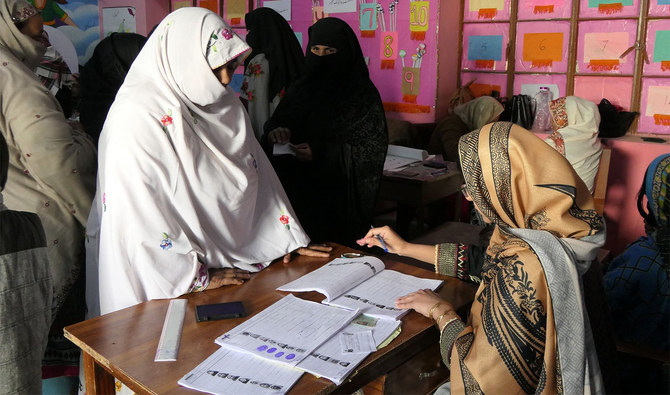

Islamabad/Lahore/Peshawar/Quetta: Pakistanis on Thursday turned out to vote in an election they hope will lead to political stability and improve the nation’s economic woes, despite allegations of rigging, a rise in militant attacks and the government shutting down mobile phone networks throughout the country.
Political parties are vying for a share of the 266 seats that are up for grabs in the Pakistani National Assembly, or the lower house of parliament, with an additional 70 seats reserved for women and minorities. The main contenders are the Pakistan Tehreek-e-Insaf (PTI) party of jailed former Prime Minister Imran Khan, the Pakistan Muslim League-Nawaz (PML-N) of three-time former premier Nawaz Sharif, and the Bilawal Bhutto Zardari-led Pakistan People’s Party.
Out of a population of 241 million, 128 million Pakistanis, or all those above 18 years of age, are eligible to vote. Polling booths opened at 8 a.m. and voting will continue until 5 p.m. (0300 GMT to 1200 GMT), but this time may be extended in exceptional individual circumstances.
Whoever wins Thursday’s election will inherit a deeply divided country with an economy in tatters, decades-high inflation, a rupee in freefall and a balance of payments crisis. An immediate challenge for the new government will be to renegotiate a new bailout deal with the International Monetary Fund (IMF). The last one, an ongoing $3 billion program, barely saved Pakistan from a debt default last June.
In the southwestern city of Quetta, the capital of Balochistan province, Muhammad Asif, 23, cast his vote in the city’s NA-263 constituency, with what he described as “high spirits.”
“I am feeling very well [after casting vote] and we hope the Noon League’s [Pakistan Muslim League-Nawaz] candidate, Zarak Khan Mandokhail, a young candidate, we expect him to come [to power] and God willing, take us to betterment,” the first-time voter said.
“The country has suffered in the last five years, but we are optimistic that the situation will get better after general polls.”
“I am expecting from the upcoming government to be fair between the poor and the rich people ... and I want the government to decrease inflation,” Shandana Munir, a resident of the northwestern city of Peshawar told Arab News, after voting in the NA-32 constituency.
“They should focus on the poor people, facilitate them in hospitals, in the education system.”
Farhan Shareef, another voter in Peshawar’s NA-32 constituency, said the people of Pakistan wanted peace and prosperity, no matter who came to power.
“My wish is that whoever comes should do better for the country,” Shareef told Arab News. “We want peace, we want less inflation, that people be happy, and that’s what we want. These days everyone is worried.”
“COMMUNICATION PROBLEMS“
Across the country, voters complained that they had trouble finding their polling stations because of communication problems as Pakistan temporarily suspended mobile phone services due to security concerns.
“People are trying to find their polling stations to vote, someone is going here, someone is going there,” Muhammad Shafiq said as he waved a PTI flag in the NA-46 constituency in the capital city of Islamabad.
“If service was open we could find out more easily where the polling station is. But I hope that God will help us.”
Jamaat-e-Islami party supporter Sadia Mirza said the “turnout was great” at the NA-46 constituency, but the network shutdown had created problems.
“We are facing problems because we are not able to communicate with anyone, which is an issue for everyone... people are not happy with that,” Mirza added.
“I am voting for the first time but what they have done, this shutting the mobile service, it’s really bad,” said Abdur Rehman, a first-time young voter, who said he supported the Pakistan Muslim League-Nawaz (PML-N) party.
“Because of this I could not call my friends, or contact PML-N camp people to ask them where the camp is. I had a transport problem in getting to the polling station so all of that was made difficult [by the mobile phone shutdown].”
“God willing it is so far peaceful and let’s see what happens as they have shut Internet and phone services,” a voter who was wearing a Pakistan Peoples Party hat said at a polling station in Peshawar.
“DISARRAY“
There were also reports of disarray and mismanagement at polling booths in parts of the South Asian country.
After polling opened on Thursday morning, widespread delays were reported in the opening of polling booths, with some stations such as in NA-223 in Badin in the southern Sindh province and NA-236 in Faisalabad in Punjab province, still not open well past noon.
Local media also widely reported delays in voting, including that voting was halted at two polling stations in NA-97 in Faisalabad due to allegations of rigging.
“There’s a lot of confusion since presiding officers are not putting the stamp on ballot papers,” a young woman voter in NA-128 in Lahore’s Model Town, who described herself as a PTI supporter, told Arab News. “Not many people know that this can invalidate their vote.”
An elderly voter in the same constituency said he had left his home early in the morning but had not managed to cast his ballot by the early afternoon.
“We live in Bhatta Chowk near the Defense Housing Society, but they have shifted our vote to Model Town,” he said, adding that he could not find his name in the voter list at the polling station specified by the election commission.
Mehwish Khan, a resident of Peshawar city in the NA-32 constituency, also lamented mismanagement.
“People do not know about the place where they’re going to cast votes and there have been last minute changes in the voting list as well, so a lot of people don’t know where they have to go [to vote],” Khan said.
“I think the Internet and mobile connections shouldn’t have been down, it would have been easier for people.”
In Karachi’s NA-248 constituency, Shagufta Aftab said there was “no system.”
“I have been worrying here [polling station at Altaf Hussain Hali School] for the last one and a half hours … The [caretaker] government made lofty claims, but there is no system in place here,” she told Arab News.
“I have even seen elderly and people with disabilities being upset over here.”
- With additional reporting by Rehmat Mehsud in Peshawar and Naimat Khan, Buraq Shabbir and Khurshid Ahmed in Karachi


