



RAWALPINDI: In the heart of Pakistan’s garrison city of Rawalpindi, the historic Lal Haveli is abuzz with political activity before any general election.
But days before millions of Pakistanis go to the polls on Feb. 8, the political atmosphere around the iconic Red Mansion was anything but charged. Earlier this week, people ambled by the busy road near the over-hundred-years-old mansion as light bunting hung overhead and photos of candidates looked at passersby from a few posters hung on lampposts and buildings.
The quiet look of Lal Haveli’s surroundings mirrors the larger election race in Pakistan. Despite a history of boisterous, if sometimes violent, electioneering, the campaign leading up to Thursday’s elections has been relatively muted across the country.
Campaigning did not begin until less than two months ago, as the date for general elections — which were supposed to be held last November but were repeatedly delayed — was not announced until mid-December.
Another reason for a quieter race is that former prime minister Imran Khan, arguably the most popular politician in the country, is in jail and barred from running in elections, while his Pakistan Tehreek-e-Insaf (PTI) party says it is facing a state-backed crackdown on political activities and electioneering.
A key Khan ally, Sheikh Rasheed Ahmed, who between 1985 and 2018 won eight elections from NA-56, the constituency in which the Lal Haveli is situated, is also in jail, taking the steam out of the race in the area. Ahmed’s work is cut out for him as he has to contest from behind bars against his fiercest rival Hanif Abbasi from the Pakistan Muslim League-Nawaz (PML-N), and the Pakistan Tehreek-e-Insaf-backed (PTI) independent candidate, Shehryar Riaz.
“Ahmed has been behind bars for the last 22 days without committing any crime,” Ahmed’s nephew Sheikh Rasheed Shafique told Arab News this week from his political office inside the Lal Haveli, calling this election race the “toughest” of his 22-year-long political career.
“We are denied permission for public gatherings, door-to-door campaigns, or even installing a sound system,” said Shafique, who is running from the constituency adjacent to his uncle’s NA-57 in Rawalpindi but overseeing his uncle’s campaign in NA-56 as well.
“We have been strictly warned in a letter that if you formally hold any activities, then we will register an FIR [police case] according to Section 144 [ban on public gathering] and send you to jail before [February] 8.”
The Rawalpindi deputy commissioner had ordered him not to organize any political activities on Feb. 6, the last day for campaigning before polls, Shafique said, while his opponents from the PML-N, Jamaat-i-Islami, and Tehreek-e-Labbaik had permission to hold their final public gatherings.
For the last month, according to Shafique, police would detain his supporters whenever he arranged a corner meeting:
“Out of 25 election campaign offices, only 2 to 3 are operational, the rest were forced to close by respective police stations,” he said.
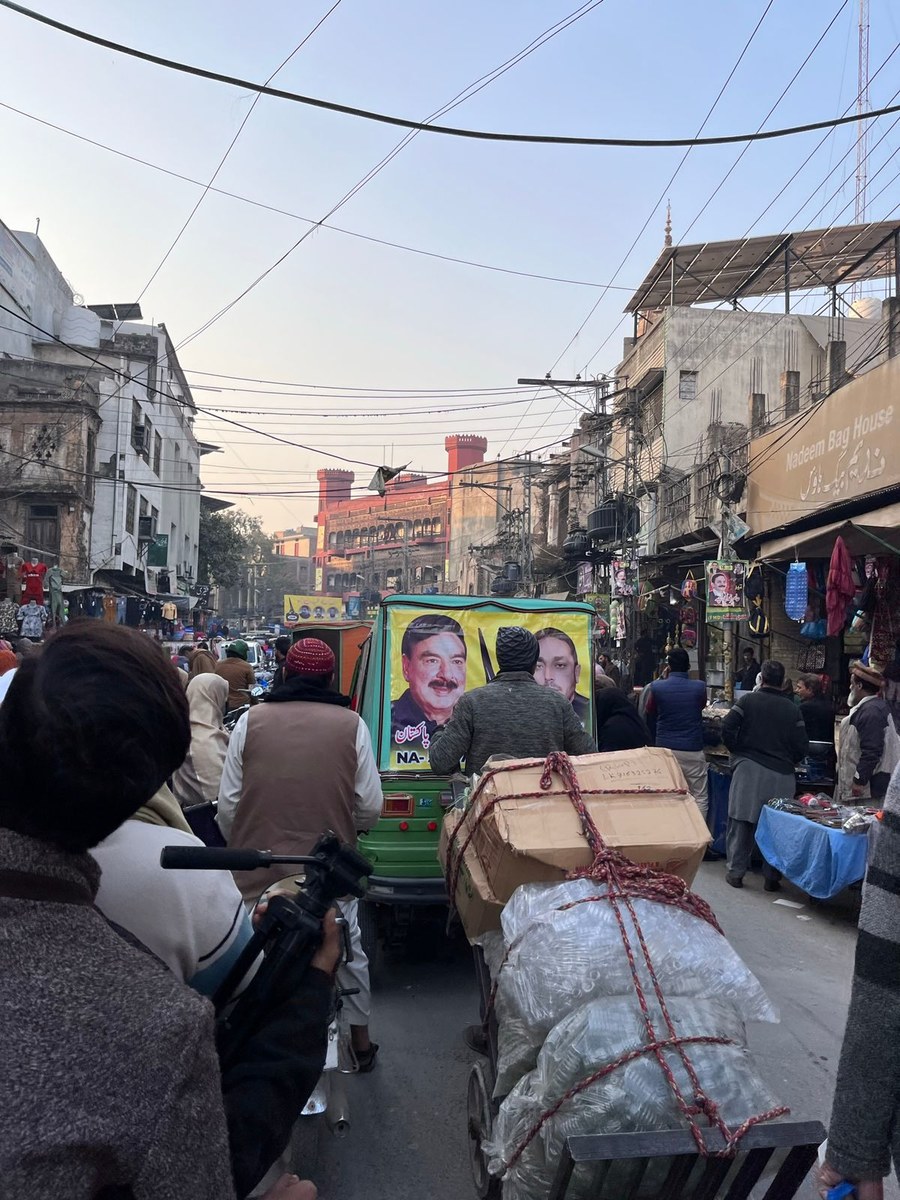
A poster of Sheikh Rasheed Ahmad, an election candidate of Pakistan's Awami Muslim League party is displayed behind an auto-rickshaw in Rawalpindi, Pakistan, on January 14, 2024. (AN photo)
The Rawalpindi deputy commissioner’s office as well as police declined comment for this piece.
“DID NOT STAND A CHANCE”
Known for his quips, political predictions and street-smart attitude, Ahmed leads the Awami Muslim League (AML) party and has been a federal minister several times in different governments. He last served as the country’s interior and railways minister when ex-PM Khan was in power between 2018-2022.
Ahmed was arrested in September last year, one among a long line of Khan allies who were jailed following riots by PTI supporters on May 9. He was released on bail but rearrested last month. The trail in the May protests case started on Tuesday this week but was adjourned until Feb. 13.
“The crime is that there are 14 FIRs [police cases] with terrorism charges against us, despite us uncle and nephew not being directly involved in any case related to May 9 riots,” Shafique lamented.
“They granted bail to the nephew but denied it to the uncle without any apparent reason.”
Shehryar Riaz, who was forced to contest the polls as an independent candidate after the PTI was stripped of its electoral symbol last month, also voiced concerns about alleged restrictions against electioneering imposed by the district administration. However, he was still confident of the PTI’s popularity.
“I have been an MPA [member provincial assembly] for five years, my father was nazim of Dhoke Ratta [area in Rawalpindi],” Riaz told Arab News during a visit to the constituency.
“We have a strong relationship with the people that cannot be broken. Because of these combined factors, we will win on February 8.”
Riaz said Ahmed had lost the 2008 elections but won the next two in 2013 and 2018 because he had aligned himself with Khan. In this election, he said Ahmed “did not stand a chance” of winning as Khan had withdrawn his support from the former minister after Ahmed distanced himself from the PTI following the state crackdown after May 9. A legion of Khan allies, including Ahmed, had deserted him after the riots and the subsequent government-backed campaign against his supporters.
“GROWING INFLATION”
But residents in Rawalpindi constituencies visited by Arab News cared little for the electoral rivalries and more for inflation, which is hitting nearly 30 percent.
“I hope that whoever wins prioritizes the country’s betterment,” 30-year-old Muhammad Harris, who sells old clothes at a roadside stall, said. “Our rulers should focus on the public’s welfare, particularly by tackling growing inflation.”
Housewife Safiya Abbas, 35, said she would not vote in this election.
“In the last election, I voted for the PML-N, but this time I am hesitant due to unfulfilled promises of reducing inflation,” Abbas told Arab News. “I will only support a leader who genuinely addresses the issue of inflation by bringing it down.”
But there were still some takers for Ahmed.
“I have supported him from the beginning and will continue to stand by him. Being my neighbor, he has the right to my vote,” Harris said with a smile. “My bigger vote is for PTI so now my smaller vote is for Sheikh sahib.”


