

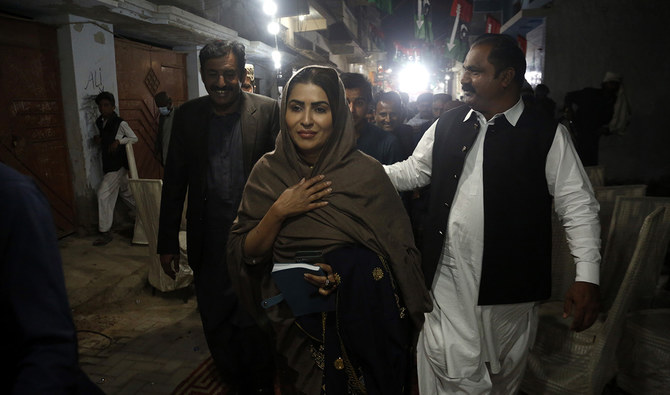

KARACHI: For former federal minister and single mother Shazia Marri, the decision to contest elections for a general seat from a remote southern Pakistan district was not an easy one. But after winning two back-to-back elections in 2013 and 2018, she is now back in the race ahead of Feb. 8 elections, running from her home constituency of Sanghar district, Pakistan’s second largest by size.
Marri is one of around 100 of women running on general seats in the upcoming general elections, out of a total of 266 national and 593 provincial assembly seats. She hails from Pakistan’s southern Sindh province from a well-entrenched political family. Her father Ata Muhammad Marri is an ex-MNA and deputy speaker of the Sindh Assembly, while her grandfather Ali Mohammad Marri was an MP in the Sindh Assembly before the Partition of British India. Her mother Perveen Ata Marri was also an MPA.
Marri’s campaign strategy was focused on direct engagement with constituents, especially women, whose voices she told Arab News had long been ignored.
“What I realized was that these people, nobody spoke with them like that, nobody went up to them, nobody asked them, nobody spoke to the women particularly, nobody did that,” she said on the campaign trail in Sanghar.
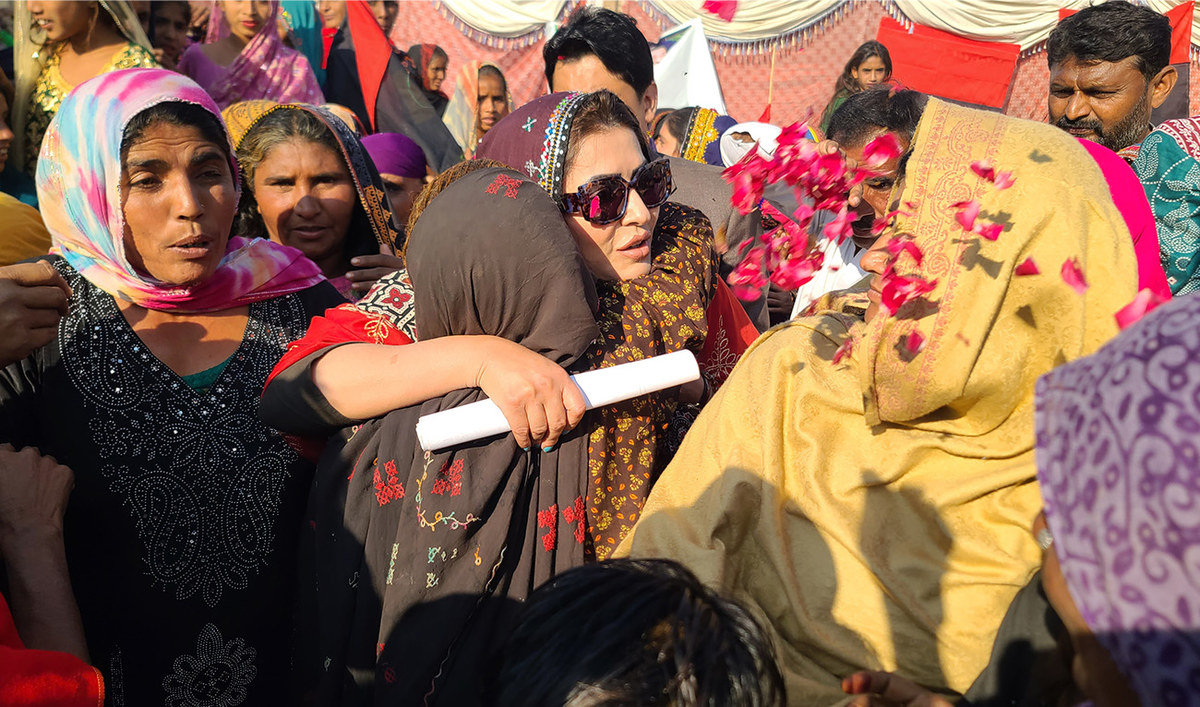
Former federal minister and Pakistan People's Party candidate Shazia Mari meets local villagers in Sanghar on January 27, 2024. (AN Photo)
“I was able to get gas, natural gas to this area. And the women were in love with me,” Marri added, speaking about 2009 when she was elected on a reserved seat for women and earned the trust and support of the community by listening to them and delivering “tangible results” in the form of the supply of natural gas to Sanghar’s Berani areas.
A man might not have understood the problems of women constituents, Marri said, as men did not have to deal with the adverse health effects of flames from make-shift ovens women had to spend hours in front of each day to prepare meals.
Reflecting on her political journey, Marri recalled the challenges she faced as a woman in a male-dominated political sphere. She said she persevered despite “moments of vulnerability,” working hard to earn respect through her dedication and accomplishments.
“It’s not an easy ride. I’ve had moments of you know, I’d say the really bad moments. I’ve been vulnerable, like many times that I felt I was vulnerable. And I was made to feel that way. Because I was a woman,” Marri said.
“They feel that she’s a woman and her focus is just to dress up or to look this way or that way. They didn’t see the brains behind it, or the passion behind it or the commitment behind it.”
Marri first received the Pakistan Peoples Party’s (PPP) ticket for NA-209 Sanghar in 2013 and won in a constituency that was previously held by the Pakistan Muslim League-Functional (PML-F) party. Through her relentless efforts, she repeated the feat in 2018 by defeating the Grand Democratic Alliance’s (GDA) Kishan Chand Parwani by almost 10,000 votes.
She is now facing another formidable opponent in the form of the GDA’s Muhammad Khan Junejo.
Since the start of electioneering last month, Marri left her home in Berani town each morning to traverse through remote villages, towns and settlements in the Achro Thar or white desert bordering India. Her constituency, Pakistan’s second largest constituency, covers 70 percent of Sanghar district, and it took her long days that stretched into nights to reach voters. But she did it all with the support of her family, which includes her son and daughter, son-in-law as well as sister and brother, who remained actively involved in her campaign.
“I’d start anywhere from 10 or 11. And there’s been a time when I got home at 3am, 4am, slept by 5am,” she said, as her car arrived at a village for a public gathering.
“It was very difficult in the beginning, having to look after the desert area, and then this side of the constituency, but it’s a mix so I can’t help it. I have to, I have to work in this area.”
She said her opponents resented the fact that she had access to both male and women voters though she treated it as a blessing.
“’She’s got an edge over us, she goes to the men, and she goes to the women, and she goes into their homes, and she just enters,’ they would say,” she said. “Well, that’s a blessing. I don’t have many advantages. But if I have one, then be it.”
In 2013, Marri’s decision to run in election in a district where her party was struggling reflected her resilience, shaped by her being a single mother.
She stands by her decision to step out of her “painful” marriage after being married at the age of 15 and to raise her children on her own.
“I think being a single mother is better than being in a relationship that’s painful. That’s disastrous,” she said.
“Because that way you not only allow yourself to endure pain, and be miserable, you also impact your children.”
Marri said her kids were witness to her struggles and the difficulties she had gone through in life.
“They respect me more, because they’ve seen it all,” she added.
Nonetheless, Marri said societal norms in the conservative Sindh region were changing and women were gradually breaking down barriers into public life.
Reforms to Pakistan’s electoral laws in 2017 made it mandatory for political parties to allot five percent of their tickets to women candidates. Under Pakistan’s constitution, women are guaranteed seats through a quota system in the national parliament and regional assemblies in Punjab, Sindh, Khyber Pakhtunkhwa and Balochistan provinces.
Ahead of general elections on Feb. 8, former prime minister Imran Khan’s Pakistan Tehreek-e-Insaf (PTI) party has awarded National Assembly tickets to 21 women candidates, the Pakistan Peoples Party to 23 women and the Pakistan Muslim League-Nawaz (PML-N) to 16 women.
As far as Pakistan’s religious parties are concerned, the Jamiat Ulema-e-Islam (JUI), has awarded two tickets to women for National Assembly seats and nine for the provincial assembly seats, while the Jamaat-e-Islami (JI) has awarded 10 tickets to women contestants for National Assembly seats and 19 for provincial assembly seats, according to data collected by the Free and Fair Election Network (FAFEN), a conglomerate of Pakistani civil society groups.
“I’ve seen a change ever since I got elected the first time and the second time,” Marri said. “Today, I feel proud [to be a women politician] but believe me, it was very difficult to get here.”
But the road here meant balancing her responsibilities as a single mother and defying societal expectations for the sake of her political ambitions.
“I have a son who is 35 and a daughter who’s 26,” she said. “I’m a single mom. And I take pride in the fact that I’ve done justice as a mother to my children.”


