

Blinken meets Israeli PM for talks on Gaza truce plan

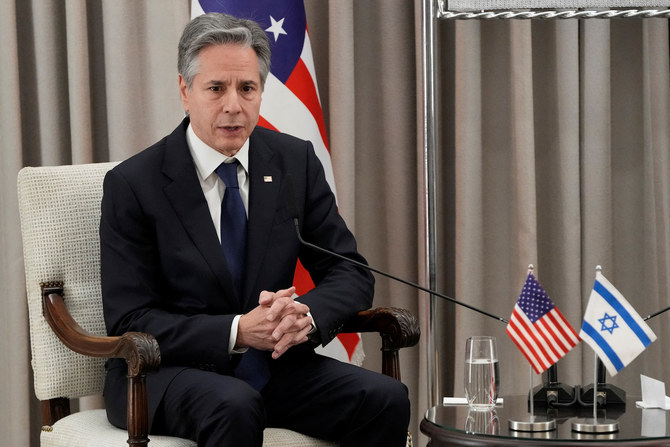
US Secretary of State Antony Blinken speaks during his meeting with Israel’s President Isaac Herzog in Jerusalem on Wednesday, Feb. 7, 2024. (Reuters)
Short Url
Updated 07 February 2024
Follow

Blinken meets Israeli PM for talks on Gaza truce plan

  • Hamas proposed 135-day truce and hostage-prisoner exchange, according to Reuters

TEL AVIV: US Secretary of State Antony Blinken met Israeli Prime Minister Benjamin Netanyahu in Jerusalem on Wednesday to push for a ceasefire as the Gaza war enters its fifth month.
Israel and Hamas have been weighing a proposal, brokered by US, Qatari and Egyptian mediators, that would be expected to temporarily halt the fighting and see Gaza hostages freed and Palestinian prisoners released.
“There’s still a lot of work to be done,” Blinken said in Doha late on Tuesday after earlier stops in Saudi Arabia and Egypt on his fifth Middle East crisis tour since the October 7 attack sparked the war.
“But we continue to believe that an agreement is possible and indeed essential, and we will continue to work relentlessly to achieve it,” the US top diplomat told reporters.
For now, the war raged on unabated in Hamas-ruled Gaza, where the health ministry said at least 100 people were killed overnight and AFP journalists reported more heavy bombing of southern cities.
Israeli forces, in their campaign to destroy Hamas, have pushed steadily south, with the heaviest combat raging in the city of Khan Yunis in recent weeks.
Fear has grown among the more than one million Palestinians now crowded into Gaza’s far south, around the city of Rafah on the Egyptian border, as the battlefront has crept ever closer.
“I am terrified that Israel will begin a ground operation in Rafah,” said Dana Ahmed, 40, who was displaced from Gaza City with her three children and now lives in a tent in Rafah.
She said she spent a sleepless night as Israeli fighter jets roared through the sky and explosions shook the ground.
“I cannot imagine what will happen to us,” she said. “Where will we go now? The situation is catastrophic. I feel like I am living a horror movie.”

Intense fighting
Israeli Defense Minister Yoav Gallant warned earlier this week that the army “will reach places where we have not yet fought... right up to the last Hamas bastion, which is Rafah.”
The UN aid coordination office OCHA voiced alarm about looming major combat in the densely crowded area.
“Intensified hostilities in Rafah in this situation could lead to large-scale loss of civilian lives, and we must do everything possible within our power to avoid that,” said its spokesman Jens Laerke.
The bloodiest ever Gaza war started with Hamas’s unprecedented attack on Israel on October 7, which resulted in the deaths of about 1,160 people, mostly civilians, according to an AFP tally based on official Israeli figures.
Militants also seized around 250 hostages. Israel says 132 remain in Gaza, of whom 29 are believed to have died.
Israel vowed to eliminate Hamas and launched air strikes and a ground offensive that have killed at least 27,585 people, mostly women and children, according to the Gaza health ministry.
The campaign has devastated swathes of Gaza and displaced the majority of its 2.4 million people who have also endured dire shortages of food, water, fuel and medicine.
The humanitarian situation in long-blockaded Gaza has become “beyond catastrophic,” the International Federation of Red Cross and Red Crescent Societies said on Tuesday.

Hamas proposes truce
To bring relief, the warring parties have discussed a possible new ceasefire deal which would follow a first, week-long truce in November that saw more than 100 hostages freed, the Israelis among them in exchange for Palestinian prisoners.
Last week, a Hamas source said the proposed new truce calls for a six-week pause to fighting and a hostage-prisoner exchange, as well as more aid for Gaza, but negotiations have continued since.
Qatari Prime Minister Mohammed bin Abdulrahman Al-Thani said on Tuesday that Hamas had responded to a new proposal, adding that “the reply includes some comments, but in general it is positive.”
Blinken said he would discuss Hamas’s reply with Israeli leaders and Netanyahu’s office said the “details are being thoroughly evaluated” by the spy agency Mossad.
Netanyahu — who had yet to comment directly on the Hamas response — stressed that Israel’s overall war aim remained unchanged: “We are on the way to the total victory and we will not stop.”
Amid the Gaza war, Iran-backed groups in Lebanon, Iraq, Syria and Yemen have launched attacks in support of Hamas, and Israel, the United States and its allies have launched strikes on them.
Yemen’s Houthi rebels have for weeks targeted what they say are Israel-linked ships in the Red Sea and Gulf of Aden, disrupting global trade and prompting reprisals by US and British forces.
Last week, the United States also carried out strikes on Iran-backed groups in Syria and Iraq, killing dozens in retaliation for an attack that killed three US troops in Jordan.
Israel has also traded deadly cross-border fire with Lebanon’s Hezbollah movement and has repeatedly bombed Iran-linked targets in Syria.
Israeli strikes on the Syrian city of Homs on Wednesday killed 10 people, including at least six civilians, according to the Britain-based war monitoring group, the Syrian Observatory for Human Rights.


Palestinian citizens in Israel demand more security from violence

Updated 4 sec ago
Follow

Palestinian citizens in Israel demand more security from violence

  • Protests and strikes are sweeping Israel over record levels of violence targeting the country’s Palestinian citizens
  • At least 26 people were killed in January alone, adding to a record-breaking toll of more than 250 last year
KAFR YASIF, Israel: Nabil Safiya had taken a break from studying for a biology exam to meet a cousin at a pizza parlor when a gunman on a motorcycle rode past and fired, killing the 15-year-old as he sat in a black Renault.
The shooting — which police later said was a case of mistaken identity — stunned his hometown of Kafr Yasif, long besieged, like many Palestinian towns in Israel, by a wave of gang violence and family feuds.
“There is no set time for the gunfire anymore,” said Nabil’s father, Ashraf Safiya. “They can kill you in school, they can kill you in the street, they can kill you in the football stadium.”
The violence plaguing Israel’s Arab minority has become an inescapable part of daily life. Activists have long accused authorities of failing to address the issue and say that sense has deepened under Israel’s current far-right government.
One out of every five citizens in Israel is Palestinian. The rate of crime-related killings among them is more than 22 times higher than that for Jewish Israelis, while arrest and indictment rates for those crimes are far lower. Critics cite the disparities as evidence of entrenched discrimination and neglect.
A growing number of demonstrations are sweeping Israel. Thousands marched in Tel Aviv late Saturday to demand action, while Arab communities have gone on strike, closing shops and schools.
In November, after Nabil was gunned down, residents marched through the streets, students boycotted their classes and the Safiya family turned their home into a shrine with pictures and posters of Nabil.
The outrage had as much to do with what happened as with how often it keeps happening.
“There’s a law for the Jewish society and a different law for Palestinian society,” Ghassan Munayyer, a political activist from Lod, a mixed city with a large Palestinian population, said at a recent protest.
An epidemic of violence
Some Palestinian citizens have reached the highest echelons of business and politics in Israel. Yet many feel forsaken by authorities, with their communities marked by underinvestment and high unemployment that fuels frustration and distrust toward the state.
Nabil was one of a record 252 Palestinian citizens to be killed in Israel last year, according to data from Abraham Initiatives, an Israeli nongovernmental organization that promotes coexistence and safer communities. The toll continues to climb, with at least 26 additional crime-related killings in January.
Walid Haddad, a criminologist who teaches at Ono Academic College and who previously worked in Israel’s national security ministry, said that organized crime thrives off weapons trafficking and loan‑sharking in places where people lack access to credit. Gangs also extort residents and business owners for “protection,” he said.
Based on interviews with gang members in prisons and courts, he said they can earn anywhere from thousands to hundreds of thousands of dollars, depending on whether the job is torching cars, shooting at buildings or assassinating rival leaders.
“If they fire at homes or people once or twice a month, they can buy cars, go on trips. It’s easy money,” Haddad said, noting a widespread sense of impunity.
The violence has stifled the rhythm of life in many Palestinian communities. In Kafr Yasif, a northern Israel town of 10,000, streets empty by nightfall, and it’s not uncommon for those trying to sleep to hear gunshots ringing through their neighborhoods.
Prosecutions lag
Last year, only 8 percent of killings of Palestinian citizens led to charges filed against suspects, compared with 55 percent in Jewish communities, according to Abraham Initiatives.
Lama Yassin, the Abraham Initiatives’ director of shared cities and regions, said strained relations with police long discouraged Palestinian citizens from calling for new police stations or more police officers in their communities.
Not anymore.
“In recent years, because people are so depressed and feel like they’re not able to practice day-to-day life ... Arabs are saying, ‘Do whatever it takes, even if it means more police in our towns,’” Yassin said.
The killings have become a rallying cry for Palestinian-led political parties after successive governments pledged to curb the bloodshed with little results. Politicians and activists see the spate of violence as a reflection of selective enforcement and police apathy.
“We’ve been talking about this for 10 years,” said Knesset member Aida Touma-Suleiman.
She labeled policing in Palestinian communities “collective punishment,” noting that when Jews are victims of violence, police often set up roadblocks in neighboring Palestinian towns, flood areas with officers and arrest suspects en masse.
“The only side that can be able to smash a mafia is the state and the state is doing nothing except letting (organized crime) understand that they are free to do whatever they want,” Touma-Suleiman said.
Many communities feel impunity has gotten worse, she added, under National Security Minister Itamar Ben-Gvir, who with authority over the police has launched aggressive and visible campaigns against other crimes, targeting protests and pushing for tougher operations in east Jerusalem and the occupied West Bank.
Israeli police reject allegations of skewed priorities, saying that killings in these communities are a top priority. Police also have said investigations are challenging because witnesses don’t always cooperate.
“Investigative decisions are guided by evidence, operational considerations, and due process, not by indifference or lack of prioritization,” police said in a statement.
Unanswered demands
In Kafr Yasif, Ashraf Safiya vowed his son wouldn’t become just another statistic.
He had just gotten home from his work as a dentist and off the phone with Nabil when he learned about the shooting. He raced to the scene to find the car window shattered as Nabil was being rushed to the hospital. Doctors there pronounced him dead.
“The idea was that the blood of this boy would not be wasted,” Safiya said of protests he helped organize. “If people stop caring about these cases, we’re going to just have another case and another case.”
Authorities said last month they were preparing to file an indictment against a 23-year-old arrested in a neighboring town in connection with the shooting. They said the intended target was a relative, referring to the cousin with Nabil that night.
And they described Nabil as a victim of what they called “blood feuds within Arab society.”
At a late January demonstration in Kafr Yasif, marchers carried portraits of Nabil and Nidal Mosaedah, another local boy killed in the violence. Police broke up the protest, saying it lasted longer than authorized, and arrested its leaders, including the former head of the town council.
The show of force, residents said, may have quashed one protest, but did nothing to halt the killings.
