

UN refugee chief warns Europe of a new influx of Sudanese migrants

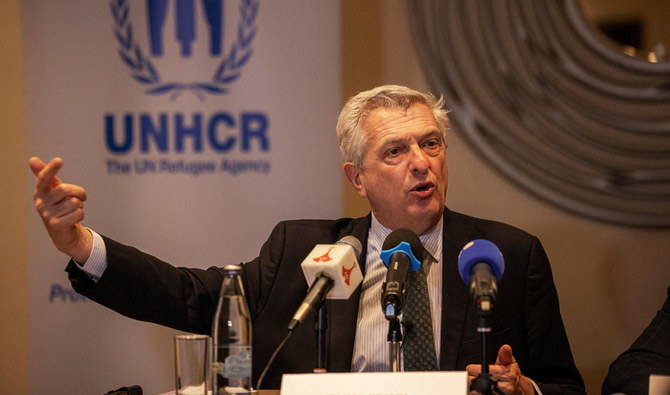
United Nations High Commissioner for Refugees (UNHCR) Filippo Grandi answers questions from journalists during a press conference in Addis Ababa on January 31, 2024. (AFP/File)
Short Url
Updated 05 February 2024
Follow

UN refugee chief warns Europe of a new influx of Sudanese migrants

NAIROBI: Europe may have to deal with a new flow of Sudanese migrants if a ceasefire agreement isn’t signed soon between Sudan’s warring sides and relief efforts aren’t strengthened, the head of the United Nations refugee agency said Monday.

“The Europeans are always so worried about people coming across the Mediterranean. Well, I have a warning for them that if they don’t support more refugees coming out of Sudan, even displaced people inside Sudan, we will see onward movements of people toward Libya, Tunisia and across the Mediterranean,” Filippo Grandi said. ”There is no doubt.”

More than 9 million people are thought to be internally displaced in Sudan, and 1.5 million refugees have fled into neighboring countries in 10 months of clashes between the Sudanese military, led by Gen. Abdel Fattah Al-Burhan, and the Rapid Support Forces, a powerful paramilitary group commanded by Gen. Mohammed Hamdan Dagalo.

The conflict erupted last April in the capital, Khartoum, and quickly spread to other areas of the country.

Grandi said several countries neighboring Sudan — Chad, Central African Republic, South Sudan and Ethiopia — have their own “fragilities” and will be unable to give refugees enough assistance.

He said refugees will move further toward northern counties like Tunisia, where some have been documented planning to cross to Europe.

“When refugees go out and they don’t receive enough assistance, they go further,” Grandi said.

He said the war in Sudan is becoming fragmented, with a number of militias controlling areas. “Militias have even less hesitation to perpetrate abuse on civilians,” he said, suggesting that it would create even more displacement.

Grandi also said conflicts in places like Sudan, Congo, Afghanistan and Myanmar should not be overlooked during the wars in Ukraine and Gaza.

“Gaza is a tragedy, it needs a lot of attention and resources, but it cannot be at the expense of another big crisis like Sudan,” he said.

Grandi spoke a day after visiting Sudan and Ethiopia, which is recovering from a two-year conflict in its northern Tigray region.

The United Nations says at least 12,000 people have been killed in Sudan’s conflict, although local doctors groups say the true toll is far higher.

Dagalo’s paramilitary forces appear to have had the upper hand over the past three months, with their fighters advancing to the east and north across Sudan’s central belt. Both sides have been accused of war crimes by rights groups.

Regional partners in Africa have been trying to mediate an end to the conflict, along with Saudi Arabia and the United States, which facilitated several rounds of unsuccessful, indirect talks between the warring parties. Al-Burhan and Dagalo are yet to meet in person since the conflict began.


Top Australian writers’ festival canceled after Palestinian author barred

Updated 4 sec ago
Follow

Top Australian writers’ festival canceled after Palestinian author barred

SYDNEY: One of Australia’s top writers’ festivals was canceled on Tuesday, after 180 authors boycotted the event and its director resigned saying she could not ​be party to silencing a Palestinian author and warned moves to ban protests and slogans after the Bondi Beach mass shooting threatened free speech.
Louise Adler, the Jewish daughter of Holocaust survivors, said on Tuesday she was quitting her role at the Adelaide Writers’ Week in February, following a decision by the festival’s board to disinvite a Palestinian-Australian author.
The novelist and academic Randa Abdel-Fattah said the move to bar her was “a blatant and shameless act of anti-Palestinian racism ‌and censorship.”
Prime ‌Minister Anthony Albanese on Tuesday announced a national day ‌of ⁠mourning ​would ‌be held on January 22 to remember the 15 people killed in last month’s shooting at a Jewish Hanukkah celebration on Bondi Beach.
Police say the alleged gunmen were inspired by the Islamic State militant group, and the incident sparked nationwide calls to tackle antisemitism, and prompted state and federal government moves to tighten hate speech laws.
The Adelaide Festival board said on Tuesday its decision last week to disinvite ⁠Abdel-Fattah, on the grounds it would not be culturally sensitive for her to appear at the literary ‌event “so soon after Bondi,” was made “out of respect ‍for a community experiencing the pain ‍from a devastating event.”
“Instead, this decision has created more division and ‍for that we express our sincere apologies,” the board said in a statement.
The event would not go ahead and remaining board members will step down, it added.
Former New Zealand Prime Minister Jacinda Ardern, British author Zadie Smith, Australian author Kathy Lette, Pulitzer Prize-winning American Percival ​Everett and former Greek finance minister Yanis Varoufakis are among the authors who said they would no longer appear at the festival ⁠in South Australia state, Australian media reported.
The festival board on Tuesday apologized to Abdel-Fattah for “how the decision was represented.”
“This is not about identity or dissent but rather a continuing rapid shift in the national discourse around the breadth of freedom of expression in our nation following Australia’s worst terror attack in history,” it added.
Abdel-Fattah wrote on social media that she did not accept the apology, saying she had nothing to do with the Bondi attack, “nor did any Palestinian.”
Adler earlier wrote in The Guardian that the board’s decision to disinvite Abdel-Fattah “weakens freedom of speech and is the harbinger of a less free nation, where lobbying and political ‌pressure determine who gets to speak and who doesn’t.”
The South Australian state government has appointed a new festival board.