

Houthis vow response after US, UK strike dozens of Yemen targets

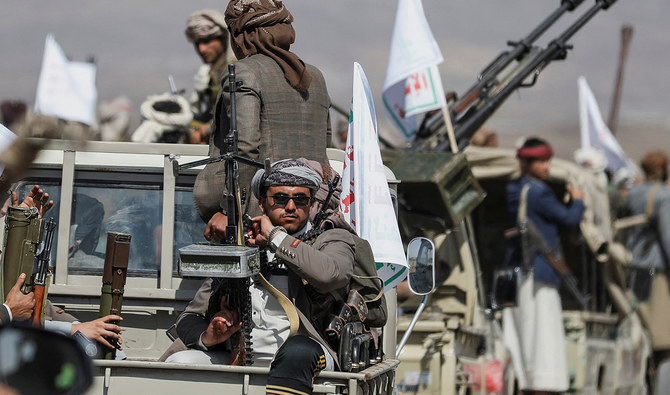
Houthi tribesmen gather to show defiance after U.S. and UK air strikes on Houthi positions near Sanaa, Yemen February 4, 2024. (REUTERS)
Short Url
Updated 04 February 2024
Follow

Houthis vow response after US, UK strike dozens of Yemen targets

  • It is the 3rd time British, US forces have jointly targeted Houthis, whose attacks in solidarity with Palestinians, have disrupted global trade
  • The joint air raids in Yemen late Saturday followed a separate wave of unilateral American strikes against Iran-linked targets in Iraq and Syria

SANAA: Yemen’s Houthis said Sunday US and British air strikes “will not deter us” and vowed a response after dozens of targets were hit in retaliation for the Iran-backed rebels’ repeated Red Sea attacks.
The joint air raids in Yemen late Saturday followed a separate wave of unilateral American strikes against Iran-linked targets in Iraq and Syria in response to a drone attack that killed three US soldiers in Jordan.
It is the third time that British and American forces have jointly targeted the Houthis, whose attacks in solidarity with Palestinians in war-battered Gaza have disrupted global trade.
The United States has also carried out a series of air raids against the Yemeni rebels on its own, but their attacks on the vital Red Sea trade route have persisted.
Saturday’s strikes hit “36 Houthi targets across 13 locations in Yemen in response to the Houthis’ continued attacks against international and commercial shipping as well as naval vessels transiting the Red Sea,” the United States, Britain and other countries that provided support for the operation said in a statement.
US Defense Secretary Lloyd Austin said the strikes “are intended to further disrupt and degrade the capabilities of the Iranian-backed Houthi militia to conduct their reckless and destabilising attacks.”
Neither Austin nor the joint statement identified the specific places that were hit, but Houthi military spokesman Yahya Saree said the capital Sanaa and other rebel-held areas were targeted.
Saree reported a total of 48 air strikes, and said on social media platform X that “these attacks will not deter us from our... stance in support of the steadfast Palestinian people in the Gaza Strip,” where the Israel-Hamas war has raged since early October.
The latest strikes “will not pass without response and punishment,” Saree said.

Britain’s defense ministry said Royal Air Force Typhoon warplanes struck targets including two ground control stations used to operate attack and reconnaissance drones.
Austin said that “coalition forces targeted 13 locations associated with the Houthis’ deeply buried weapons storage facilities, missile systems and launchers, air defense systems, and radars.”
There were no immediate reports of casualties.


US and Iran slide towards conflict as military buildup eclipses nuclear talks

Updated 28 min 13 sec ago
Follow

US and Iran slide towards conflict as military buildup eclipses nuclear talks

  • Washington building up one of its biggest military deployments in the region since the invasion of Iraq in 2003
  • Iran is expected to submit a written proposal in the coming days, a US official says

Iran and the United States are sliding rapidly towards military conflict as hopes fade for a diplomatic solution to their standoff over Tehran’s nuclear program, officials on both sides and diplomats across the Gulf and Europe say.

Iran’s Gulf neighbors and its enemy Israel now consider a conflict to be more likely than a settlement, these sources say, with Washington building up one of its biggest military deployments in the region since the invasion of Iraq in 2003.

Israel’s government believes Tehran and Washington are at an impasse and is making preparations for possible joint military action with the United States, though no decision has been made yet on whether to carry out such an operation, said a source familiar with the planning.

It would be the second time the US and Israel have attacked Iran in less than a year, following US and Israeli airstrikes against military and nuclear facilities last June.

Regional officials say oil-producing Gulf countries are preparing for a possible military confrontation that they fear could spin out of control and destabilize the Middle East.

Two Israeli officials told Reuters they believe the gaps between Washington and Tehran are unbridgeable and that the chances of a near‑term military escalation are high.

Some regional officials say Tehran is dangerously miscalculating by holding out for concessions, with US President Donald Trump boxed in by his own military buildup - unable to scale it back without losing face if there is no firm commitment from Iran to abandon its nuclear weapons ambitions.

“Both sides are sticking to their guns,” said Alan Eyre, a former US diplomat and Iran specialist, adding that nothing meaningful can emerge “unless the US and Iran walk back from their red lines - which I don’t think they will.”

“What Trump can’t do is assemble all this military, and then come back with a ‘so‑so’ deal and pull out the military. I think he thinks he’ll lose face,” he said. “If he attacks, it’s going to get ugly quickly.”

Two rounds of Iran-US talks have stalled on core issues, from uranium enrichment to missiles and sanctions relief.

When Omani mediators delivered an envelope from the US side containing missile‑related proposals, Iranian Foreign Minister Abbas Araghchi refused even to open it and returned it, a source familiar with the talks said.

After talks in Geneva on Tuesday, Araghchi said the sides had agreed on “guiding principles,” but the White House said there was still distance between them.

Iran is expected to submit a written proposal in the coming days, a US official said, and Araghchi said on Friday he expected to have a draft counterproposal ready within days.

But Trump, who has sent aircraft carriers, warships and jets to the Middle East, warned Iran on Thursday it must make a deal over its nuclear program or “really bad things” will happen.

He appeared to set a deadline of 10 to 15 days, drawing a threat from Tehran to retaliate against US bases in the region if attacked. The rising tensions have pushed up oil prices.

US officials say Trump has yet to make up his mind about using military force although he acknowledged on Friday that he could order a limited strike to try to force Iran into a deal.

“I guess I can say I am considering that,” he told reporters.

The possible timing of an attack is unclear. US Secretary of State Marco Rubio is due to meet Israeli Prime Minister Benjamin Netanyahu on February 28 to discuss Iran. A senior US official said it would be mid-March before all US forces were in place.