

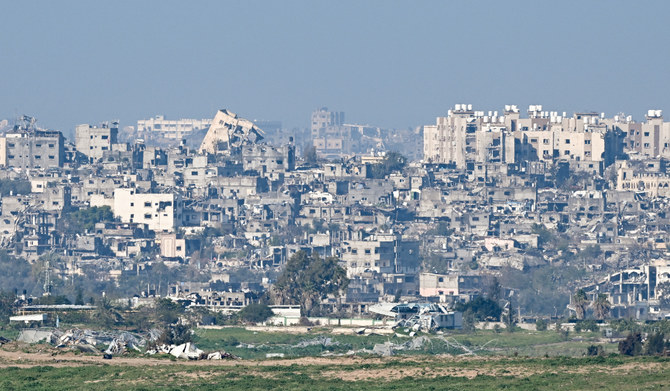

NAHAL OZ, Israel: Israeli forces in Gaza have systematically destroyed buildings in an attempt to create a buffer zone inside the Palestinian territory, experts and rights groups told AFP, raising fears over the civilian cost.
The plan, not publicly confirmed by Israel, appears to entail taking a significant chunk of territory out of the already tiny Hamas-ruled Gaza Strip, something experts as well as Israel’s foreign allies have warned against.
Since Hamas militants stormed across the border on October 7, Israeli forces have targeted structures in Gaza within a kilometer (0.6 miles) of the border, said Adi Ben Nun, a professor at Hebrew University of Jerusalem who has carried out an analysis of satellite imagery.
More than 30 percent of all buildings in that area have been damaged or destroyed during the war, he said.
Last month, the Israeli army’s deadliest day since the ground invasion began in late October offered a glimpse of the tactics being used to clear the border area.
Israeli army chief Herzi Halevi said at the time that 21 reservists were killed “during a defensive operation in the area separating the Israeli communities from Gaza” to allow for residents’ “safe return.”
The troops had laid out explosives to blow up buildings when they were fired upon by militants, the army said.
Displacement of Gazans including from the border area could breach the laws of war, experts said.
“We are seeing mounting evidence that Israel appears to be rendering large parts of Gaza unlivable,” said Nadia Hardman, a refugee rights expert at Human Rights Watch.
“One very clear example of that may be the buffer zone — this may amount to a war crime.”
When contacted by AFP, the military declined to comment on the buffer zone.
Cecilie Hellestveit, of the Norwegian Academy of International Law, warned of “the prospect of ethnic cleansing, transfer, or lack of rebuilding, so that the Palestinians will eventually be forced out of the area entirely.”
Scrutiny of Israel’s actions in Gaza is likely to be heightened by last month’s International Court of Justice ruling asking Israel to prevent any acts of genocide.
The United States, Israel’s top ally and provider of military aid, has repeatedly said Gaza’s territory should not change and that a buffer zone would breach that principle.
“When it comes to the permanent status of Gaza... we remain clear about not encroaching on its territory,” said US Secretary of State Antony Blinken.
Rights experts said Israel could use parts of its own territory to create a security zone.
“If the Israeli government wants a buffer zone, it has every right to create one in far larger Israel, but it has no right to seize land in Gaza,” human rights expert Ken Roth, a professor at Princeton University, said on social media.
Border security has become a priority for many Israelis, experts said, and the return to communities near the Gaza border would be seen as a sign that Hamas no longer posed a threat.
In Nahal Oz, a kibbutz barely a kilometer from Gaza that was targeted in the October 7 attack, artillery fire rang out and smoke billowed over the Palestinian territory in the distance.
Like many Israelis who lived along the border before the attack, nearly all of the kibbutz’s 400 residents were evacuated and have yet to return.
“It is still not a place to go back to with children, not yet unfortunately,” Eran Braverman, a 63-year-old farmer, told AFP.
“If there really would be such a (buffer) zone... it could help a lot. I hope it happens.”
Hamas’s attack on Israel resulted in the deaths of around 1,160 people, mostly civilians, according to an AFP tally based on official figures, with militants also seizing hostages — dozens of whom Israel says remain in Gaza.
In response, Israel launched a withering offensive that has killed at least 27,238 people in Gaza, mostly women and children, according to the health ministry in the Hamas-run territory.
Israel in 2005 unilaterally withdrew its troops and settlers from Gaza, ending a presence that began in 1967 but maintaining near complete control over the coastal territory’s borders.
A narrow no-go area of varying width was maintained along the full length of the Israel-Gaza border, and the zone immediately beyond it on the Palestinian side has been restricted to cropland.
A crippling blockade since Hamas took power in 2007 was followed shortly after the October 7 attack with an Israeli siege of Gaza.
Egypt operates a buffer zone on its side of the border with the narrow Palestinian territory.
Although Israel decided against installing a buffer zone in the early 2000s, the idea has been revived two decades later, said Hellestveit.
“With the war and the reoccupation of Gaza, this plan from when Israel last had control over Gaza militarily has come back on the table,” she said.


