

Pro-Palestinian demonstrators in London call on UK government to end complicity with Israel’s genocide in Gaza

1 / 10
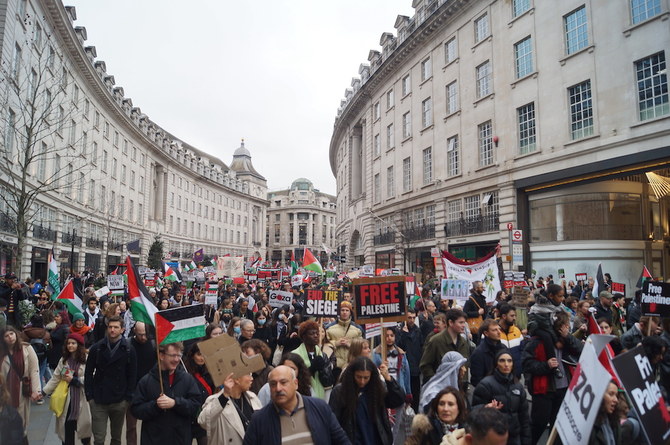
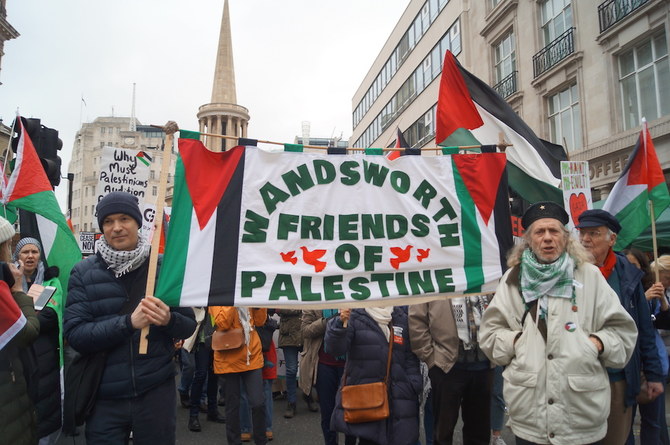
Thousands of pro-Palestinian protesters attended the eighth national march for Palestine in London on Feb. 3, 2024. (AN Photo)
2 / 10
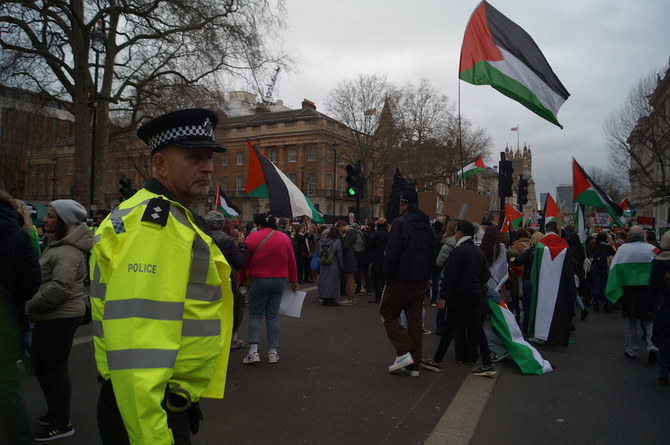
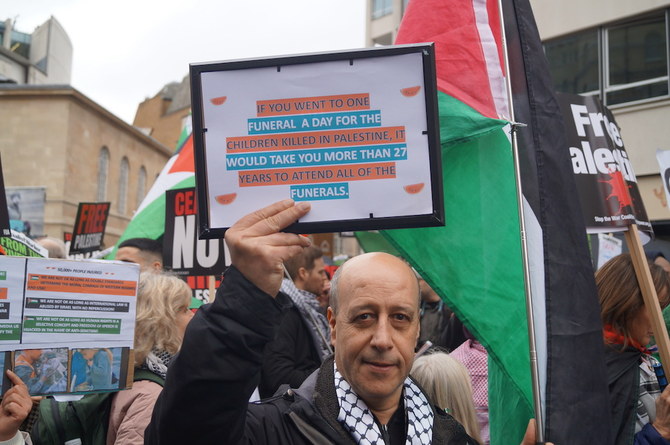
Thousands of pro-Palestinian protesters attended the eighth national march for Palestine in London on Feb. 3, 2024. (AN Photo)
3 / 10
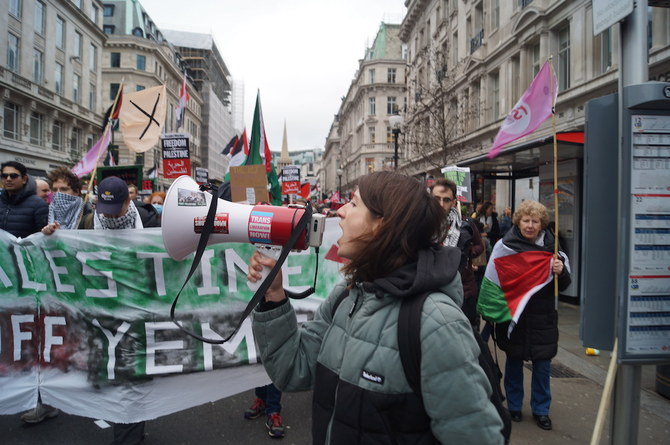
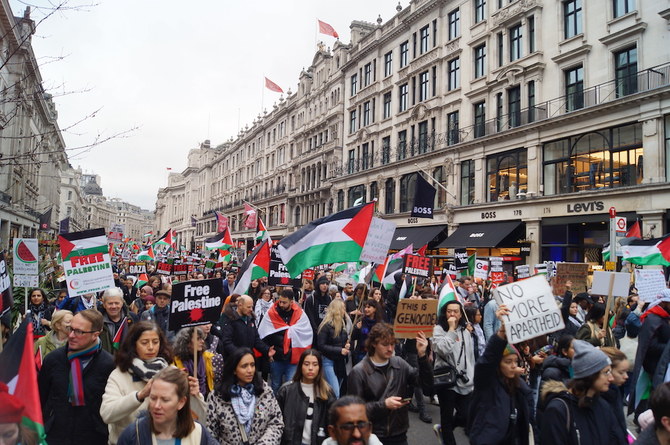
Thousands of pro-Palestinian protesters attended the eighth national march for Palestine in London on Feb. 3, 2024. (AN Photo)
4 / 10
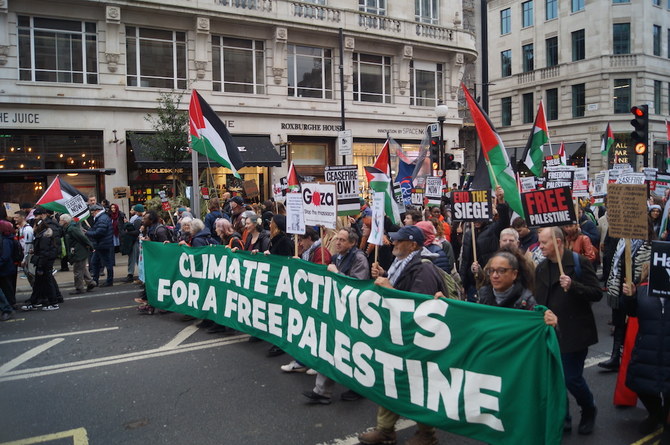
Thousands of pro-Palestinian protesters attended the eighth national march for Palestine in London on Feb. 3, 2024. (AN Photo)
5 / 10
Thousands of pro-Palestinian protesters attended the eighth national march for Palestine in London on Feb. 3, 2024. (AN Photo)
6 / 10
Thousands of pro-Palestinian protesters attended the eighth national march for Palestine in London on Feb. 3, 2024. (AN Photo)
7 / 10
Thousands of pro-Palestinian protesters attended the eighth national march for Palestine in London on Feb. 3, 2024. (AN Photo)
8 / 10
Thousands of pro-Palestinian protesters attended the eighth national march for Palestine in London on Feb. 3, 2024. (AN Photo)
9 / 10
Thousands of pro-Palestinian protesters attended the eighth national march for Palestine in London on Feb. 3, 2024. (AN Photo)
10 / 10
Thousands of pro-Palestinian protesters attended the eighth national march for Palestine in London on Feb. 3, 2024. (AN Photo)
Short Url
Updated 04 February 2024
Follow

Pro-Palestinian demonstrators in London call on UK government to end complicity with Israel’s genocide in Gaza

  • The eighth such march comes in the wake of ICJ's interim ruling against Israel

LONDON: Thousands of pro-Palestinian demonstrators marched through the streets of London on Saturday to “condemn UK government actions” in the war on Gaza and call for an immediate ceasefire, organizers said.

“This is the eighth such march and comes in the wake of the interim ruling against Israel by the International Court of Justice on Jan. 26,” the UK-based Palestinian Solidarity Campaign told Arab News.

“Not only did the ICJ find South Africa’s case — that ‘Israel …. is engaging in … genocidal acts against the Palestinian people in Gaza’ — to be plausible, it also found evidence of the risk of further acts of genocide to be sufficient for the court to order interim measures to prevent such acts,” PSC added.

“Israel has destroyed most health care services and education facilities. Far from obeying the ICJ orders, Israel continues its attacks in what constitutes an attempt at ethnic cleansing of Palestinians from Gaza,” PSC also said.

On Dec. 29, South Africa filed an application instituting proceedings against Israel concerning alleged violations in the Gaza Strip, calling on the government to “immediately suspend its military operations” in the besieged Palestinian territory.

“The ICJ found it plausible that Israel’s acts could amount to genocide and issued six provisional measures, ordering Israel to take all measures within its power to prevent genocidal acts, including preventing and punishing incitement to genocide, ensuring aid and services reach Palestinians under siege in Gaza, and preserving evidence of crimes committed in Gaza,” the Office of the High Commissioner for Human Rights said on Wednesday.

Israel’s bombardment of the Gaza Strip since Oct. 7 has claimed the lives of more than 27,000 Palestinians, including more than 11,000 children, and wounded 66,452 others. Thousands more are missing or presumed dead, while almost all of Gaza’s population has been displaced.

The ICJ has ordered Israel and its military to stop killing Palestinians, punish incitement to genocide, enable emergency assistance and restore basic services to Gaza, and take steps to ensure that possible genocide does not continue.

“The UK government’s response to this ruling has been absolutely shameful, seeking to downplay its significance and urgency,” PSC said. “An immediate response should be to suspend UK arms exports to Israel but instead the government joined other nations in suspending funding to UNRWA, which plays a crucial role in providing essential services to Palestinian refugees in Gaza and elsewhere across the region. This is unconscionable in the context of a genocide.”

UNRWA, the UN Palestinian refugee agency, said on Thursday that it may have to stop operations in Gaza and the wider Middle East region by the end of the month if funding does not resume, after more than a dozen countries, including the US, Germany, Britain and Sweden, suspended funding over allegations that 12 staff members were involved in Hamas’ surprise attack on Israel ahead of the assault.

“Such a step by the UK government opens it to the charge of being in violation of its responsibilities, as a party to the Genocide Convention, to act to ensure it is not complicit in the commission of genocide. Cutting funding to UNRWA will undeniably increase the risk of irreparable harm to the people of Gaza,” PSC said.

Ben Jamal, PSC director, said: “Israel has been committing the gravest of crimes in Gaza — genocide. It has been brought before the International Court of Justice, which having assessed the substantial body of evidence provided by South Africa, found it to be credible.

“We have been marching and protesting in our hundreds of thousands for more than three months warning of exactly this — Israel’s actions demonstrate a genocidal intent ... How long will our political leaders continue to aid and provide cover for genocide?“

The protesters on Friday marched to Whitehall to send a message to Downing Street that “the UK must end its complicity in Israel’s genocide and demand a permanent ceasefire (which) must be the starting point to address the underlying causes, including Israeli military occupation and a system of oppression against the Palestinian people that is considered internationally to meet the legal definition of apartheid,” Jamal said.

The national march, which has been organized almost every Saturday for more than three months, was organized by a coalition including the Friends of Al-Aqsa, Palestinian Forum in Britain, Stop the War Coalition, Campaign for Nuclear Disarmament, Palestine Solidarity Campaign and Muslim Association of Britain.

London’s Metropolitan Police said that the “events passed peacefully with disruption kept to a minimum” and would “always seek to work with protest organizers” to ensure disorder is prevented.

“A small number of arrests were made, two for public order offenses, one for obstructing police and one after a smoke bomb/flare was set off,” Deputy Assistant Commissioner Matt Ward from the Met Police said in a statement on X.

Ismail Patel, the chair of Friends of Al-Aqsa, said: “The ICJ findings are a warning to the British government and opposition leader Keir Starmer (that) if they continue with their unequivocal support of Israel, they will be complicit to the crimes of genocide.”

He added: “The British government must immediately stop the sale of military hardware to Israel that is charged with the crimes of genocide.

“Further, we need to continue with our campaign of calling an end to the genocide in Gaza and demand that British politicians stop supporting Israel in its genocide.”


Guinea junta strongman headed for victory in presidential vote

Updated 6 sec ago
Follow

Guinea junta strongman headed for victory in presidential vote

CONAKRY: Guineans vote in a presidential election Sunday with victory all but assured for Mamady Doumbouya, a general who led the junta that seized power in the west African country four years ago.
By running, the strongman is reneging on a pledge not to stand for office and to hand the country back to civilian rule by the end of 2024.
Instead, he has sought to silence dissent. All the main opposition leaders have been barred from standing in the election.
UN human rights chief Volker Turk said Friday the campaign had been “marked by intimidation of opposition actors, apparently politically-motivated enforced disappearances, and constraints on media freedom.”
Guinea’s opposition has called for a boycott of the vote, in a country rich in minerals but where 52 percent of the population lives in poverty, according to World Bank figures.
While long blighted by coups, Guinea experienced a democratic transition with the November 2010 election of Alpha Conde, the country’s first freely elected president. Doumbouya overthrew him in September 2021.
Under Doumbouya, Guinea effectively “reverted to what it has essentially known since independence in 1958: authoritarian regimes, whether civilian or military,” Gilles Yabi, founder of the west African think tank Wathi, told AFP.
Some 6.8 million people are eligible to choose between the nine candidates, including 41-year-old Doumbouya, who is running as an independent. Polling closes at 1800 GMT.
With his remaining rivals relatively unknown, Doumbouya looks set to win in the first round of voting.
Provisional results could be announced within two days, according to Djenabou Toure, head of the General Directorate of Elections.
The vote, which falls on the same day as general elections in Central African Republic, caps a busy electoral year in Africa — marked by authoritarianism and oppression, as well as wins by several longstanding leaders, including in Cameroon and Ivory Coast where the main rivals were also barred.

- ‘Electoral charade’ -

With the main opposition absent, Guinea’s election “does not allow for a free choice among voters” and aims to consolidate Doumbouya’s power, Yabi said.
In September, Guinea approved a new constitution in a referendum, which the opposition called on voters to boycott.
The new document allowed junta members to stand for election, paving the way for Doumbouya’s candidacy.
It also lengthened presidential terms from five to seven years, renewable once.
Unlike its neighbors Mali, Burkina Faso and Niger, which are also under military rule, Guinea has maintained good relations with former colonial master France and other international partners.
Opposition leader and former Guinean prime minister Cellou Dalein Diallo has condemned the vote as “an electoral charade” aimed at giving legitimacy to “the planned confiscation of power.”
Diallo is one of three leading opposition figures barred from standing in the vote by the new constitution.
Diallo is excluded because he lives in exile and his primary residence is not in Guinea. Former president Conde and ex-prime minister Sidya Toure, who also live in exile, are not permitted to run because they are over the maximim age limit of 80.

- Economic record -

Without the opposition figures, the election’s key stakes will be participation and credibility, Kabinet Fofana, director of Conakry-based think tank Les Sondeurs, told AFP.
It is the first time since 2006 that the vote is being organized by a government ministry, whose head is appointed by Doumbouya, rather than an independent electoral body, Fofana said.
In a social media video, Doumbouya touted his infrastructure achievements, promised to fight corruption and expressed his ambition to “make Guinea an emerging country.”
He highlighted the recent start of operations at Simandou, one of the world’s biggest iron ore mines. Yabi said that while Guineans are enthusiastic about such projects, it is not clear what “economic governance will look like” after the election.