Hamas won’t accept truce plan, hostage release unless Israel quits Gaza

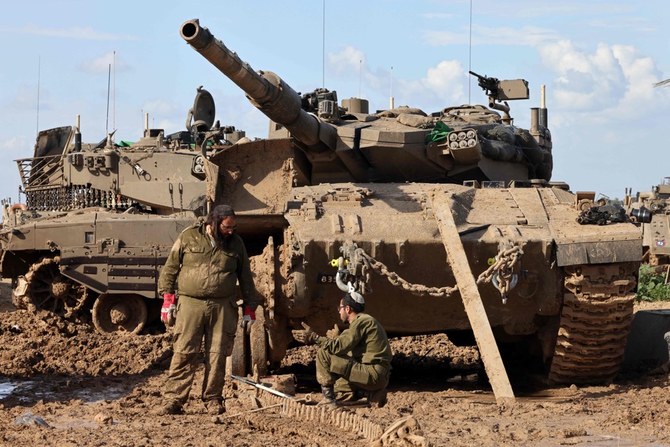
Israeli soldiers clean tank chains at a position near the border with the Gaza Strip, upon returning from a mission there on February 1, 2024, amid ongoing battles between Israel and the Palestinian militant group Hamas. (AFP)
Short Url
Updated 01 February 2024
Follow

Hamas won’t accept truce plan, hostage release unless Israel quits Gaza

  • Israel ‘must end war, quit enclave,’ says Hamas

JEDDAH: Hamas will not accept new plans for a ceasefire in Gaza and the release of hostages unless Israel commits to ending the war and quitting the enclave, a Palestinian official close to peace talks said on Thursday.

Qatari and Egyptian mediators have offered the militant group the first concrete proposal for an extended halt to fighting, agreed on by Israel and the US at talks last week in Paris.
Hamas is studying the text and preparing a response.
An initial ceasefire would last for 40 days, when fighting would cease while Hamas freed remaining civilians from about 130 Israel hostages it still holds.
In further phases, Israeli soldiers would be released, followed by the handover of the bodies of dead hostages.
“I expect that Hamas will not reject the paper, but it might not give a decisive agreement either,” the Palestinian official said.
“Instead, I expect them to send a positive response, and reaffirm their demands: for the agreement to be signed, it must ensure Israel will commit to ending the war in Gaza and pull out from the enclave completely.”
The diplomatic progress comes despite confusion over the stance of Israeli Prime Minister Benjamin Netanyahu, who is thought to need the war to continue to save his political career.
In public, Netanyahu insists that there will be no ceasefire until all the hostages are released and Hamas has been eradicated.
However, US National Security Council spokesman John Kirby said: “I can’t speak to the prime minister’s public comments, all I can tell you is that the conversations we have had in recent days with our counterparts, including Israel, lead us to believe that there is real potential progress here toward getting a deal.”
The number of Palestinians killed in the war passed 27,000 on Thursday, with thousands more uncounted bodies still under the rubble.
Israel launched a huge ground assault last week to capture the main southern city Khan Younis, which is sheltering hundreds of thousands of displaced civilians. Combat has also surged in northern areas that Israel claimed to have subdued weeks ago.
Osama Ahmed, 49, a father of five from Gaza City now sheltering in western Khan Younis along the Mediterranean coast, said there had been fierce resistance in the city, and relentless bombardment from air, ground and sea as tanks advance.
“They haven’t entered deep into Al-Mawasi where we live but everyday they get closer,” he said.
“All we want is a ceasefire now and to return to our homes, end the war and humiliation.”


Palestinian PM: Gaza reconstruction advancing amid US talks, Saudi support

In an interview with Arab News, Mohammed Mustafa said “Palestinian objective is clear,’ but we need to ‘get Gaza right first.’
Updated 21 January 2026
Follow

Palestinian PM: Gaza reconstruction advancing amid US talks, Saudi support

  • In an interview with Arab News, Mohammed Mustafa said “Palestinian objective is clear,’ but we need to ‘get Gaza right first’
  • Speaking at Davos panel, PM calls Kingdom a key stakeholder in the Palestinian cause

DAVOS: Palestinian Prime Minister Mohammed Mustafa told Arab News that progress is underway in Gaza’s reconstruction talks, with clear dialogue between the Palestinian Authority, US President Donald Trump and Special Envoy Steve Witkoff.

“I think the Palestinian objective is pretty clear, it has been for a long time, which is to establish their own independent state, (achieve) international resolution,” Mustafa said, noting that “we need to get Gaza right first.”

Despite a ceasefire taking hold earlier in 2025, Gaza remains under what the international community describes as an Israeli-enforced blockade. Basic supplies such as food and medicine are still subject to Tel Aviv’s scrutiny, which controls all access in and out of the Strip.

On Sunday, Trump announced that his Gaza plan had entered its second phase, in which Hamas would release all remaining hostages, Israel would free more Palestinian prisoners and fully withdraw its forces — a step international actors say should pave the way from ceasefire to lasting peace.

The formation of a technocratic National Committee for the Administration of Gaza, or NCAG, composed of Palestinian figures, marks the first concrete step toward implementing the plan and restoring Palestinian ownership of the next phase.

A precise timeline for reconstruction remains unclear, with analysts warning that major works hinge on Hamas disarmament — a politically fraught task assigned to the Gaza Peace Board.

“It’s going to take more than two years to fix Gaza, but at least we want to make sure that things are in the right direction,” continued Mustafa, adding that the West Bank remains part of the broader conversation.

He stressed the urgency of reunifying Gaza’s institutions with the West Bank to achieve the PA’s political goal of independence. 

“Our priority is what’s happening to our people in Gaza today. Despite four months passing (after) the ceasefire, people are still dying. Yes, there is a ceasefire but it’s not fully observed due to Israeli military actions,” he said, stressing that “shelter is the biggest challenge” at the moment.

Mustafa revealed he held “very active and useful” talks with US officials on Tuesday, saying both sides “share the same goals” on the matter.

Later in his panel, Mustafa said a Palestinian reform plan is in the works with the help of partners including Saudi Arabia.

In a session at the World Economic Forum in Davos, Mustafa said Saudi Arabia and other partners such as Egypt and Jordan were not just contributors but key stakeholders in the Palestinian cause.

“Saudi Arabia along with France have been working with us on the two state solution and integrating it,” he said.

“We want to work with the board of peace to ensure that they do their part of things to prepare for reconstruction efforts,” he added.

Mustafa said although some view the Oslo treaty as outdated, it still holds its place as an internationally recognized framework.

“According to the Oslo agreement, Israel should have withdrawn from most of the West Bank and Gaza. We want to see Israel respecting this agreement,” he said.

“The Israelis did not respect the economic part of the treaty. We are praying for a heavy price, not only in Gaza and people being killed every day. But also actions on the ground in the West Bank. We said clearly, we want to achieve our goals by peaceful means,” he said.

“Israel today holds $4 billion of our government’s money. They control the borders and collect the tax fines. For the past four months they have sent zero dollars. Our ability to govern has been impacted due to this,” Mustafa said.

In a sideline interview with Arab News, Palestinian Ambassador to Switzerland Ibrahim Mohammad Khraishi said that he met an Egyptian minister who expressed hope that the Rafah crossing could soon reopen on both sides.

“We need the understanding from all,” Khraishi said. “Yes, we have this administrative committee (as part of the Gaza Peace Board), but without the Palestinian Authority, they cannot deliver. Because we have everything. We have the institutions, we have the government,” Khraisi said.

Commenting on recent West Bank developments, including Israeli bulldozers razing the UNRWA compound in occupied East Jerusalem on Tuesday, he warned: “This is the scenario for the Israelis. For them, there is nothing to talk about. It’s total crash and destruction. Now, what they are doing in West Bank is on the way.”