ABU DHABI: Britain will not send ground troops into combat against Houthi militants in Yemen, Deputy Prime Minister Oliver Dowden said on Thursday, adding that air strikes had weakened the Iran-backed group.
The United States and Britain have, since January, hit Houthi targets in Yemen with air strikes following months of Houthi attacks on commercial and naval ships in the Red Sea. The Houthis say the attacks, which have disrupted global trade, are a response to Israel’s assault on Gaza.
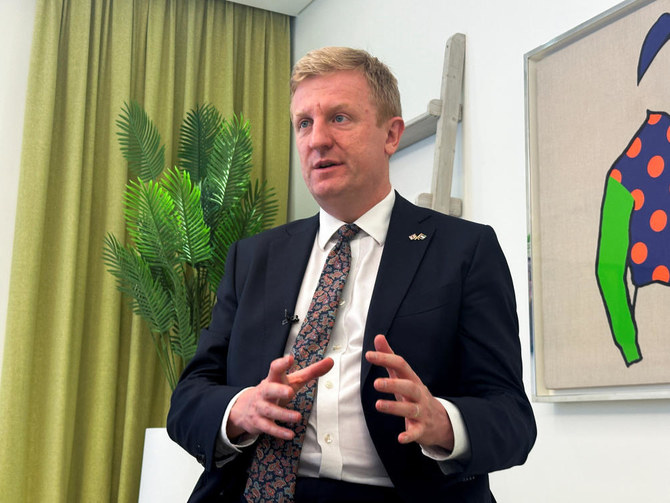
“Let’s be absolutely clear from the start. We have no plans whatsoever to put boots on the ground,” Dowden said in an interview at the British ambassador’s residence in Abu Dhabi.
He said the air strikes, which have garnered some international support, were aimed at reducing the Houthis’ ability to threaten vessels in the Red Sea and not at ousting the group, which outlasted a years-long Saudi bombing campaign.
The attacks on Red Sea shipping have raised the profile of the Yemeni movement, which took control over large parts of the impoverished country a decade ago. Many citizens in the Middle East see the Houthis as the only Arab force taking on Israel.
Major shipping lines have largely abandoned the major Red Sea trade route for longer routes around Africa. This has increased costs, sparking concerns for global inflation and sapped Egypt of crucial foreign revenue it would normally earn from shippers sailing the Suez Canal to or from the Red Sea.
Dowden said he was confident the military strikes were a step in degrading the Houthis’ capability to threaten the Red Sea, and part of broader measures that include sanctions on Houthi figures.
“We need to tighten the pressure on the Houthis because at the root of this lies a commitment from the United Kingdom to ensure stability and free trade of goods and movement.”
Britain and the US have framed their coordinated effort as having broad international support. Australia, Bahrain, Canada, the Netherlands and others have provided some material support to the campaign but have not taken part in the air strikes.
But few of London and Washington’s closest Arab partners have joined the campaign or provided any public support.
The Houthis have remained defiant. Vessels in the Red Sea continue to come under drone and missile attacks and the Houthis have issued statements goading the British and Americans with threats of targeting their naval vessels.
The British and American air strikes are also taking place amid an unrelated peace process in Yemen. The UN in December said the Houthis and other warring parties had committed to ceasefire measures and political dialogue.
Dowden described the broader regional situation as “fragile and dangerous” and urged all sides to show restraint.
This week, Iranian-backed militants were blamed for a drone attack that killed three US service members in Jordan, the first such deadly strike against US forces since the Israel-Hamas war erupted in October.

UK Deputy PM says strikes weakening Houthis, won’t send troops into Yemen
Short Url
https://arab.news/zrkhw
UK Deputy PM says strikes weakening Houthis, won’t send troops into Yemen
- "We have no plans whatsoever to put boots on the ground,” Dowden said
- He said the air strikes were aimed at reducing the Houthis’ ability to threaten vessels in the Red Sea
Trump tells Iranians ‘help on its way’
- US president says Iranians should 'keep protesting' and that he canceled all meetings with Iranian officials
- Successive nights of mass protests nationwide may have killed thousands, NGO says
PARIS: US President Donald Trump urged Iranians on Tuesday to keep protesting against the country’s theocratic leadership, telling them “help is on its way” as international outrage grows over a crackdown one rights group said has likely killed thousands.
Iranian authorities insisted they had regained control after successive nights of mass protests nationwide since Thursday that have posed one of the biggest challenges to the clerical leadership since the 1979 Islamic revolution that ousted the shah.
Rights groups accuse the government of fatally shooting protesters and masking the scale of the crackdown with an Internet blackout that has now lasted almost five days.
New videos on social media, whose location AFP verified, showed bodies lined up in the Kahrizak morgue just south of the Iranian capital, with the corpses wrapped in black bags and distraught relatives searching for loved ones.
International phone links were restored on Tuesday, but only for outgoing calls, according to an AFP journalist, and the quality remains spotty, with frequent interruptions.
Trump, who has repeatedly threatened Iran with military intervention, said Iranians should continue their nationwide protests, take over institutions and record the names of “killers and abusers.”
“Iranian Patriots, KEEP PROTESTING,” Trump wrote on his Truth Social platform. “I have canceled all meetings with Iranian Officials until the senseless killing of protesters STOPS. HELP IS ON ITS WAY.”
It was not immediately clear what meetings he was referring to or what the nature of the help would be.
European nations also signalled their anger, with France, Germany and the United Kingdom among the countries that summoned their Iranian ambassadors to protest what French Foreign Minister Jean-Noel Barrot called “state violence unquestioningly unleashed on peaceful protesters.”
“The rising number of casualties in Iran is horrifying,” said EU chief Ursula von der Leyen, vowing further sanctions against those responsible.
- ‘In the thousands’ -
The Norway-based NGO Iran Human Rights (IHR) said it had confirmed 734 people killed during the protests, including nine minors, but warned the death toll was likely far higher.
“The figures we publish are based on information received from fewer than half of the country’s provinces and fewer than 10 percent of Iran’s hospitals. The real number of those killed is likely in the thousands,” the director of Norway-based NGO Iran Human Rights (IHR) Mahmood Amiry-Moghaddam said.
Fears have also grown that the Islamic republic could use the death penalty to crack down on the protests after Tehran prosecutors said Iranian authorities will press capital charges of “moharebeh,” or “waging war against God,” against some suspects arrested over recent demonstrations.
“Concerns are mounting that authorities will once again resort to swift trials and arbitrary executions to crush and deter dissent,” Amnesty International said.
IHR highlighted the case of Erfan Soltani, 26, who was arrested last week in the Tehran satellite city of Karaj and who, according to a family source, has already been sentenced to death and is due to be executed as early as Wednesday.
Iranian state media has said dozens of members of the security forces have been killed, with their funerals turning into large pro-government rallies. Authorities have declared three days of national mourning for those killed.
Amir, an Iraqi computer scientist, returned to Baghdad on Monday and described dramatic scenes in Tehran.
“On Thursday night, my friends and I saw protesters in Tehran’s Sarsabz neighborhood amid a heavy military presence. The police were firing rubber bullets,” he told AFP in Iraq.
‘Last days’
The government on Monday sought to regain control of the streets with mass nationwide rallies that supreme leader Ayatollah Ali Khamenei hailed as proof that the protest movement was defeated, calling them a “warning” to the United States.
In power since 1989 and now 86, Khamenei has faced significant challenges, most recently the 12-day war in June against Israel, which resulted in the killing of top security officials and forced him to go into hiding.
“When a regime can only hold on to power through violence, then it is effectively finished,” said German Chancellor Friedrich Merz during a trip to India. “I believe that we are now witnessing the last days and weeks of this regime.”
Analysts, however, have cautioned that it is premature to predict the immediate demise of the theocratic system, pointing to the repressive levers the leadership has, including the Revolutionary Guards Corps (IRGC), which are charged with safeguarding the Islamic revolution.
“These protests arguably represent the most serious challenge to the Islamic republic in years, both in scale and in their increasingly explicit political demands,” Nicole Grajewski, professor at the Sciences Po Center for International Studies in Paris, told AFP.
She said it was unclear if the protests would unseat the leadership, pointing to “the sheer depth and resilience of Iran’s repressive apparatus.”
Iranian authorities insisted they had regained control after successive nights of mass protests nationwide since Thursday that have posed one of the biggest challenges to the clerical leadership since the 1979 Islamic revolution that ousted the shah.
Rights groups accuse the government of fatally shooting protesters and masking the scale of the crackdown with an Internet blackout that has now lasted almost five days.
New videos on social media, whose location AFP verified, showed bodies lined up in the Kahrizak morgue just south of the Iranian capital, with the corpses wrapped in black bags and distraught relatives searching for loved ones.
International phone links were restored on Tuesday, but only for outgoing calls, according to an AFP journalist, and the quality remains spotty, with frequent interruptions.
Trump, who has repeatedly threatened Iran with military intervention, said Iranians should continue their nationwide protests, take over institutions and record the names of “killers and abusers.”
“Iranian Patriots, KEEP PROTESTING,” Trump wrote on his Truth Social platform. “I have canceled all meetings with Iranian Officials until the senseless killing of protesters STOPS. HELP IS ON ITS WAY.”
It was not immediately clear what meetings he was referring to or what the nature of the help would be.
European nations also signalled their anger, with France, Germany and the United Kingdom among the countries that summoned their Iranian ambassadors to protest what French Foreign Minister Jean-Noel Barrot called “state violence unquestioningly unleashed on peaceful protesters.”
“The rising number of casualties in Iran is horrifying,” said EU chief Ursula von der Leyen, vowing further sanctions against those responsible.
- ‘In the thousands’ -
The Norway-based NGO Iran Human Rights (IHR) said it had confirmed 734 people killed during the protests, including nine minors, but warned the death toll was likely far higher.
“The figures we publish are based on information received from fewer than half of the country’s provinces and fewer than 10 percent of Iran’s hospitals. The real number of those killed is likely in the thousands,” the director of Norway-based NGO Iran Human Rights (IHR) Mahmood Amiry-Moghaddam said.
Fears have also grown that the Islamic republic could use the death penalty to crack down on the protests after Tehran prosecutors said Iranian authorities will press capital charges of “moharebeh,” or “waging war against God,” against some suspects arrested over recent demonstrations.
“Concerns are mounting that authorities will once again resort to swift trials and arbitrary executions to crush and deter dissent,” Amnesty International said.
IHR highlighted the case of Erfan Soltani, 26, who was arrested last week in the Tehran satellite city of Karaj and who, according to a family source, has already been sentenced to death and is due to be executed as early as Wednesday.
Iranian state media has said dozens of members of the security forces have been killed, with their funerals turning into large pro-government rallies. Authorities have declared three days of national mourning for those killed.
Amir, an Iraqi computer scientist, returned to Baghdad on Monday and described dramatic scenes in Tehran.
“On Thursday night, my friends and I saw protesters in Tehran’s Sarsabz neighborhood amid a heavy military presence. The police were firing rubber bullets,” he told AFP in Iraq.
‘Last days’
The government on Monday sought to regain control of the streets with mass nationwide rallies that supreme leader Ayatollah Ali Khamenei hailed as proof that the protest movement was defeated, calling them a “warning” to the United States.
In power since 1989 and now 86, Khamenei has faced significant challenges, most recently the 12-day war in June against Israel, which resulted in the killing of top security officials and forced him to go into hiding.
“When a regime can only hold on to power through violence, then it is effectively finished,” said German Chancellor Friedrich Merz during a trip to India. “I believe that we are now witnessing the last days and weeks of this regime.”
Analysts, however, have cautioned that it is premature to predict the immediate demise of the theocratic system, pointing to the repressive levers the leadership has, including the Revolutionary Guards Corps (IRGC), which are charged with safeguarding the Islamic revolution.
“These protests arguably represent the most serious challenge to the Islamic republic in years, both in scale and in their increasingly explicit political demands,” Nicole Grajewski, professor at the Sciences Po Center for International Studies in Paris, told AFP.
She said it was unclear if the protests would unseat the leadership, pointing to “the sheer depth and resilience of Iran’s repressive apparatus.”
© 2026 SAUDI RESEARCH & PUBLISHING COMPANY, All Rights Reserved And subject to Terms of Use Agreement.


