Norway ‘reasonably optimistic’ funding to UNRWA can get back on track

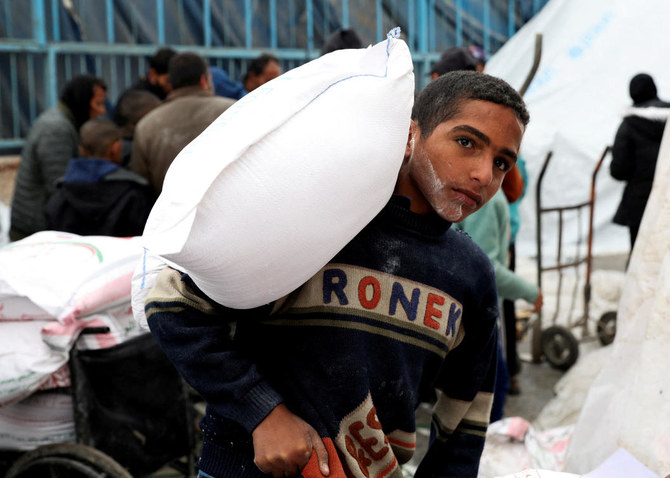
A Palestinian boy carries a bag of flour distributed by UNRWA, amid the ongoing conflict between Israel and Hamas, in Rafah on Jan. 29, 2024. (Reuters)
Short Url
Updated 01 February 2024
Follow

Norway ‘reasonably optimistic’ funding to UNRWA can get back on track

  • “I am reasonably optimistic that we will get funding back on track,” Barth Eide
  • The Nordic country said it was urging countries that have paused funding to the agency to consider the consequences of their actions

OSLO/JERUSALEM: Norwegian Foreign Minister Espen Barth Eide told Reuters on Thursday he was “reasonably optimistic” some countries that had paused funding to the UN agency for Palestinian refugees (UNRWA) would resume payments.
UNRWA on Thursday said its entire operations in the Middle East, not only in Gaza, will most likely be forced to shut down by the end of February if its funding remains suspended.
“I am reasonably optimistic that we will get funding back on track,” Barth Eide said in an interview.
He said “many countries” were realizing that the current situation could not last very long. He declined to name specific countries.
“They’re looking for a way out. And maybe if now UNRWA comes up quickly with a good response, which is accepted as serious, they will then happily restart,” said the minister.
“Because I think we hear from several governments, and also governments who have been vocal publicly about the need to suspend, that they understand the very, very serious consequences.”
The Nordic country, a top donor to UNRWA, said on Wednesday it was urging countries that have paused funding to the agency to consider the consequences of their actions on the population in Gaza.
Oslo is maintaining its funding following accusations that some agency staff took part in the Oct. 7 attack by Hamas militants, in contrast to several other countries.
Asked whether he was speaking with his counterpart in Sweden, a top UNRWA donor that paused funding and is a close Norway ally, he said: “I’ll be very careful about mentioning individuals. But of course, we talk to our close friends.”
Meanwhile, in Israel, Defense Minister Yoav Gallant described UNRWA as “Hamas with a facelift,” when briefing a visiting delegation of ambassadors to the UN, according to a statement from his office.
An Israeli government spokesperson reiterated Prime Minister Benjamin Netanyahu’s call for UNRWA to be replaced with other aid agencies, and urged countries to start work on this.
“The UN already has aid agencies with expertise in emergency relief in conflict zones. To date, however, they have been prevented from operating from Gaza because of UNRWA’s monopoly,” the spokesperson, Eylon Levy, said in a briefing.
“These viable alternatives must be developed now so that aid can be distributed effectively and professionally instead of being routed through an agency that is not just compromised by terrorists, but failing to do its job.”


First responders enter devastated Aleppo neighborhood after days of deadly fighting

Updated 10 sec ago
Follow

First responders enter devastated Aleppo neighborhood after days of deadly fighting

  • The US-backed SDF, which have played a key role in combating the Daesh group in large swaths of eastern Syria, are the largest force yet to be absorbed into Syria’s national army

ALEPPO, Syria: First responders on Sunday entered a contested neighborhood in Syria’ s northern city of Aleppo after days of deadly clashes between government forces and Kurdish-led forces. Syrian state media said the military was deployed in large numbers.
The clashes broke out Tuesday in the predominantly Kurdish neighborhoods of Sheikh Maqsoud, Achrafieh and Bani Zaid after the government and the Syrian Democratic Forces, the main Kurdish-led force in the country, failed to make progress on how to merge the SDF into the national army. Security forces captured Achrafieh and Bani Zaid.
The fighting between the two sides was the most intense since the fall of then-President Bashar Assad to insurgents in December 2024. At least 23 people were killed in five days of clashes and more than 140,000 were displaced amid shelling and drone strikes.
The US-backed SDF, which have played a key role in combating the Daesh group in large swaths of eastern Syria, are the largest force yet to be absorbed into Syria’s national army. Some of the factions that make up the army, however, were previously Turkish-backed insurgent groups that have a long history of clashing with Kurdish forces.
The Kurdish fighters have now evacuated from the Sheikh Maqsoud neighborhood to northeastern Syria, which is under the control of the SDF. However, they said in a statement they will continue to fight now that the wounded and civilians have been evacuated, in what they called a “partial ceasefire.”
The neighborhood appeared calm Sunday. The United Nations said it was trying to dispatch more convoys to the neighborhoods with food, fuel, blankets and other urgent supplies.
Government security forces brought journalists to tour the devastated area, showing them the damaged Khalid Al-Fajer Hospital and a military position belonging to the SDF’s security forces that government forces had targeted.
The SDF statement accused the government of targeting the hospital “dozens of times” before patients were evacuated. Damascus accused the Kurdish-led group of using the hospital and other civilian facilities as military positions.
On one street, Syrian Red Crescent first responders spoke to a resident surrounded by charred cars and badly damaged residential buildings.
Some residents told The Associated Press that SDF forces did not allow their cars through checkpoints to leave.
“We lived a night of horror. I still cannot believe that I am right here standing on my own two feet,” said Ahmad Shaikho. “So far the situation has been calm. There hasn’t been any gunfire.”
Syrian Civil Defense first responders have been disarming improvised mines that they say were left by the Kurdish forces as booby traps.
Residents who fled are not being allowed back into the neighborhood until all the mines are cleared. Some were reminded of the displacement during Syria’s long civil war.
“I want to go back to my home, I beg you,” said Hoda Alnasiri.