

Bodies of nine Pakistanis killed by unknown gunmen in Iran repatriated

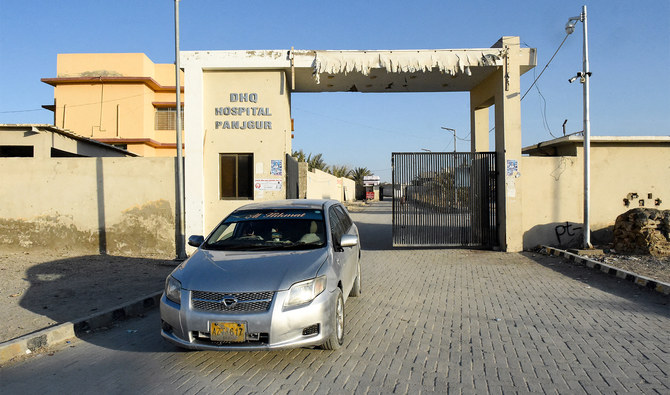
A car leaves the district headquarter hospital (DHQ) in Panjgur town of Pakistan's Balochistan province on January 17, 2024. (AFP/File)
Short Url
Updated 01 February 2024
Follow

Bodies of nine Pakistanis killed by unknown gunmen in Iran repatriated

  • It was still unclear who was behind the attack Saturday in a home in Iran’s Sistan-Baluchestan province 
  • Tehran handed over the bodies of the slain men at the Taftan border crossing, a Pakistani official says 

QUETTA: The bodies of nine Pakistani laborers killed by gunmen in Iran last week were repatriated to their home country Thursday. 

It was still unclear who was behind the attack Saturday in a home in Iran’s Sistan and Baluchestan province. Three Pakistanis wounded in the attack were still being treated at an Iranian hospital. 

Tehran handed over the bodies of the slain men at the Taftan border crossing, local government administrator Waqar Kakar said. He said the bodies were being flown to the city of Multan and will be sent from there to their hometowns. 

The killings occurred as tensions erupted between Pakistan and Iran after Pakistan launched retaliatory strikes inside Iran that were said to be targeting militant hideouts and killed at least nine people. An Iranian attack against alleged militant hideouts inside Pakistan killed two children in southwestern Baluchistan province. 

Following the tit-for-tat attacks, both sides agreed Monday to improve their security cooperation. 

The attacks appeared to target two Baluch militant groups with similar separatist goals. The two countries have accused each other of providing safe haven to the groups in their respective territories. 


EU criticizes Pakistan over jailing of rights lawyers, flags free speech concerns

Updated 24 min 3 sec ago
Follow

EU criticizes Pakistan over jailing of rights lawyers, flags free speech concerns

  • EU says the convictions of Imaan Mazari-Hazir, Hadi Ali Chattha violate freedom of expression
  • Both lawyers were arrested last week over social media posts under Pakistan’s cybercrime laws

KARACHI: The European Union on Thursday criticized Pakistan over the conviction of two human rights lawyers for their social media activity, saying the ruling ran counter to freedom of expression and the independence of the legal profession, core democratic principles that Islamabad is committed to uphold under international law.

Imaan Mazari-Hazir and her husband Hadi Ali Chattha were arrested last Friday as they were on their way to a court appearance and were later remanded to two weeks in judicial custody.

Authorities accused them of violating the Prevention of Electronic Crimes Act (PECA) over posts on X that they said incited ethnic divisions and portrayed the military as being involved in “terrorism.” Both deny the allegations.

“The conviction of human rights lawyers Imaan Mazari and Hadi Ali Chattha over social media activity goes against freedom of expression and independence of lawyers,” Anouar El Anouni, the EU’s spokesperson for foreign affairs and security policy, said in a post on X. “These are not only key democratic principles but also part of Pakistan’s international human rights commitments.”

Pakistan is one of the largest beneficiaries of the EU’s Generalized Scheme of Preferences Plus (GSP+), which grants duty-free access to most European markets in return for implementing 27 international conventions covering human rights, labor standards, environmental protection and good governance.

Pakistan’s GSP+ status came under scrutiny in the past after, in April 2021, the European Parliament adopted a resolution calling for an immediate review, citing concerns over violence against religious minorities, curbs on media freedom and broader human rights issues.

Earlier this week, lawyers in Pakistan’s capital went on strike and announced plans to stage a protest against the court ruling, which handed Mazari-Hazir and Chattha a cumulative 17-year sentence.

The Pakistani government has not yet responded to the EU statement.