

High turnover of players is price to pay for the appeal of tournaments like DP World ILT20

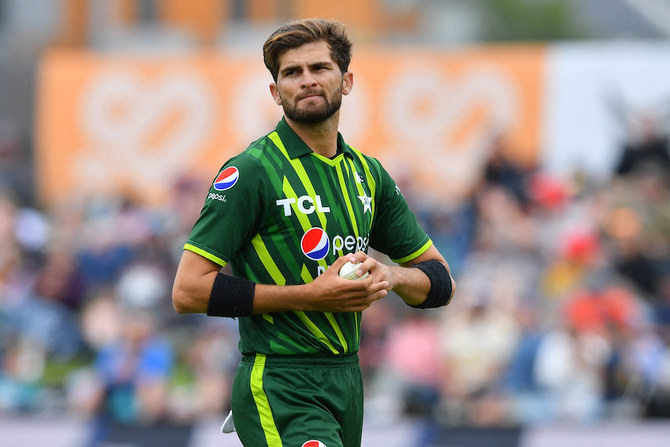
Shaheen Shah Afridi is currently captain of Pakistan’s T20I team and a high-quality left-arm quick bowler. (AFP)
Short Url
Updated 01 February 2024
Follow

High turnover of players is price to pay for the appeal of tournaments like DP World ILT20

  • Franchise competitions are introducing several coping measures to address unexpected international call-ups, injuries and scheduling issues

At the halfway stage of the group matches in the DP World ILT20, reached on Jan. 30, the table was topped by the MI Emirates, with four wins out of six matches and eight points. In second were the Sharjah Warriors on six points with three wins from five matches.

Each team plays each other twice in the group stage. Notably, the captain winning the toss has chosen to field in 13 of the 15 matches.

Prior to the 15th match, the Desert Vipers lay at the foot of the table, somewhat surprisingly, given that the team made the final in 2023. They will need a run of victories if they are to finish in the top four teams which then contest the knockout stage.

The Vipers’ squad appeared to have been strengthened by the addition of four leading Pakistani players.

Shaheen Shah Afridi is currently captain of Pakistan’s T20I team and a high-quality left-arm quick bowler. Mohammad Amir is also a left-arm quick bowler, currently retired from international cricket. Shadab Khan is a right-arm leg-spin bowler, who, on March 27, 2023, became the first Pakistani male cricketer to take 100 T20I wickets for his country. Azam Khan is an aggressive batter/wicketkeeper who made his debut for Pakistan in 2021.

Each one should bring extra quality. A characteristic of ILT20 is that players come and go. Afridi, for example, was playing for Pakistan in New Zealand until Jan. 14. It takes a while for the players to assimilate into a squad. All four players will participate in the Pakistan Super League. This starts on Feb. 17, the same day as the ILT20 final. Thus, after only a handful of matches, the four players will be off to Pakistan. This creates upheaval for coaches and for the team. The Vipers’ future performances will hinge on how well those players, who have not featured much so far, fill the gap.

The same will apply to other teams. Shamar Joseph, fresh from his exploits for the West Indies in Australia, was due to join the Dubai Capitals. However, the toe injury which he sustained in Brisbane necessitates treatment and he will miss out. Such is the sudden demand for his services that he has been signed up by PSL team, Peshawar Zalmi.

In order to address player movement, unexpected call-ups to international squads, injuries and scheduling issues, the franchise tournaments are introducing coping measures. The PSL held a conference call to facilitate its replacement and supplementary draft on Jan. 29. The fluidity of the measure was illustrated by Zalmi announcing a replacement player who is currently on England duty in India. The tour is not scheduled to end until March 12. Joesph’s signing was announced on social media, separate to the draft. All very different from the days when team and squad selections were awaited with great expectancy by wireless.

Another coping measure was introduced this year for the ILT20. This is a non-mandatory wildcard. Each franchise is allowed, within spending conditions, to sign two players on this basis at any point during the season. Two other franchise leagues allow the wildcard — the Hundred and SA20.

The first use of the ILT20 wildcard was made by the MI Emirates, who announced the signing of Tim David before the league began. David has played for the Mumbai Indians in India, MI Cape Town in SA20 and MI New York. England’s Dan Lawrence was signed by the Desert Vipers but, after playing one match, was called up by England for India duty. It is not unreasonable to expect more wildcards in the second half of the league.

Although the MI Emirates lead the table at the midpoint, the teams in third to sixth all had four points, separated by net run rate. This should create an exciting second half of the group stage with any team showing itself capable of beating the others. The MI Emirates have two of the top three leading run scorers in West India’s Nicholas Pooran and the UAE’s Waseem Mohammad, who leads with 204 runs and a top score of 89 not out. Johnson Charles of the West Indies is in second place. Another UAE player, Alishan Sharafu, has made an impression in scoring 145 runs for the Abu Dhabi Knight Riders, with a match-winning top score of 82.

On the bowling front, Fazalhaq Farooqi of Afghanistan has claimed 12 wickets for the MI Emirates, followed by Maheesh Theekshana of the Sharjah Warriors with 11, and then Trent Boult of the MI Emirates and Daniel Sams of the Sharjah Warriors, both with 10. Five of the top 10 wicket takers are with the MI Emirates. This, coupled with three scores in excess of 170, goes a long way to explaining why they lead the way.

Much was made of an exodus of players from Australia’s Big Bash League to join the ILT20, before the BBL finals had started. This did put a dampener on the BBL and has caused discussion on ways to reduce the impact of such player movement. This is unlikely to be easy. Although the BBL was rejuvenated in 2023/2024, with a shorter season being matched by an uplift in average crowds of just over a quarter, its pay for top players, despite a 25 percent increase, is still below par with other offers.

The onus to shift the balance looks to lie with the BBL. The league is set to enter a consultation process. On the table are likely to be discussions over longer contracts, changes to the draft system and a further reduction to the schedule. Any change has a single purpose of making the BBL more attractive to more top overseas players. In turn, this boosts crowds and drives higher international broadcast revenues, an imperative in modern cricket.

It seems that the appeal of spending a summer month in Australia, playing in front of large, enthusiastic crowds, for not unreasonable returns, comes second-best to higher returns on offer elsewhere.


T20 cricket set to dominate game’s landscape in 2026

Updated 22 January 2026
Follow

T20 cricket set to dominate game’s landscape in 2026

  • Inexorable rise of one of sport’s controlling forces

Following the end of the Ashes series in Australia, it has not taken long for cricket’s longest format — Test cricket — to be overwhelmed by the T20 format.

Apart from the 50-over Under-19s World Cup taking place in Namibia, it seems that, wherever one turns, there are only T20 tournaments.

Two explanations for this situation are the looming ICC Men’s and Women’s World Cups. The men’s event, to be jointly hosted by India and Sri Lanka, starts on Feb. 7, while the women’s tournament starts on June 12 in England.

The women’s event will comprise 12 teams, the largest number ever, of which eight have qualified already. The other four will emerge from 10 teams competing in a qualifying tournament in Nepal. This began on Jan. 18 and will end on Feb. 1. The teams have been divided into two groups of five and will play each other once. Group A comprises Bangladesh, Ireland, Namibia, Papua New Guinea and the US, with the Netherlands, Nepal, Scotland, Thailand and Zimbabwe in Group B. The top three teams will qualify for the Super Six stage in which the three teams from Group A will play the three teams from Group B. Points earned against the other two qualifying teams from each group are carried forward. The top four teams at the end of the Super Six will qualify for the World Cup in June.

The four highest-ranked teams in the competition are Ireland, Bangladesh, Scotland and Thailand. They are expected to progress to the Super Sixes but it remains to be seen if each of them will reach the main event in June. Thailand will probably face tough challenges against Ireland and Bangladesh in the Super Six stage. The Thai team are in good form, having triumphed in the ICC Women’s Emerging Nations Trophy and won double gold medals in the women’s cricket competitions in the SE Asia Games at the end of 2025. This form has continued into the tournament with victories over Nepal and Zimbabwe, but sterner tests lie ahead.

Players who are squad members of teams who have qualified for the World Cup are warming up in different ways. A number are currently involved in India’s Women’s Premier League, which is halfway into its schedule and will conclude on Feb. 5. In New Zealand, the Women’s Super Smash concludes on Jan. 31, while in South Africa the CSA Women’s Pro20 will resume on Feb. 8. There are upcoming bilateral tours by India to Australia in late February, Pakistan to South Africa in February, Zimbabwe to New Zealand in March, followed by South Africa. No doubt other matches will be arranged once the identity of the final four qualifying teams is known. Immediately prior to the World Cup, formal warm-up matches will take place at three venues in England and Wales.

The need for preparation is even more pressing for those involved in the men’s T20 World Cup, which comprises 20 teams. The Big Bash League in Australia allows four overseas players in each 18-man squad. In 2025/26, English players represent the bulk of non-Australian players, followed by players from Pakistan and New Zealand. The South African World Cup players are fully engaged in SA20, in which 19-man squads are allowed to contain seven overseas players, four of whom can be selected for a playing 11. English players are well represented. The Bangladesh Premier League will conclude on Jan. 23. Indian players with central contracts are not allowed to participate in franchise leagues outside India. Their World Cup players will feature in a T20 series against New Zealand that started on Jan. 21 in Nagpur. It followed an ODI series which was won by New Zealand. England start a three-match T20 series against Sri Lanka on Jan. 30, following three ODIs.

Outside of the leading countries, it can be difficult for players and teams to gain enough game-time preparation. Some of the UAE players participated in the DP World ILT20. Their next international action is a two-match series on Jan. 29 and 31 against Ireland in Dubai, where Afghanistan currently have a three-match T20 series against the West Indies, who then play a series against South Africa. Ireland will remain in Dubai where they will play three T20 matches against Italy, who are making their first appearance in a World Cup.

Australia will visit Pakistan and play three T20 matches. Teams such as the US, Canada, Oman, Nepal, Namibia and the Netherlands appear to have limited match preparation opportunities.

At least they do not face the uncertainties of Bangladesh. In early January, in a further example of the use of cricket as a political weapon, the Indian authorities excluded the Bangladeshi cricketer Mustafizur Rahman from the 2026 Indian Premier League, amid rising tensions between the two countries. Rahman had been bought at auction by the Kolkata Knight Riders franchise, which is owned by Shah Rukh Khan, the Indian actor and film producer, who was born into a Muslim family. Following this decision, the Bangladesh Cricket Board requested that the International Cricket Council move matches involving Bangladesh in the T20 World Cup out of India, citing the “safety and well-being of the players.”

Discussions ensued between the parties. Independent security assessments were commissioned by the ICC, along with comprehensive venue-level security plans and formal assurances from the host authorities. These were shared with the BCB. All assessments consistently concluded that “there is no credible or verifiable threat to the safety or security of the Bangladesh team in India.” On Jan. 17, the BCB suggested a swap of their matches with those of Ireland, whose group matches are to be played in Sri Lanka. The suggestion was rejected. At an emergency meeting of the ICC’s board on Jan. 21, 14 out of the 16 members voted against Bangladesh’s request. It is assumed that, apart from Bangladesh, the other vote in favour was from Pakistan.

It appears that the BCB’s attempt at a hardline stance has backfired. It must now either accept to play in India or withdraw from the competition, with significant loss of face either way. If it withdraws, a replacement team need to be introduced. The next-best-ranked T20I team are Scotland, who will have even less time to prepare than the other 19 teams.

Once again, a major international tournament has been disrupted by geopolitics. It is also the case that, once again, almost everyone has fallen in behind the combined power of the ICC and the Indian board. This stranglehold and the inexorable rise of T20 cricket are now undoubtedly the controlling forces shaping cricket’s future landscape.