

Houthis claim attack on US Navy ship in Gulf of Aden

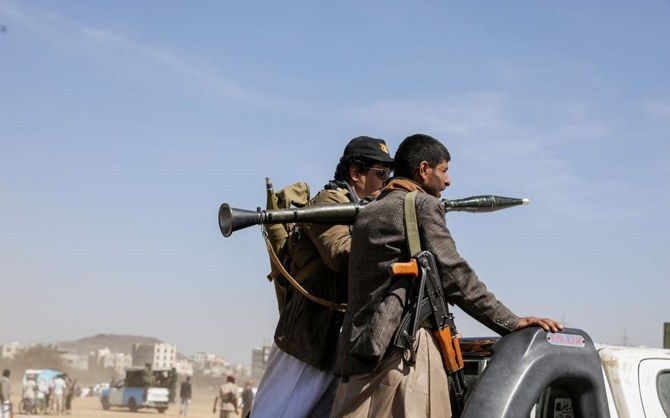
Houthi fighters on the back of a pick-up truck during a parade in support of strikes on ships in the Red Sea and the Gulf of Aden, Sanaa, Yemen, Jan. 29, 2024. (Reuters)
Short Url
Updated 29 January 2024
Follow

Houthis claim attack on US Navy ship in Gulf of Aden

  • Houthi naval troops fired an anti-ship missile at the USS Lewis B. Puller as it traveled in the Gulf of Aden
  • Yemeni leader Rashad Al-Alimi urges EU to declare Houthis as terrorists during talks with envoy

AL-MUKALLA: Yemen’s Houthi militia on Monday said they fired a missile at a US Navy ship in the Gulf of Aden, vowing to continue their attacks on ships in the Red Sea, Bab Al-Mandab, and the Gulf.

Houthi military spokesperson Yahiya Sarae said that Houthi naval troops fired an anti-ship missile at the USS Lewis B. Puller as it traveled in the Gulf of Aden. Sarae said the attack was retribution for US and UK bombings in Yemen and in solidarity with the “oppressed” Palestinians.

“The targeting procedure is part of the Yemeni armed forces’ military actions in defense of Yemen and evidence of their determination to help the oppressed Palestinian people,” Sarae said.

Despite the Houthi’s claims, neither the US Central Command nor the UK’s Maritime Trade Operations agency, which monitors Houthi assaults on ships, reported any fresh strikes in the waters off Yemen over the past 24 hours.

Since November, the Houthis have seized a commercial ship known as Galaxy Leader and fired dozens of drones and missiles against commercial ships in the region, which they say is to push Israel to cease operations in Gaza.

The attacks have pushed the US to lead a coalition to protect international trade lines off Yemen, carrying out dozens of attacks on Houthi-controlled regions and reclassifying the group as terrorists.

The Houthis have said that neither the coalition attacks nor the new designation will stop them from preventing all Israel-bound ships passing through the Red Sea.

“Neither America nor anybody else will be able to prevent Yemen from meeting its humanitarian and moral obligations towards the tortured people of Gaza,” chief Houthi negotiator Mohammed Abdulsalam said on social media platform X on Sunday.

Experts believe the Houthis continue to attack ships to remain in the spotlight and keep the US involved in the region, as they are aware that the administration of President Joe Biden will not deploy troops to Yemen during an election year.

Elisabeth Kendall, a Middle East expert and head of Girton College at the University of Cambridge, told Arab News that the current exchange of strikes between the Houthis and the US may escalate into an aggressive US bombardment of Yemen and may also see the Houthis intensify their own attacks.

“As long as there is no ceasefire in Gaza, the Houthis can position themselves as having rightson their side,” she said.

“The more the US bombs them, the more they can justify their own expansion of operations — as long as they still retain capability, which looks to be the case. We may already be in a spiral.”

Meanwhile, the chairman of Yemen’s Presidential Leadership Council, Rashad Al-Alimi, urged the EU on Monday to declare the Houthis terrorists.

The official news agency SABA reported that Al-Alimi discussed the UN-brokered peace efforts with the EU Ambassador to Yemen Gabriel Munuera Vinals in Riyadh, as well as the impact of the Houthi attacks on Yemen’s oil terminals and the EU’s economic support for the Yemeni government.


US makes plans to reopen embassy in Syria after 14 years

Updated 21 February 2026
Follow

US makes plans to reopen embassy in Syria after 14 years

  • The administration has been considering re-opening the embassy since last year
  • Trump told reporters on Friday that Al-Sharaa was “doing a phenomenal job” as president

WASHINGTON: The Trump administration has informed Congress that it intends to proceed with planning for a potential re-opening of the US Embassy in Damascus, Syria, which was shuttered in 2012 during the country’s civil war.
A notice to congressional committees earlier this month, which was obtained by The Associated Press, informed lawmakers of the State Department’s “intent to implement a phased approach to potentially resume embassy operations in Syria.”
The Feb. 10 notification said that spending on the plans would begin in 15 days, or next week, although there was no timeline offered for when they would be complete or when US personnel might return to Damascus on a full-time basis.
The administration has been considering re-opening the embassy since last year, shortly after longtime strongman Bashar Assad was ousted in December 2024, and it has been a priority for President Donald Trump’s ambassador to Turkiye and special envoy for Syria, Tom Barrack.
Barrack has pushed for a deep rapprochement with Syria and its new leadership under former rebel Ahmad Al-Sharaa and has successfully advocated for the lifting of US sanctions and a reintegration of Syria into the regional and international communities.
Trump told reporters on Friday that Al-Sharaa was “doing a phenomenal job” as president. “He’s a rough guy. He’s not a choir boy. A choir boy couldn’t do it,” Trump said. “But Syria’s coming together.”
Last May, Barrack visited Damascus and raised the US flag at the embassy compound, although the embassy was not yet re-opened.
The same day the congressional notification was sent, Barrack lauded Syria’s decision to participate in the coalition that is combating the Daesh militant group, even as the US military has withdrawn from a small, but important, base in the southeast and there remain significant issues between the government and the Kurdish minority.
“Regional solutions, shared responsibility. Syria’s participation in the D-Daesh Coalition meeting in Riyadh marks a new chapter in collective security,” Barrack said.
The embassy re-opening plans are classified and the State Department declined to comment on details beyond confirming that the congressional notification was sent.
However, the department has taken a similar “phased” approach in its plans to re-open the US Embassy in Caracas, Venezuela, following the US military operation that ousted former President Nicolás Maduro in January, with the deployment of temporary staffers who would live in and work out of interim facilities.