

Pakistan, Iran resolve to consolidate ties, address common challenges after tit-for-tat strikes

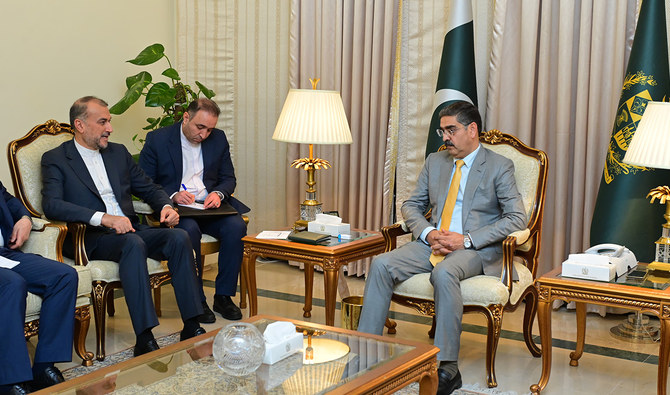
Iranian Foreign Minister Amir Abdollahian (L) speaks during a meeting with the Caretaker Pakistan Prime Minister Anwaar-ul-Haq Kakar in Islamabad, Pakistan on January 29, 2024. (Photo courtesy: PMO)
Short Url
Updated 29 January 2024
Follow

Pakistan, Iran resolve to consolidate ties, address common challenges after tit-for-tat strikes

  • The development comes amid high-level engagements between Iranian FM, Pakistani civilian and military leaders
  • Both sides agree to operationalize mechanism for deployment of military liaison officers to respond to common threats

ISLAMABAD: Pakistan and Iran on Monday resolved to consolidate ties and address common challenges through cooperation, the Pakistan prime minister’s office said, amid high-level meetings by the Iranian foreign minister during his ongoing visit to Islamabad.

The visit by the Iranian FM Hossein Amir Abdollahian comes less than two weeks after both countries traded missile strikes aimed at what they said were militant targets inside each other’s territory.

The strikes were the highest-profile cross-border intrusions between Pakistan and Iran in recent years and raised concerns about another conflict in the Middle East since Israel waged a war against Hamas on Oct. 7.

On Monday, FM Abdollahian held a series of high-level meetings, including with Pakistan PM Anwaar-ul-Haq Kakar, FM Jalil Abbas Jilani and Army Chief General Asim Munir, in an attempt to mend ties after the tit-for-tat strikes


Iranian Foreign Minister Amir Abdollahian (right) shakes hands with the Caretaker Pakistan Prime Minister Anwaar-ul-Haq Kakar in Islamabad, Pakistan on January 29, 2024. (Photo courtesy: PMO)

In his meeting with the Iranian foreign minister, PM Kakar underscored close relations between both countries and stressed the need for a collaborative approach to common challenges.

“The Prime Minister reaffirmed Pakistan’s commitment to further consolidate bilateral ties,” PM Kakar’s office said in a statement after the meeting. “The Prime Minister also emphasized the need to address common challenges through collaborative and cooperative approaches, rooted in the respect for international law and the principles of the UN Charter, in particular, territorial integrity and sovereignty of both Pakistan and Iran.”

The strikes took place in the porous border region of Baluchestan, which is divided between Pakistan, Iran and Afghanistan, and has long been the scene of sporadic clashes between security forces and separatist militants and smugglers.

However, the two countries quickly moved to de-escalate tensions and sent their ambassadors, who were recalled after the strikes, to their respective postings last week, followed by FM Abdollahian’s visit to Islamabad on Sunday.

In his joint media briefing with his Pakistani counterpart Jilani on Monday, the Iranian FM said there was “no doubt” militants harboring along a shared border with Pakistan were supported by “third countries” as both neighbors agreed to form a foreign ministerial-level advisory body to review bilateral cooperation and challenges.
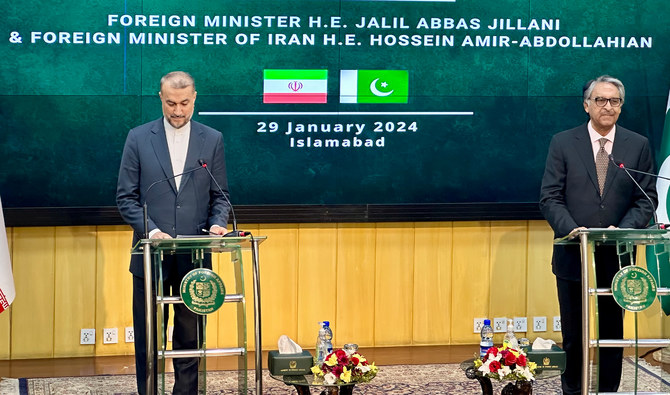


Pakistan's Foreign Minister Jalil Abbas Jilani (R) holds a joint press conference with his Iranian counterpart Hossein Amir-Abdollahian (L) at the Ministry of Foreign Affairs in Islamabad on January 29, 2024. (AN photo)

Pakistan has long accused rivals and neighboring Afghanistan and India of stoking unrest in its southwestern Balochistan province that borders Iran. Both deny the charge.

“We consider Pakistan’s security as a brotherly friendly and neighborly country as the security of the Islamic Republic of Iran, and the security of the whole region,” Abdollahian said.

“We have agreed to establish a high-ranking advisory committee at the level of the ministers of foreign affairs of the two countries, alternatively to meet in Islamabad and Pakistan,” he said, adding the committee would “oversee the progress that is being made in various areas of cooperation.”

In a separate meeting with Pakistan’s army chief, both sides emphasized on strengthening bilateral ties and fostering greater understanding of each other’s concerns, according to the Inter-Services Public Relations (ISPR), the Pakistani military’s media wing.
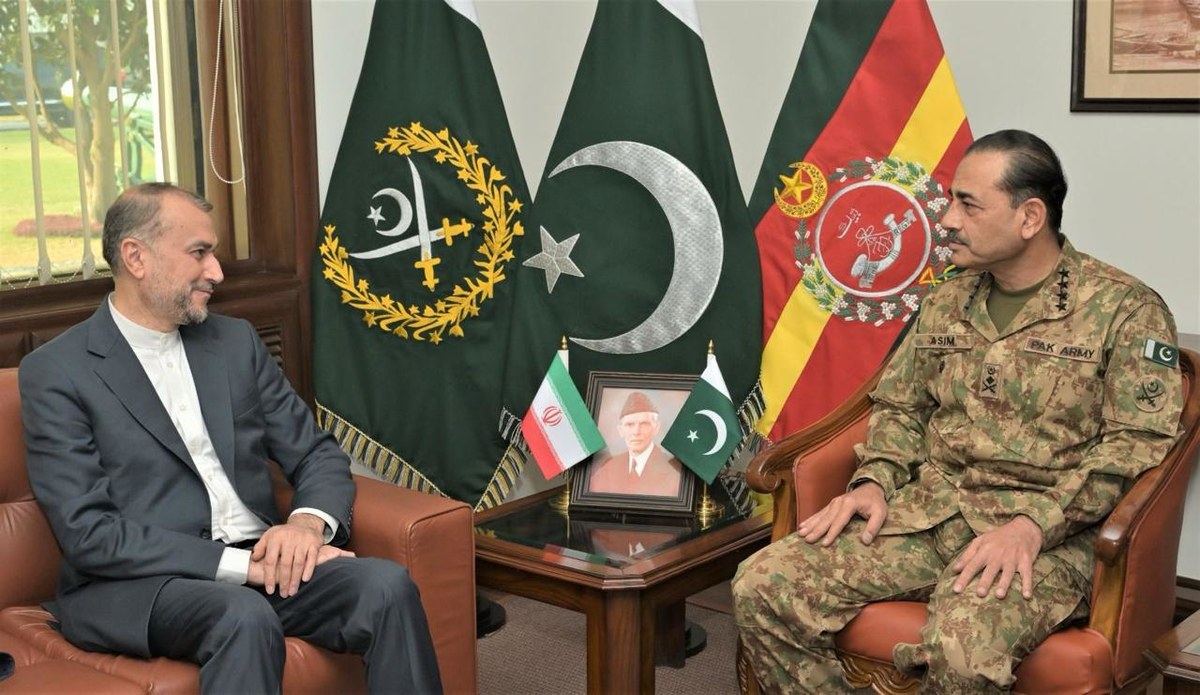


Pakistan's Army Chief General Asim Munir (right) in a meeting with the Iranian Foreign Minister Amir Abdollahian in Islamabad, Pakistan on January 29, 2024. (Photo courtesy: military's media wing)

“COAS (Chief of Army Staff) underscored the centrality of respecting the other state’s sovereignty and territorial integrity, calling it sacrosanct, inviolable and the most important cardinal of state-to-state relationship,” the ISPR said in a statement.

“Both sides agreed to operationalize the mechanism of deployment of military liaison officers in each other’s country at an early date to improve coordination and efficiency of response against common threats.”

They reiterated their commitment to peace, stability and prosperity in the border region which they said was an “indispensable requirement” for the well-being of people living on both sides, the ISPR added.


Zimbabwe surprise as T20 World Cup Super Eights begin without Australia

Updated 6 sec ago
Follow

Zimbabwe surprise as T20 World Cup Super Eights begin without Australia

  • Pakistan and New Zealand will clash in Colombo on Saturday as the second “Super Eights” phase of the T20 World Cup kicks off
  • India carry hopes of millions of cricket-obsessed fans of winning back-to-back T20 World Cups and lifting the trophy on home soil

Kolkata: Pakistan and New Zealand will clash in Colombo on Saturday as the second “Super Eights” phase of the T20 World Cup kicks off without former champions Australia, who shockingly failed to make it out of their group.

Instead, surprise packages Zimbabwe, who did not even qualify in 2024, topped Group B after a stunning unbeaten campaign where they not only beat Australia but also co-hosts Sri Lanka.

An injury-depleted Australia endured a chaotic campaign and failed to make the second phase of the T20 World Cup for the first time since 2009.

Australia’s acerbic media did not hold back in their criticism, citing selection “stuff-ups” and “shambolic” preparations, including a 3-0 pre-tournament series loss in Pakistan, for the embarrassment.

Australia coach Andrew McDonald admitted his players were “devastated” but any inquest into the failure would only begin “when we exit the shores here.”

India, the world number one-ranked T20 side, are hot favorites to retain their crown on home soil.

However, in the second round they face a tough rematch of the 2024 final against an in-form South Africa in Ahmedabad at a packed 130,000-capacity Narendra Modi stadium on Sunday.

Both teams came through the first round phase with four wins from four.

India are on a 12-match unbeaten run at the T20 World Cup, stretching back to their defeat in the semifinal against eventual winners England in 2022.

No team has won back-to-back T20 World Cups or lifted the trophy on home soil, and India have the hopes of hundreds of million of cricket-obsessed fans on their shoulders.

But India have not been consistent and have a problem at the top of the order with their number one-ranked batter Abhishek Sharma recording three consecutive ducks.

Their batting has looked shaky and India were 77-6 against the United States before coming through to win.

Also in Super Eights Group 1 are Zimbabwe and the West Indies, who meet in Mumbai on Monday, with all that group’s games being hosted in India.

ENGLAND YET TO FIRE

The West Indies toppled England convincingly in the group phase and the two-time champions have all-round strength in depth.

They won the T20 World Cup the last time it was hosted in India, in 2016, and have started in clinical fashion, winning all four group games.

They will be extremely wary of Zimbabwe, whose colorful band of traveling supporters have had plenty to cheer so far. Even a washout against Ireland could not dampen their spirits.

In Sri Lanka, Group 2 pits the co-hosts against England, Pakistan and New Zealand.

The top two from each group will advance to the semifinals.

Pakistan were the last team to secure their berth. They did so by beating Namibia by 102 runs, with captain Salman Agha calling it a “complete performance” as they bounced back from a group defeat to bitter rivals India.

Another pre-tournament fancy, England stumbled through their group matches in Mumbai and Kolkata, losing to the only Test-playing side they faced, the West Indies.

Harry Brook’s side were unconvincing in wins against minnows Nepal, Scotland and finally Italy, who were making their World Cup debut.

But they return to a happy hunting ground in Kandy to face Sri Lanka on Sunday at a venue where England swept a T20 series 3-0 this month, with Sam Curran taking a hat-trick along the way.

Their top order needs to find form, with explosive openers Jos Buttler and Phil Salt yet to make a telling score and Brook failing to fire.

Sri Lanka have also been hot and cold.

Pathum Nissanka scored a superb century on Monday to all but end Australia’s tournament.

But they lost to Zimbabwe in their final group game, although Nissanka was in the runs again with 62.