

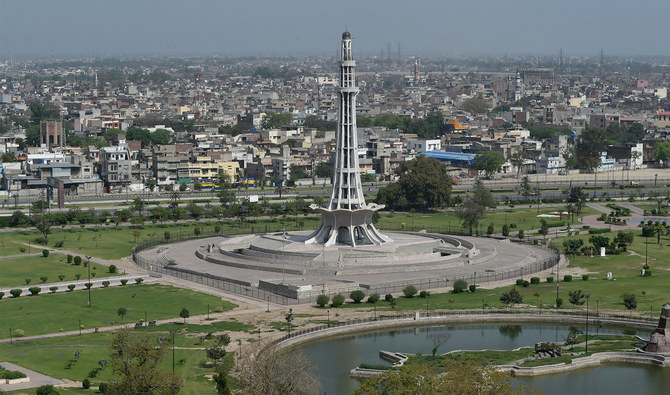
Minar-e-Pakistan: A national monument for political ideas and power shows

A general view of Minar-e-Pakistan, a national monument in Iqbal Park is seen in Lahore, Pakistan on April 10, 2020. (AFP/File)
Short Url
Updated 29 January 2024
Follow

Minar-e-Pakistan: A national monument for political ideas and power shows

  • Minar-e-Pakistan is historically significant for being the site where the Lahore Resolution was passed in March 1940
  • Pakistan’s major political parties PTI, PPP and PML-N have held massive public gatherings at the venue over the years

LAHORE: In the eastern city of Lahore, a 70-meter-tall tower provides a panoramic view of Pakistan’s second-largest city where political parties have, over the years, flexed their muscles by holding massive power shows. With national polls less than two weeks away, Minar-e-Pakistan, or the “Tower of Pakistan” is in the spotlight owing to its rich political and historical significance. 

It was on March 23, 1940, that Pakistan’s founder, Muhammad Ali Jinnah and other leaders of the All-Pakistan Muslim League demanded a separate homeland for the Muslims of the sub-continent by passing the Lahore Resolution at this site. The government decided to commemorate the historic site by building a monument here. The foundation stone for the Minar-e-Pakistan monument— designed and supervised by Pakistani-Russian architect Nasreddin Murat-Khan— ​ was laid on March 23, 1960 at the Greater Iqbal Park, while it was completed on October 21, 1968. 

The powerful monument symbolizes a place where political struggles come to fruition, and revolutionary ideas are birthed. It comes as no surprise that political parties such as the Pakistan Peoples Party (PPP), the Pakistan Muslim League-Nawaz (PML-N) and the Pakistan Tehreek-e-Insaf (PTI), among others, have chosen this site to hold large rallies to show off their support among the masses. 

Historian and associate professor of Lahore University of Management Sciences (LUMS) Dr. Ali Usman Qasmi said the venue used to be a “large green space” for denizens of the city who used to fly kites and hold celebrations. Famous former Pakistani cricketers Wasim Akram and Abdul Razzaq regularly played the sport here, Qasmi noted. Now, the “manicured lawns” and dancing fountains at the venue means the park is no longer a massive green space for citizens to enjoy social activities like they used to before. Instead, political parties regularly hold large gatherings here. 

“It has a very central place when it comes to Pakistan’s history and politics, and this is the reason why major political actors have used it as a launch pad or used this space to affirm their support among the masses, to project themselves as national leaders,” Qasmi told Arab News recently. 

When slain former prime minister Benazir Bhutto returned to Pakistan in April 1986, it was a seismic event in Pakistani politics. Bhutto arrived in Lahore, and held a massive public gathering at Minar-e-Pakistan, instead of landing in Karachi, Qasim noted. 

PPP’s Aitzaz Ahsan remembers the day all too well when Bhutto arrived at the monument to rally the masses against then-military ruler General Zia-ul-Haq. 

“When Shaheed Benazir Bhutto arrived back after years of exile, it seemed like one mass, one body of people from the airport to Minar-e-Pakistan,” Ahsan told Arab News, describing the scenes of a massive rally. 

Ahsan said similar to Jinnah’s mausoleum in Karachi, Minar-e-Pakistan has also become an “attraction” for Pakistan’s masses over the years. 

“Minar-e-Pakistan also became a measure as to how strong or how vibrant and widespread a movement or a party is,” Ahsan explained. 

The most recent public gathering that was held at the venue was in October 2023, when former three-time prime minister Nawaz Sharif arrived in Pakistan after nearly four years of self-imposed exile. The massive power show marked Sharif’s return to electoral politics, cementing his place as Pakistan’s “comeback kid.”

PML-N leader Sheikh Rohale Asghar admitted people were less enthusiastic about the upcoming national polls in Lahore and throughout the country but it was due to the “bad weather.”

“The election [activities and enthusiasm] will increase slowly because the time left [for polls] is less now,” Asghar told Arab News. 

Another major political event jolted Pakistan in October 2011 when cricketer-turned-politician Imran Khan’s Pakistan Tehreek-e-Insaf (PTI) held a massive show at Minar-e-Pakistan. Khan’s rally heralded a stark warning to his rivals, the Pakistan Peoples Party (PPP) and the Pakistan Muslim League-Nawaz (PML-N): the PTI had emerged as a major political player on the national scene. 
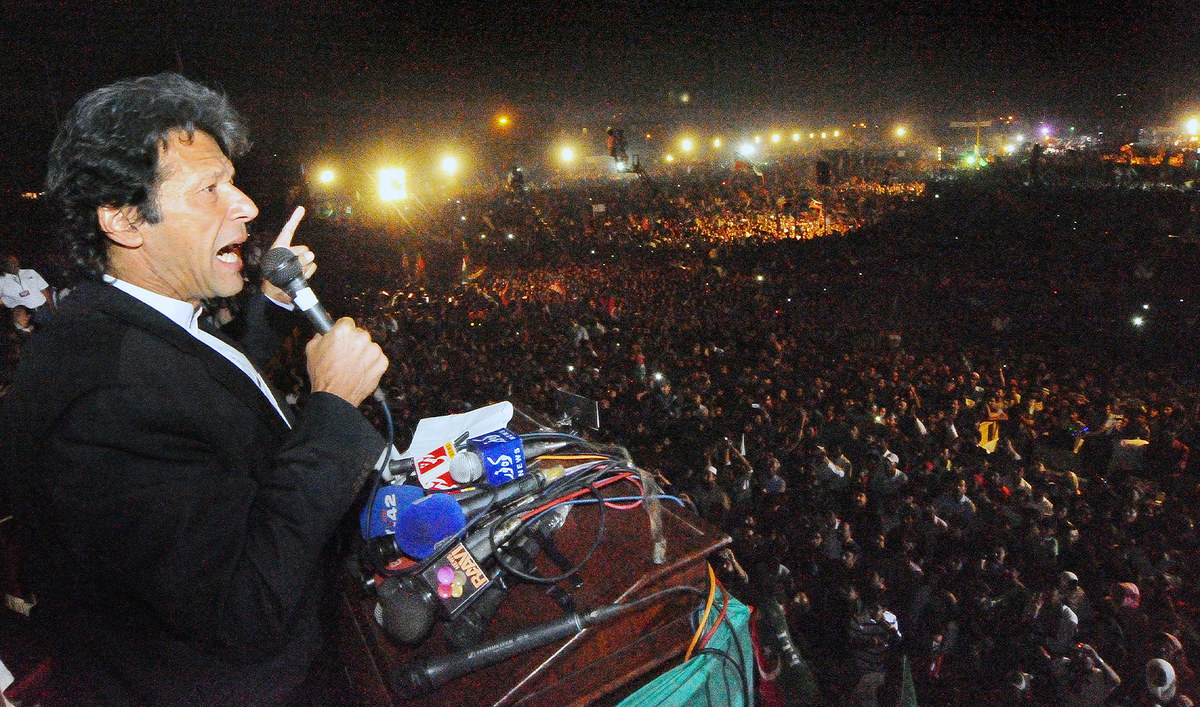


Pakistani politician and former cricketer Imran Khan addresses a rally in Lahore, Pakistan, on October 30, 2011. (AFP)

And Punjab, Pakistan’s most prosperous and populous province, was up for grabs. 

PTI’s Salman Akram Raja, who is contesting as the party’s candidate from the NA-128 constituency in the city, feels his party is being unfairly restrained from holding a public gathering at the venue. 

“Our popularity is intact and other parties do not have the popularity to hold big processions at Minar-e-Pakistan,” Raja told Arab News. 

Ahsan agrees, saying only Sharif’s party has been given a “free run” by the state to campaign for the upcoming polls. 

“He is the only leader and [his] party is the only one that has held a public meeting at Minar-e-Pakistan park,” Ahsan said. “It was an apology for a public meeting [because] a section of the park was cordoned off, there dinner and tables were set for after Nawaz Sharif’s speech.”


Pakistan, other Muslim states raise alarm over Gaza situation after heavy flooding

Updated 8 sec ago
Follow

Pakistan, other Muslim states raise alarm over Gaza situation after heavy flooding

  • Cold winter rains have repeatedly lashed the sprawling tent cities, turning Gaza’s dirt roads into mud and causing damaged buildings to collapse
  • The situation has been compounded by lack of sufficient humanitarian access, acute shortages of essential life-saving supplies and materials

ISLAMABAD: Foreign ministers of Pakistan, Saudi Arabia and other Muslim nations on Friday voiced concern over the situation in Gaza, following severe flooding triggered by heavy rains in the territory.

As 2026 begins, the shaky 12-week-old ceasefire between Israel and Hamas has largely ended large-scale Israeli bombardment of Gaza. But Palestinians are still being killed almost daily by Israeli fire, and the humanitarian crisis shows no signs of abating.

Cold winter rains have repeatedly lashed the sprawling tent cities over past weeks, turning Gaza’s dirt roads into mud and causing buildings damaged in Israeli bombardment to collapse. UNICEF says at least six children have now died of weather-related causes.

In a joint message, foreign ministers of Pakistan, Saudi Arabia, Egypt, Indonesia, Jordan, Qatar, Türkiye, the United Arab Emirates, expressed their “deepest concern” over the situation, compounded by lack of sufficient humanitarian access, acute shortages of essential life-saving supplies, and the slow pace of the entry of essential materials required for the rehabilitation of basic services.

“The ministers highlighted that the severe weather has laid bare the fragility of existing humanitarian conditions, particularly for almost 1.9 million people and displaced families living in inadequate shelters,” the Pakistani foreign ministry said in a joint statement.

“Flooded camps, damaged tents, the collapse of damaged buildings, and exposure to cold temperatures coupled with malnutrition, have significantly heightened risks to civilian lives, including due to disease outbreaks, especially among children, women, the elderly, and individuals with medical vulnerabilities.”

The statement came a day after UNICEF said a 7-year-old, Ata Mai, had drowned Saturday in severe flooding that engulfed his tent camp in Gaza City. Mai had been living with his younger siblings and family in a camp of around 40 tents.

They lost their mother earlier in the war, according to the UN agency.

Video from Civil Defense teams, shown on Al Jazeera, showed rescue workers trying to get Mai’s body out of what appeared to be a pit filled with muddy water surrounded by wreckage of bombed buildings. The men waded into the water, pulling at the boy’s ankle, the only part of his body visible. Later, the body is shown wrapped in a muddy cloth being loaded into an ambulance.

Foreign minister of Pakistan, Saudi Arabia and other states appreciated the efforts of all United Nations (UN) organizations and agencies as well as non-government organizations (NGOs) in continuing to assist Palestinian civilians and deliver humanitarian assistance under extremely difficult and complex circumstances.

“They demanded that Israel ensure the UN and international NGOs are able to operate in Gaza and the West Bank in a sustained, predictable, and unrestricted manner, given their integral role in the humanitarian response in the Strip. Any attempt to impede their ability to operate is unacceptable,” the statement read.

The foreign ministers reaffirmed support to President Donald Trump’s plan for Gaza, with a view to ensuring the sustainability of the ceasefire, bringing an end to the war in Gaza, to secure a dignified life for the Palestinian people who have endured prolonged humanitarian suffering, and leading to a credible pathway to Palestinian self-determination and statehood.

“In this context, they stressed the urgent need to immediately initiate and scale up early recovery efforts, including the provision of durable and dignified shelter to protect the population from the severe winter conditions,” the statement read further.

“The ministers called on the international community to uphold its legal and moral responsibilities and to pressure Israel, as the occupying power, to immediately lift constraints on the entry and distribution of essential supplies including tents, shelter materials, medical assistance, clean water, fuel, and sanitation support.”
