

Armenia PM proposes non-aggression pact to Azerbaijan

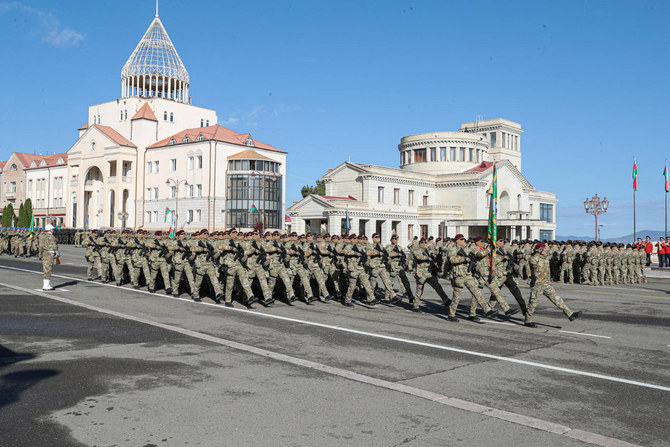
Azerbaijani troops parade in the town of Stepanaker (Khankendi), in Nagorno-Karabakh region on November 8, 2023. (Azerbaijani Presidential Press Office /Handout via AFP)
Short Url
Updated 29 January 2024
Follow

Armenia PM proposes non-aggression pact to Azerbaijan

YEREVAN: Armenian Prime Minister Nikol Pashinyan said on Sunday that he has proposed the signing of a non-aggression pact to Azerbaijan, pending a comprehensive peace treaty between the arch-foe Caucasus neighbors.
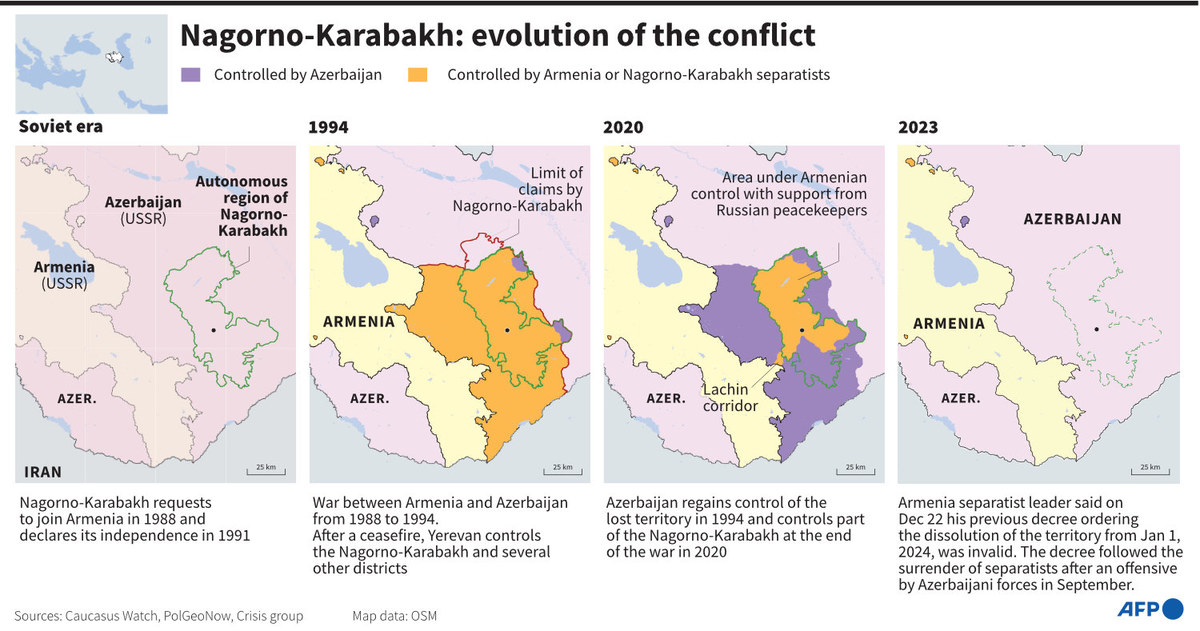
Yerevan and Baku have fought two wars — in 2020 and in the 1990s — over the disputed Nagorno-Karabakh region, which Azerbaijan recaptured in a lightning offensive last year.
“We have presented Azerbaijan with a proposal for a mutual arms control mechanism and the signing of a non-aggression pact if the signature of a peace treaty encounters delays,” Pashinyan said in a speech during an Armenian Army Day celebration event.
He also said that Armenia — a longstanding ally of Russia which had voiced fears of Azerbaijani military moves against its territory — must revise its security arrangements.
“We need to reconsider our strategic thinking in the security sphere and diversify our (international) relations in that sphere,” Pashinyan said.
“We are set to purchase new and modern weapons, and over the last years the government has signed contracts on arms procurement worth billions of dollars,” he added.
Azerbaijan has denied having territorial claims to Armenia and ruled out a fresh conflict with its fellow ex-Soviet republic.
Pashinyan and Azerbaijani President Ilham Aliyev had previously said a peace agreement could have been signed by the end of the last year.
But internationally mediated peace talks have so far failed to produce a breakthrough.
Last month, Armenia and Azerbaijan swapped prisoners of war, a first step toward normalizing relations.
The European Union, the United States as well as regional powers Turkiye and Russia have praised the move as a “breakthrough.”
The prisoner exchange raised hopes for reviving face-to-face talks between Pashinyan and Aliyev.
The pair have met several times for normalization talks mediated by EU chief Charles Michel.
But the process has been on hold since October.
Traditional regional power broker Russia, bogged down with its dragging Ukraine offensive, has seen its influence wane in the Caucasus.
Aliyev sent troops to Karabakh on September 19 and after just one day of fighting Armenian separatists — who had controlled the region for three decades — surrendered and agreed to reintegrate with Baku.
But in December, separatist leader Samvel Shahramanyan said in Yerevan that his previous decree ordering the dissolution of separatist institutions was not valid.
Almost the entire ethnic-Armenian population — more than 100,00 people — fled Karabakh for Armenia following Baku’s takeover, sparking a refugee crisis.
Azerbaijan’s victory in September marked the end of the territorial dispute, which had long been seen as unresolvable.


2025 among world’s three hottest years on record, WMO says

Updated 14 January 2026
Follow

2025 among world’s three hottest years on record, WMO says

  • All eight datasets confirmed that the last three years were the planet’s three hottest since records began, the WMO said
  • The slight differences in the datasets’ rankings reflect their different methodologies and types of measurements

BRUSSELS: Last year was among the planet’s three warmest on record, the World Meteorological Organization said on Wednesday, as EU scientists also confirmed average temperatures have now exceeded 1.5 degrees Celsius of global warming for the longest since records began.
The WMO, which consolidates eight climate datasets from around the world, said six of them — including the European Union’s European Center for Medium-Range Weather Forecasts (ECMWF) and the British national weather service — had ranked 2025 as the third warmest, while two placed it as the second warmest in the 176-year record.
All eight datasets confirmed that the last three years were the planet’s three hottest since records began, the WMO said. The warmest year on record was 2024.

THREE-YEAR PERIOD ABOVE 1.5 C AVERAGE ⁠WARMING LEVEL
The slight differences in the datasets’ rankings reflect their different methodologies and types of measurements — which include satellite data and readings from weather stations.
ECMWF said 2025 also rounded out the first three-year period in which the average global temperature was 1.5 C above the pre-industrial era — the limit beyond which scientists expect global warming will unleash severe impacts, some of them irreversible.
“1.5 C is not a cliff edge. However, we know that every fraction of a degree matters, particularly for worsening extreme weather events,” said Samantha Burgess, strategic ⁠lead for climate at ECMWF.
Burgess said she expected 2026 to be among the planet’s five warmest years.

CHOICE OF HOW TO MANAGE TEMPERATURE OVERSHOOT
Governments pledged under the 2015 Paris Agreement to try to avoid exceeding 1.5 C of global warming, measured as a decades-long average temperature compared with pre-industrial temperatures.
But their failure to reduce greenhouse gas emissions means that target could now be breached before 2030 — a decade earlier than had been predicted when the Paris accord was signed in 2015, ECMWF said. “We are bound to pass it,” said Carlo Buontempo, director of the EU’s Copernicus Climate Change Service. “The choice we now have is how to best manage the inevitable overshoot and its consequences on societies and natural systems.”
Currently, the world’s long-term warming level is about 1.4 C above the pre-industrial era, ECMWF said. Measured on a short-term ⁠basis, average annual temperatures breached 1.5 C for the first time in 2024.

EXTREME WEATHER
Exceeding the long-term 1.5 C limit would lead to more extreme and widespread impacts, including hotter and longer heatwaves, and more powerful storms and floods. Already in 2025, wildfires in Europe produced the highest total emissions on record, while scientific studies confirmed specific weather events were made worse by climate change, including Hurricane Melissa in the Caribbean and monsoon rains in Pakistan which killed more than 1,000 people in floods.
Despite these worsening impacts, climate science is facing political pushback. US President Donald Trump, who has called climate change “the greatest con job,” last week withdrew from dozens of UN entities including the scientific Intergovernmental Panel on Climate Change.
The long-established consensus among the world’s scientists is that climate change is real, mostly caused by humans, and getting worse. Its main cause is greenhouse gas emissions from burning fossil fuels like coal, oil and gas, which trap heat in the atmosphere.