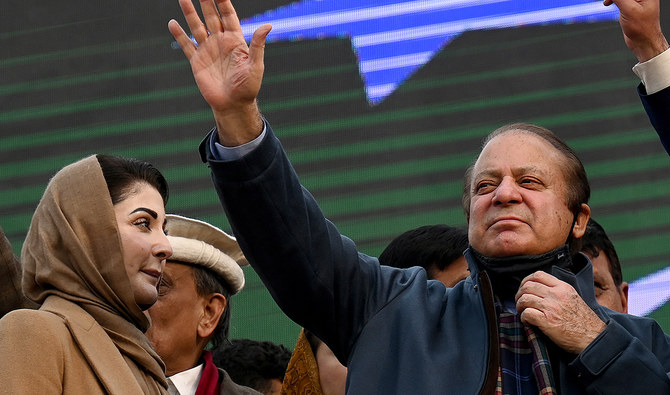
ISLAMABAD: Former prime minister Nawaz Sharif on Saturday unveiled the election manifesto of his Pakistan Muslim League-Nawaz (PML-N) party and vowed to drastically cut inflation, enhance trade through exports and promote peace with neighboring countries, as the South Asian country heads for polls slated for Feb. 8.
Electioneering is gaining momentum in the nation of 241 million people by the day as political parties gear up for national polls less than two weeks away. The PML-N, which has won elections thrice and formed a government most recently in April 2022 after ousting former prime minister Imran Khan in a parliamentary vote, is a strong contender in the upcoming polls.
Sharif’s party has always positioned itself as one that champions development and takes credit for building a vast network of roads and launching state-of-the-art mass transit projects in Pakistan. The party has vowed to rid the country of its pressing issues of inflation and militancy.
“A lot of hard work has gone into preparing, writing and printing this manifesto,” Sharif told reporters at a news conference in the eastern city of Lahore. “If Allah allows us to form our government once again, we will fully implement it.”
Sharif spoke highly of his previous tenure as prime minister from 2013-2017, regretting what he called were conspiracies hatched by his opponents, especially former prime minister Imran Khan, to oust him from power.
“What did you do during your four years in power,” Sharif asked, referring to Khan’s tenure from 2018-2022 as the country’s prime minister. “Can you even put one finger to a project that you fulfilled?”
The party’s ambitious election manifesto, a copy of which was seen by Arab News, aims to bring inflation down to single-digit figure within one year and in five years, reduce it drastically to 4-5 percent. The document also states that the party would take Pakistan’s annual exports to $60 billion in five years and enhance workers’ remittances to $40 billion annually.
The PML-N said it would enhance public wages to “match inflation” and achieve a 6.0 plus gross domestic product (GDP) target within three years of forming its government.
As far as its plans to provide cheap power are concerned, the manifesto said the party would reduce electricity bills by 20-30 percent, produce another 15,000 megawatts and provide subsidies to farmers and the underprivileged.
On international relations, the party vowed to “forge even closer ties” with China and deliver the next phase of the multi-billion economic corridor with Beijing.
“The PML-N strongly holds the position that normalization of ties with India cannot take place till New Delhi reverses the unilateral measures taken on August 5, 2019,” the manifesto read.
“Relations anchored in mutual respect, shared vision for regional stability and economic growth.”
Pakistan, which is being run by a caretaker government under Prime Minister Anwaar-ul-Haq Kakar, is scheduled to hold national polls next month.
Sharif, who arrived in Pakistan in October last year to lead the PML-N ahead of polls, is eyeing a victory in the elections once again to become prime minister for the fourth time.
Political analysts say the PML-N manifesto is “ambitious” but most of the targets are achievable only through a proper strategy and good governance.
“Majority of the targets set in the manifesto are achievable, but the issue is political stability and trust of the people in the political system,” Dr. Rasul Bakhsh Rais, a political scientist, told Arab News.
He said the biggest issue at the moment was to see if the elections would be free and fair to reflect the “actual public mandate” in the upcoming government.
“The PML-N has been in power before, so it is pertinent to ask them as to why they failed to implement the reforms in legal and judicial system they are promising now to the public,” he said.
Dr. Khurram Shahzad, a senior economist, said the promises in the manifesto would remain superficial unless a proper strategy was devised to implement them.
“We need a complete overhaul of our economic and taxation system to boost the government’s revenues instead of mere cosmetic measures to fix them,” he told Arab News.
“Also, the strategy of how to do and achieve it all is conspicuously missing from the PML-N manifesto.”


![]()

Ex-PM Sharif unveils party’s election manifesto as Pakistan gears up for polls
Short Url
https://arab.news/jaqdb
Ex-PM Sharif unveils party’s election manifesto as Pakistan gears up for polls
- In ambitious manifesto, Sharif’s PML-N party promises to drastically slash inflation and enhance wages
- Analysts say majority of the targets are achievable, but require overhaul of economic, taxation system


Latest updates



Recommended


© 2026 SAUDI RESEARCH & PUBLISHING COMPANY, All Rights Reserved And subject to Terms of Use Agreement.