

Pneumonia claims 234 child lives in Pakistan’s Punjab amid smog, frosty weather

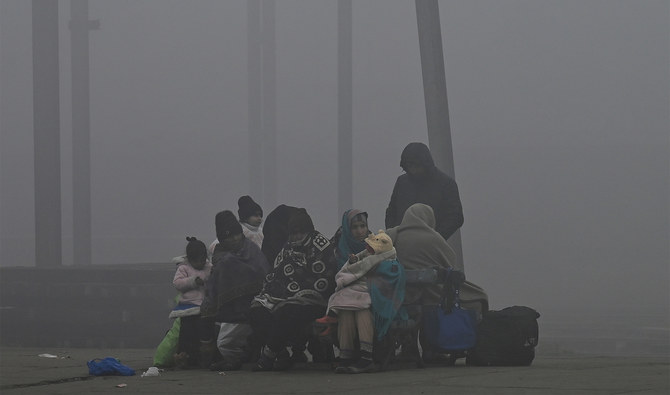
Passengers wait for a train at a railway station amid heavy smog conditions in Lahore January 17, 2024. (AFP/File)
Short Url
Updated 26 January 2024
Follow

Pneumonia claims 234 child lives in Pakistan’s Punjab amid smog, frosty weather

  • Punjab health minister says mortality rate among children is around 10% higher than previous years due to long spell of cold, smog  
  • Public health expert says pneumonia is a seasonal disease which can be prevented through vaccination and breast-feeding children 

ISLAMABAD: An outbreak of pneumonia in Pakistan’s most populous Punjab province has killed 234 children this month amid smog, extreme winter and low vaccination of minors, the Punjab caretaker health minister said on Friday, hoping the situation would improve as the cold weather subsided in the next few weeks.

Pneumonia is an infection caused by bacteria, viruses or fungi that causes the air sacs to fill with pus and fluid. It poses high risk to people aged 65 and above and children below the age of 2 years.

The infectious disease claims around 55,000 to 60,000 child lives in the South Asian country every year amid cold and dry weather conditions, according to the Punjab health ministry. 

“This is not a new phenomenon in Punjab or Pakistan, but the mortality rate in the province is around 10 percent higher than the previous years due to a long spell of smog and freezing weather,” Punjab Caretaker Health Minister Professor Javed Akram told Arab News.  

“The major causes of the pneumonia and deaths among kids were low rate of mother feeding and vaccination, coupled with the chilly weather.” 

The province has reported around 18,000 pneumonia cases so far this, with a mortality rate of 1.3 percent, according to the minister.  

He advised people to keep their rooms heated for children and elderly people during the winter season to avoid the infection.  

“We have been running awareness campaigns through media to educate the public about benefits of children’s mother feeding and their proper vaccination,” he said.  

“Majority of the kids have been suffering from the viral pneumonia and it has affected the kids with low immunity.” 

Akram hoped that the number of pneumonia cases would reduce with the cold weather subsiding in the coming weeks.   

Public health experts say pneumonia is a seasonal disease that could be prevented through vaccination and breast-feeding.  

“Pneumonia is a winter disease as viruses and bacteria flourish in this season, therefore it hits children and elderly people,” Professor Maqbool Hussain, head of Children’s Hospital at Islamabad's Pakistan Institute of Medical Sciences (PIMS), told Arab News.  

“A majority of victims of pneumonia are malnourished kids with low immunity,” he said, urging mothers to breast-feed their children to boost their immunity against such diseases. 


Saudi Arabia leads Pakistan’s December remittances as inflows rise 16.5%

Updated 8 sec ago
Follow

Saudi Arabia leads Pakistan’s December remittances as inflows rise 16.5%

  • Remittances reach $3.6bn in December, central bank says
  • Flows from Gulf countries remain backbone of Pakistan’s external financing

KARACHI: Workers’ remittances to Pakistan rose sharply in December with inflows led by Saudi Arabia, according to State Bank of Pakistan data released on Friday, providing critical support to the country’s foreign exchange reserves and balance of payments. 

Remittances, a key source of hard currency for Pakistan, have remained resilient despite global economic uncertainty, helping cushion the country’s current account, support the rupee and stabilize foreign exchange reserves at a time when Islamabad remains under an International Monetary Fund (IMF) bailout program.

According to the State Bank of Pakistan’s official data, workers’ remittances reached a record $38.3 billion in fiscal year 2024-25 (July 2024–June 2025), up from about $30.3 billion the year before, reflecting strong labor migration to Gulf countries and improved formal banking channels. Economists say remittances are especially vital for Pakistan because they finance imports, support household consumption and reduce reliance on external borrowing.

“Workers’ remittances recorded an inflow of $ 3.6 billion during December 2025,” the central bank said in a statement.

“In terms of growth, remittances increased by 16.5 and 12.6% on y/y and m/m basis respectively.”

On a cumulative basis, remittances also posted solid growth in the current fiscal year.

“Cumulatively, with an inflow of $ 19.7 billion, workers’ remittances increased by 10.6% during H1FY26 compared to $ 17.8 billion received during the same period last year,” the statement said.

Saudi Arabia remained the single largest source of inflows in December with $813.1 million, followed by the United Arab Emirates at $726.1 million, the United Kingdom at $559.7 million and the United States at $301.7 million, according to the central bank.

Millions of Pakistanis work abroad, particularly in Saudi Arabia and the United Arab Emirates, sending money home to support families and local economies. The government and central bank have encouraged the use of formal channels in recent years, helping improve transparency and sustain inflows.