In Canada foreign interference probe, commission seeks information on Indian meddling in elections

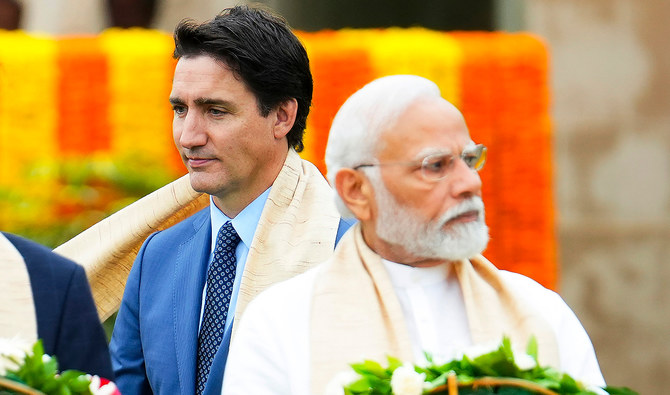
In this file photo, taken on September 10, 2023, Canada's Prime Minister Justin Trudeau (left) walks past Indian Prime Minister Narendra Modi as they take part in a wreath-laying ceremony at Raj Ghat, Mahatma Gandhi's cremation site, during the G20 Summit in New Delhi. (AP/File)
Short Url
Updated 25 January 2024
Follow

In Canada foreign interference probe, commission seeks information on Indian meddling in elections

  • Commission set up to conduct public inquiry after reports of alleged Chinese attempts to influence elections 
  • Commission requests documents “relating to alleged interference by India related to 2019 and 2021 elections”

OTTAWA: An independent commission probing alleged foreign interference in Canada asked the Trudeau government on Wednesday to share information about possible meddling in elections by India, a development that could aggravate already-tense Ottawa-New Delhi relations.
The commission was set up by Prime Minister Justin Trudeau’s government in September to conduct a public inquiry into foreign meddling in Canadian affairs after reports of alleged Chinese attempts to influence elections and mounting pressure for an inquiry. Beijing has repeatedly denied any interference.
The commission said in a statement on Wednesday that it had requested the Canadian government to provide documents “relating to alleged interference by India related to the 2019 and 2021 elections.”
“The commission will also examine the flow of information within the federal government in relation to these issues, evaluate the actions taken in response, assess the federal government’s capacity to detect, deter, and counter foreign interference, and make recommendations on these issues,” it said.
The commission, led by Quebec Judge Marie-Josee Hogue, is charged with conducting an independent public inquiry into allegations of attempted foreign interference in Canadian affairs by China, Russia and others. It is expected to complete an interim report by May 3 and deliver its final report by the end of this year.
Diplomatic relations between India and Canada have frayed in recent months over Canada’s allegations linking Indian agents to the murder of Sikh separatist Hardeep Singh Nijjar in British Columbia last year. India has rejected that allegation. Canadian authorities have yet to charge anyone with the killing.
The Indian High Commission in Ottawa did not immediately respond to a request for comment on Wednesday.


Eritrea withdraws from regional bloc as UN expresses concern over tensions with Ethiopia

Updated 57 min 38 sec ago
Follow

Eritrea withdraws from regional bloc as UN expresses concern over tensions with Ethiopia

  • Eritrea and Ethiopia have in recent months accused each other of interference, sparking concerns over the possibility of a return to hostilities

NAIROBI: Eritrea on Friday withdrew from the Intergovernmental Authority on Development, accusing the East African regional bloc of nations of acting against the country’s interests.
At the same time, the United Nations expressed concern over renewed tensions between Eritrea and neighboring Ethiopia, which signed a peace agreement 25 years ago.
Eritrea’s foreign ministry said in a statement Friday it was withdrawing “from an organization that has forfeited its legal mandate and authority; offering no discernible strategic benefit to all its constituencies and failing to contribute substantively to the stability of the region.”
Eritrea quit IGAD in 2003 and rejoined two years ago, but said Friday that the bloc had failed to contribute to regional stability. IGAD responded by saying Eritrea had not participated in regional activities since it rejoined.
In addition to Eritrea and Ethiopia, IGAD includes Djibouti, Kenya, Somalia, South Sudan, Sudan and Uganda. The organization works on regional policies concerning trade, customs, transport, communications, agriculture, natural resources and the environment, according to its website.
Eritrea and Ethiopia have in recent months accused each other of interference, sparking concerns over the possibility of a return to hostilities.
Ethiopia said it wants to peacefully gain Red Sea access through Eritrea, which it relied on heavily for trade before the secession. Ethiopian Prime Minister Abiy Ahmed said in September it was a “mistake” to lose access to the sea when Eritrea gained independence in 1993 by seceding from Ethiopia to form a separate nation. Abiy’s rhetoric has been seen as provocative by Eritrea.
The office of UN Secretary-General Antonio Guterres on Friday urged the two countries to “recommit to the vision of lasting peace and the respect for sovereignty and territorial integrity.”
The UN cited the Algiers Agreement signed in 2000, which ended nearly three decades of border war between Eritrea and Ethiopia. The UN called for a recommitment to the agreement, which it described as a “crucial framework” for peace.
Eritrea accused Ethiopia in June of having a “long-brewing war agenda” aimed at seizing its Red Sea ports. Ethiopia recently claimed Eritrea was “actively preparing to wage war against it,” as well as supporting Ethiopian rebel groups.