Pakistan’s caretaker commerce minister given additional charge of interior ministry

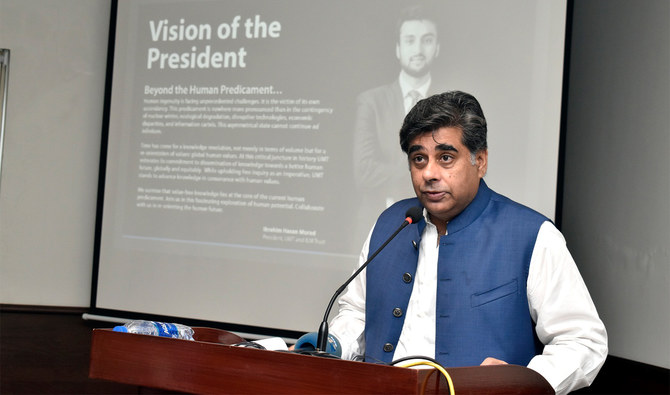
The file photo taken on June 16, 2021, shows Pakistan's commerce minister, Dr. Gohar Ejaz, who was given additional charge of the interior minister on January 24, 2024. (University of Management and Technology/Website)
Short Url
Updated 24 January 2024
Follow

Pakistan’s caretaker commerce minister given additional charge of interior ministry

  • Interior minister’s post was vacant since Sarfraz Bugti resigned in December 
  • New minister’s appointment comes weeks before Pakistan heads to the polls on Feb. 8

ISLAMABAD: Caretaker Prime Minister Anwaar-ul-Haq Kakar on Wednesday handed over the additional charge of the interior ministry to Commerce Minister Dr. Gohar Ejaz, days before Pakistan heads to the polls amid fears of militant attacks marring elections. 

The interior minister’s post was vacant since December when Sarfaraz Bugti, then Pakistan’s interior minister, resigned citing “personal reasons.” Bugti later joined the Pakistan Peoples Party (PPP) ahead of national elections, his move coming hours before the Election Commission of Pakistan (ECP) announced the schedule for polls. 

Pakistan’s law bars any member of a caretaker set-up from contesting elections. 

“The Prime Minister, in terms of rule 3(4) of the Rules of Business, 1973, has been pleased to assign the portfolio of Interior to Mr.[Gohar] Ejaz with immediate effect,” a notification from the Cabinet Division seen by Arab News said. 

Gohar assumed office following the notification, the ministry said in a post on social media website. It uploaded a video of the new caretaker interior minister meeting senior personnel during a visit to the ministry. 

Gohar, a businessperson and industrialist, assumes charge of the ministry as Pakistan suffers an uptick in militant attacks in its western regions bordering Afghanistan.

An election candidate was gunned down on Jan. 10 in northwestern Pakistan along with two others, while a former minister of the Pakistan Muslim League-Nawaz (PML-N) was critically wounded in a gun attack in southwestern Pakistan the same day. 

The attacks stoked fears that polls would be marred by violence carried out by banned outfits and militant groups in the South Asian country. 

Pakistan’s federal cabinet headed by PM Kakar on Tuesday approved the deployment of army soldiers and civil armed forces personnel for polls. The Prime Minister’s Office said army contingents would act as a Rapid Response Force on polling day. 

The troops would be stationed in sensitive and highly sensitive constituencies and inside polling stations, the PMO said. 

Pakistan cuts key rate by 50 bps to 10.5% in surprise move after holding for four meetings

Updated 9 sec ago
Follow

Pakistan cuts key rate by 50 bps to 10.5% in surprise move after holding for four meetings

  • An IMF staff report last week warned against premature easing, with analysts expecting SBP to hold the policy rate
  • Inflation remains within the bank’s target band, but analysts expect price pressures to rise later in the fiscal year

KARACHI: Pakistan’s central bank cut its key interest rate by 50 basis points to 10.5 percent on Monday, the bank said on its website, breaking a hold on the rate for four meetings in a move that surprised analysts and came despite IMF warnings to avoid premature easing.

All 12 analysts in a Reuters poll had expected the State Bank of Pakistan (SBP) to hold the policy rate at 11 percent.

Monday’s reduction takes the total easing since rates peaked at 22 percent to 1,150 basis points, after the SBP delivered 1,100 bps of cuts between June 2024 and May 2025 and then held the rate steady for four meetings before Monday’s move.

Inflation edged down to 6.1 percent in November from 6.2 percent in October, within the SBP’s 5 percent–7 percent target band, with analysts expecting it to rise again later in FY26 as base effects fade and food and transport prices stay volatile.

An IMF staff report last week warned against premature easing, calling for policy to remain data-dependent to anchor expectations and rebuild external buffers, even as Pakistan received a $1.2 billion disbursement under its loan program.