

Election printing business witnesses around 50 percent drop ahead of Pakistan’s polls — stakeholders

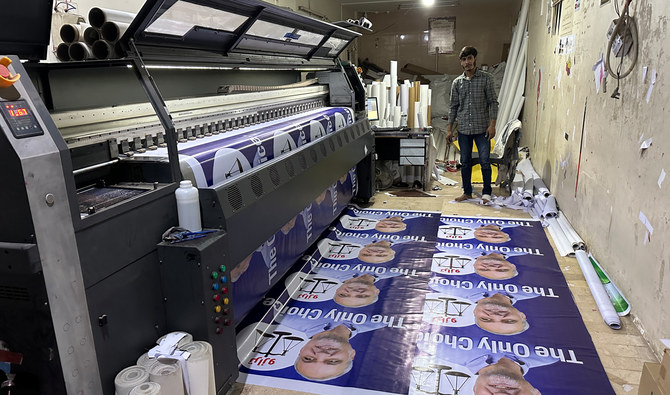
A worker prints election posters on a printing press in Karachi on January 23, 2024, ahead of the upcoming general elections. (AN Photo)
Short Url
Updated 24 January 2024
Follow

Election printing business witnesses around 50 percent drop ahead of Pakistan’s polls — stakeholders

  • Stakeholders blame political uncertainty and the prevailing economic conditions for the slump in business  
  • Demand for digital panaflex printing, use of social media have also cut demand, printing press owners say 

KARACHI: Business activities relating to printing of election material have witnessed a downturn of around 50 percent ahead of Pakistan’s general elections, industry stakeholders said, blaming it on prevailing political uncertainty and economic conditions.
The South Asian country of over 241 million people will be going to national elections on February 8 after more than a year of political instability stemming from the ouster of former prime minister Imran Khan in a parliamentary no-trust vote in April 2022.
Pakistan last year narrowly escaped a sovereign debt default, thanks to a $3 billion International Monetary Fund (IMF) bailout. However, decades of economic mismanagement resulted in lowering of forex reserves to critically low levels, depreciation of local currency and record inflation that raised the prices of almost all commodities, including printing materials.
Amid a precarious security situation in the country's western regions, uncertainty continues to shroud the conduct of polls despite repeated assurances from election authorities, deterring election candidates and their supporters against spending much on the printing of election material, according to printing press owners.
“Election-related business activities have declined more than 50 percent if we compare them with the economic activity generated in the previous election in 2018,” Hamid Mehmood, general secretary of Small Printing Press Association (SPPA) in Pakistan's largest city of Karachi, told Arab News. 


A worker gestures for a photograph as he prints election posters on a printing press in Karachi on January 23, 2024, ahead of the upcoming general elections. (AN Photo)

“The key reasons are uncertainties surrounding the holding of elections on February 8 and the worst economic conditions country is facing."
Mehmood said even the candidates, whose nominations had been accepted, were not sure of the conduct of polls. There had been a "flood" of demands for printing materials like badges, stickers, posters, and pamphlets in 2018, but this time it was almost negligible, he added.
Mehboob Elahi, a printing press owner at Karachi's Pakistan Chowk, agreed with Mehmood, saying there was a huge difference between the printing demand for previous elections and the current election campaigns.
“If we compare the current business trend with the previous elections that were held in 2018, the current business is much lower,” Elahi said, estimating the business had dropped by up to 40 percent, compared to 2018.


A worker prints election posters on a printing press in Karachi on January 23, 2024, ahead of the upcoming general elections. (AN Photo)

While some improvement was witnessed in the last couple of days, business activities were still sluggish, Elahi said.
Like Mehmood, he also attributed the sluggish business trend to the uncertainty relating to the conduct of elections as well as to a trend shift towards digital panaflex printing and social media.
“Many candidates are turning to the social media to run their election campaign which also cuts demand for the offset printing material,” Elahi said.
Panaflex, commonly used for outdoor signage and banners, is often made of a flexible, weather-resistant plastic material that is suitable for various outdoor advertising purposes. They are popular for their durability, versatility, and ability to withstand different weather conditions.
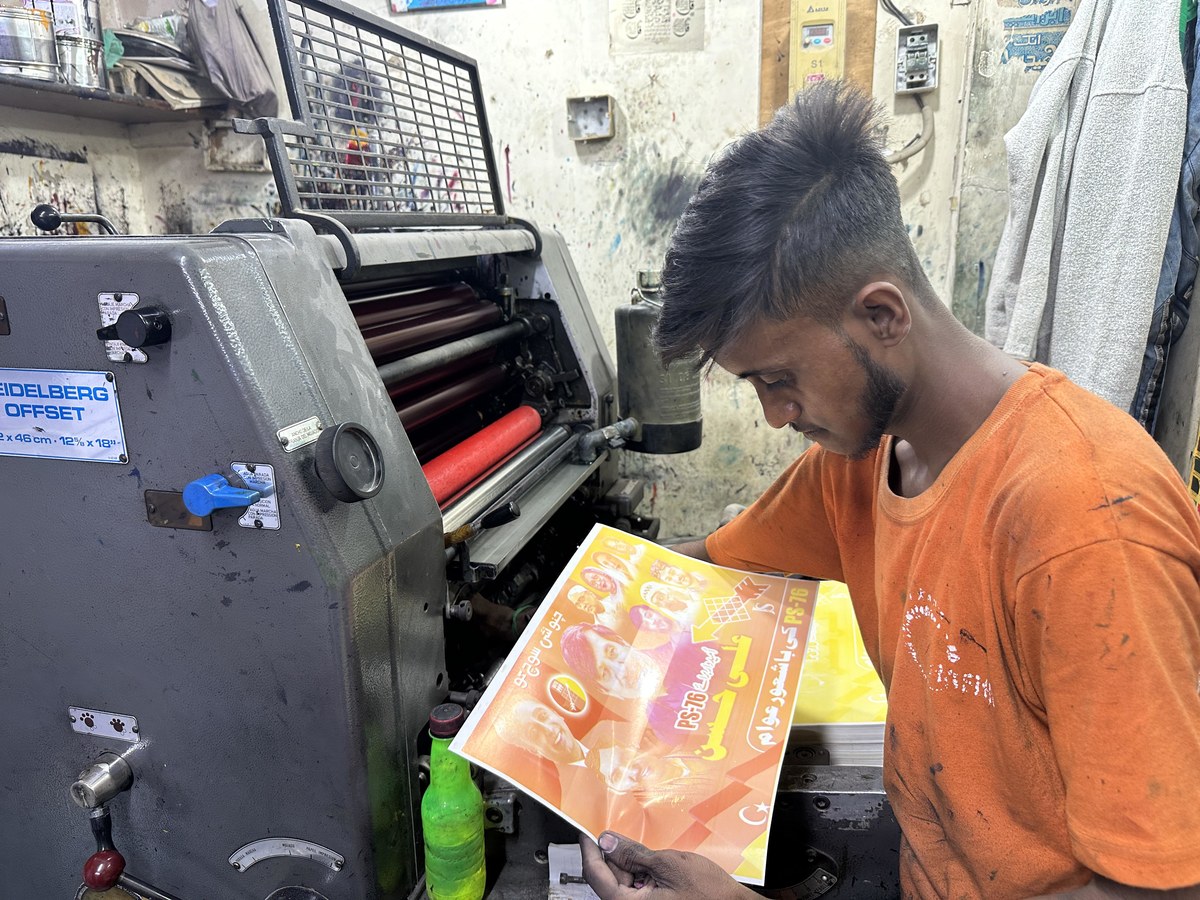


A worker prints election posters on a printing press in Karachi on January 23, 2024, ahead of the upcoming general elections. (AN Photo)

Javed Ahmed Khan, owner of Uzair Print and Panaflex, said while they were receiving orders, it could still not be equated with what it was in 2018.
“We had round-the-clock operations back then (2018) and we would decline booking orders,” he recalled. “This month, we have had only a couple of days when we ran the operations in three shifts.” 
Khan shared the printing cost had also gone up due to the hike in the price of materials. “The cost has increased from Rs15-16 per square feet to Rs25-30 per square feet this time,” he said, attributing it to the dollar-rupee disparity. 
With the polling day just less than two weeks away, printing press stakeholders expect the business may improve a bit, if the uncertainty subsides.


Pakistan likely to import around 7 million cotton bales this year as local production nearly halves

Updated 5 sec ago
Follow

Pakistan likely to import around 7 million cotton bales this year as local production nearly halves

  • Pakistan produced 5.3 million cotton bales by mid-December against 10 million targeted, government data shows
  • While the imports may ensure smooth supply of raw material, they may put pressure on foreign exchange reserves

KARACHI: Pakistan is likely to import around 7 million cotton bales this year owing to a decline of nearly half the annual target set by the Federal Committee on Agriculture (FCA), industry stakeholders said on Tuesday.

Pakistan’s cotton production stood at 5.3 million bales each weighing 170 kilograms as of Dec. 15, according to state-run Pakistan Central Cotton Committee (PCCC) data. The FCA had set a target of 10.2 million bales in April.

Karachi Cotton Brokers Forum (KCBF) Chairman Naseem Usman Osawala sees the country’s cotton production declining by 46 percent this season, compared to the FCA target.

“The country is expected to produce about 5.5 million bales this year,” he told Arab News, adding Pakistan would have to import around 7 million bales to meet requirement of its textile industry which consumes about 12 million bales a year.

The country had sown cotton over 2.002 million hectares, which was down by 11 percent from the targeted 2.26 million hectares.

Muhammad Waqas Ghani, head of research at Karachi-based JS Global Capital brokerage firm, said the South Asian country is likely to miss its cotton output target of 10 million bales.

“At the current rate of arrival, the output can reach 7 million bales at its best,” he added.

Cotton is a raw material for Pakistan’s largest textile industry and was the worst hit crop by climate-induced floods earlier this year.

Osawala said Pakistan’s cotton production has been falling because of an increasing number of sugar mills being established in the country’s cotton-producing regions.

Courts in Pakistan have been issuing significant rulings to bar the establishment of sugar mills in the designated cotton belt areas of the Punjab province. In 2018, the Supreme Court ordered relocation of three sugar mills from cotton-producing districts in southern Punjab to protect the crop.

Since cotton prices are low in the international market, textile millers would go for more imports, according to the KCBF chairman.

On Dec. 22, the price of cotton in the New York market stood at as much as 65.85 cents per pound, 1.64 cents lower than last year, according to the PCCC data.

Osawala said Pakistan’s increasing textile imports are also “hurting local cotton production.”

According to the Pakistan Bureau of Statistics’ (PBS) July-November data, the country had imported raw cotton, synthetic fiber, synthetic and artificial silk yarn and worn clothing worth $2.82 billion, 5 percent more than the imports during the same period last year.

Speaking of the impact of Pakistan’s falling cotton production, Kamran Arshad, chairman of All Pakistan Textile Mills Association (APTMA), said the millers would have to import “a lot of cotton” this year.

“I think approximately 7-7.5 million bales will have to be imported this year,” he said.

The textile and apparel sector is Pakistan’s largest exporter, accounting for more than half of the country’s overall exports and contributing around 8.5 percent of the gross domestic product (GDP) by employing nearly 40 percent of the industrial labor force. But high energy costs and outdated infrastructure among other factors continue to slow growth and leave the country trailing regional peers.

In the last fiscal year, Pakistan imported as much as 6.2 million cotton bales each weighing 220 kilograms, mostly from Brazil and the United States, according to KCBF Chairman Arshad.

Shankar Talreja, head of research at Karachi-based Topline Securities, said Pakistan is likely to import cotton worth $1.2 billion this year “considering the requirement.”

“The full-year import of cotton is likely to remain over $1 billion,” Talreja said.

Economic experts say while importing more cotton would ensure smooth supply of raw material to Pakistan’s textile sector, it may put pressure on the country’s foreign exchange reserves that rose to $15.9 billion last week after the International Monetary Fund (IMF) released a $1.2 billion tranche under Pakistan’s $7 billion loan program.