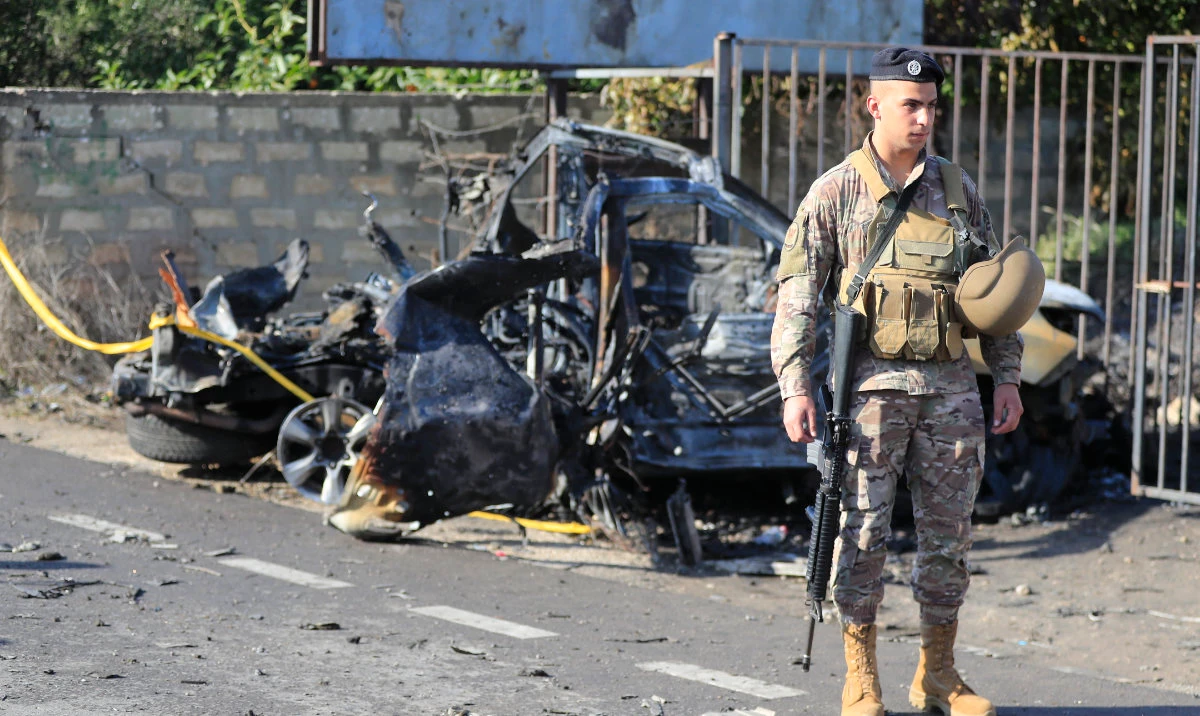
- A security source stated that “although Israel violated the rules of engagement, it is still excluding civilians in general
BEIRUT: Israel has been found to have again violated the rules of engagement. Israeli warplanes launched air strikes on an open forest area located between Roumine, Houmin Al-Fawqa, and Sarba, in the Iqlim Al-Tuffah region on Tuesday afternoon.
A resident in the targeted area told Arab News that the intensity of artillery fire was unspeakable: “The buildings and the floor shook. Everyone was terrified.”
A security source stated that “although Israel violated the rules of engagement, it is still excluding civilians in general.
The Israeli army claims that the houses it is bombing are of Hezbollah cadres or have armed militants. Nonetheless, the destruction is huge, and the economy is paralyzed all along the border region.”
Israeli aircraft launched two missiles on the targeted area. A massive explosion rocked Nabatieh and Iqlim Al-Tuffah and clouds of smoke coated the area.
Hostilities between Hezbollah and the Israeli army were witnessed across all southern border fronts. Israel launched artillery shells targeting Hamams Hill, the outskirts of Chihine, Marwahin, Tayr Harfa, Ramyah, Jabal Blat, and the southern outskirts of Mays El Jabal.
An Israeli drone fired two missiles at a shipping container located on an agricultural land in Al-Wazzani.
Israeli warplanes raided Jumayjimah — a village located between Tyre and Bint Jbeil — for the first time since the beginning of the attacks.
UNIFIL, the peacekeeping mission in Lebanon, remained in position while the administrative staff were still working from home.
Alarm sirens sounded multiple times at the UNIFIL centers during the Israeli bombardment of the area, indicating that the Israeli army expanded the geographical scope of its assaults beyond the southern Litani River, targeting southern villages that had not experienced attacks since the beginning of the conflict.
Meanwhile, Hezbollah announced that it had “attacked the Meron Air Control Base in Jabal Al-Jarmaq for the second time in response to the recent assassinations in Lebanon and Syria and the repeated attacks on civilians and homes in our steadfast villages with a large number of suitable missiles, achieving direct hits.”
The Israeli army spokesman confirmed the attack, saying that “damage was caused to the infrastructure of Meron Air Control Base after being hit by missiles launched from Lebanon.”
Hezbollah also announced that it had targeted “a gathering of enemy soldiers on Cobra Hill with missile weapons, achieving direct hits.”
Israeli media reported that sirens sounded in several areas in the Upper Galilee. The launch of missiles caused a power outage in many settlements in the region.
Israeli aircraft raided Blida on Monday night targeting three houses. The massive destruction in the town was revealed on Tuesday morning.
After Israel threatened to launch a war against Lebanon, the Lebanese Ministry of Health resumed emergency preparedness activities in government hospitals in the south and in Beirut, simulating crisis situations in the event of any possible attack against Lebanon.
Rafic Hariri University Hospital, located on the outskirts of Beirut’s southern suburb, hosted a training maneuver for the hospital staff. Competent authorities participated in the training, including the Lebanese Red Cross, the Emergency and Medical Services, the army command, the Internal Security Forces, and the municipality of Ghobeiry, in cooperation with the Ministry of Health, World Health Organization, and the International Committee of the Red Cross.