

Prominent journalist Motaz Azaiza flees Gaza after 108 days of Israeli onslaught

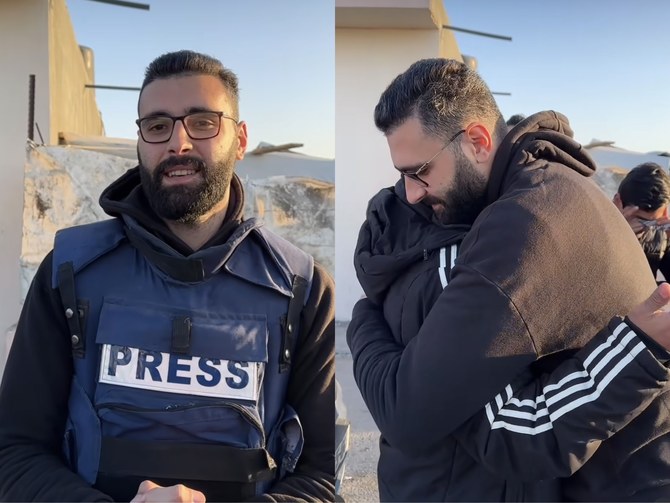
24-year-old Palestinian photojournalist Motaz Azaiza announces his evacuation from Gaza on Instagram. (Instagram/@motaz_azaiza)
Short Url
Updated 24 January 2024
Follow

Prominent journalist Motaz Azaiza flees Gaza after 108 days of Israeli onslaught

  • Azaiza amassed over 18m followers on Instagram, surpassing US President Joe Biden
  • 24-year-old became the world’s eyes into the daily realities of Israel’s brutal war in Gaza

LONDON: Palestinian photojournalist Motaz Azaiza, known for his compelling coverage of war-torn Gaza, has safely arrived in Doha after evacuating the strip on Tuesday.

Gaining immense popularity, Azaiza’s Instagram following surged to over 18 million in just 108 days as he documented the daily realities of Israel’s military invasion and relentless bombardment of the besieged strip. 

On Tuesday morning, the 24-year-old announced his evacuation from Gaza in a heartfelt video on social media. He expressed a mix of relief and sorrow, saying: “This is the last time you will see me with this heavy, stinky (press) vest. I decided to evacuate today. … Hopefully soon I’ll jump back and help to build Gaza again.” 

Azaiza hinted at multiple reasons for his evacuation, some of which he suggested were known to his audience.

The photojournalist has openly spoken about receiving death threats and alleged offers from Israel to stop documenting the aggression in Gaza. 

His journey out of Gaza took him through the Egyptian border to El Arish airport where he was received by a Qatari military jet. 

Azaiza told his followers that this was the first time he had flown in an airplane. 

His announcement video on Instagram has already garnered over 2.5 million likes and a flood of supportive comments, including from celebrities like Kehlani, Karen Wazen, and Alana Hadid.

Citizen journalists like Azaiza have played a crucial role in humanizing the Gaza war. Through platforms like Instagram, they have forged deep emotional bonds with a global audience, spotlighting the human impact of the bloody conflict.

The situation in Gaza has also compelled other journalists to leave. Wael Dahdouh, Al Jazeera’s bureau chief in Gaza, evacuated to Doha for medical treatment earlier this month, following the death of his son Hamza, also a journalist, in an Israeli airstrike. Plestia Alaqad, a 22-year-old journalist, moved to Melbourne in November, prompted by concerns for her family’s well-being.

Despite these departures, several prominent journalists continue to report from Gaza, including 9-year-old Lama Jamous, 25-year-old Bisan Owda, and 29-year-old Hind Khoudary.


Paris exhibition marks 200 years of Le Figaro and the enduring power of the press

Updated 17 January 2026
Follow

Paris exhibition marks 200 years of Le Figaro and the enduring power of the press

  • The exhibition celebrated the bicentennial of Le Figaro, offering visitors a rare opportunity to step inside the newspaper’s vast historical archive

PARIS: One of France’s most influential newspapers marked a major milestone this month with a landmark exhibition beneath the soaring glass nave of the Grand Palais, tracing two centuries of journalism, literature and political debate.
Titled 1826–2026: 200 years of freedom, the exhibition celebrated the bicentennial of Le Figaro, offering visitors a rare opportunity to step inside the newspaper’s vast historical archive. Held over three days in mid-January, the free exhibition drew large crowds eager to explore how the title has both chronicled and shaped modern French history.
More than 300 original items were displayed, including historic front pages, photographs, illustrations and handwritten manuscripts. Together, they charted Le Figaro’s evolution from a 19th-century satirical publication into a leading national daily, reflecting eras of revolution, war, cultural change and technological disruption.
The exhibition unfolded across a series of thematic spaces, guiding visitors through defining moments in the paper’s past — from its literary golden age to its role in political debate and its transition into the digital era. Particular attention was paid to the newspaper’s long association with prominent writers and intellectuals, underscoring the close relationship between journalism and cultural life in France.
Beyond the displays, the program extended into live journalism. Public editorial meetings, panel discussions and film screenings invited audiences to engage directly with editors, writers and media figures, turning the exhibition into a forum for debate about the future of the press and freedom of expression.
Hosted at the Grand Palais, the setting itself reinforced the exhibition’s ambition: to place journalism firmly within the country’s cultural heritage. While the exhibition has now concluded, the bicentennial celebrations continue through special publications and broadcasts, reaffirming Le Figaro’s place in France’s public life — and the enduring relevance of a free and questioning press in an age of rapid change.