

Russia’s Lavrov talks Middle East with Iran, Turkiye, Lebanon

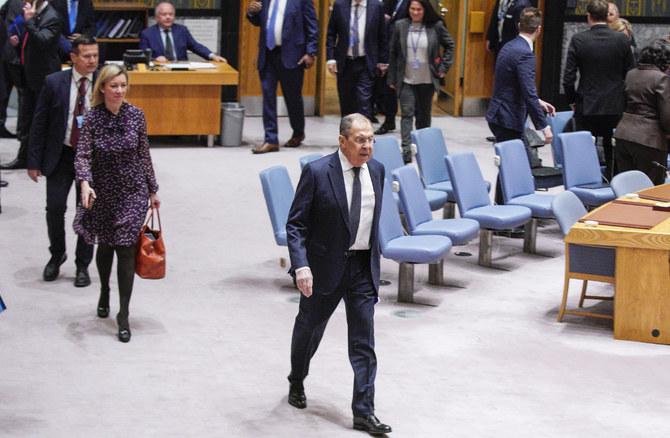
Russian Foreign Minister Sergei Lavrov, center, arrives to attend a security council meeting at the United Nations Headquarters in New York, Monday, Jan. 22, 2024. (AP)
Short Url
Updated 23 January 2024
Follow

Russia’s Lavrov talks Middle East with Iran, Turkiye, Lebanon

  • The ministry said Lavrov and Iranian Foreign Minister Hossein Amir-Abdollahian agreed on the need for a swift ceasefire in Gaza and conditions for providing humanitarian assistance to civilians

MOSCOW: Russia’s Foreign Minister Sergei Lavrov met with his counterparts from Iran, Turkiye and Lebanon ahead of the United Nations Security Council meeting on Tuesday due to discuss the Middle East, the Russian foreign ministry said.
The bilateral meetings focused on the Gaza Strip, Syria and “the tense situation” in the Red Sea, the ministry said on the Telegram messaging app on Tuesday. The meetings took place in New York on Monday.
The ministry said Lavrov and Iranian Foreign Minister Hossein Amir-Abdollahian agreed on the need for a swift ceasefire in Gaza and conditions for providing humanitarian assistance to civilians.
“General concern was expressed about the tense situation in the Red Sea, which has sharply degraded,” it said.
On Monday, the United States and Britain carried out an additional round of strikes against Yemen’s Houthis over their targeting of Red Sea shipping, the Pentagon said.
Lavrov and Lebanon’s Foreign Minister Abdallah Bou Habib talked about the importance of collective efforts of countries in the region toward an immediate ceasefire, the ministry said.
Israel in recent days carried out reportedly the most intense bombardment in southern Gaza since the war began in October, prompting calls from Washington to protect innocent people in hospitals, medical staff and patients.
According to the UN agenda, the Security Council is to discuss “the situation in the Middle East, including the Palestinian question.”
Lavrov said on Thursday he will propose “collective efforts” at the meeting to solve the Middle East crisis.
With his Turkish counterpart Hakan Fidan, Lavrov also discussed energy issues as well as “upcoming bilateral contacts.”
In December, the Kremlin said that Russian President Vladimir Putin may visit Turkiye in early 2024.


Bangladesh’s religio-political party open to unity govt

Updated 4 sec ago
Follow

Bangladesh’s religio-political party open to unity govt

  • Opinion polls suggest that Jamaat-e-Islami will finish a close second to the Bangladesh Nationalist Party in the first election it has contested in nearly 17 years

DHAKA: A once-banned Bangladeshi religio-political party, poised for its strongest electoral showing in February’s parliamentary vote, is open to joining a unity government and has held talks with several parties, its chief said.

Opinion polls suggest that Jamaat-e-Islami will finish a close second to the Bangladesh Nationalist Party in the first election it has contested in nearly 17 years as it marks a return to mainstream politics in the predominantly Muslim nation of 175 million.

Jamaat last held power between 2001 and 2006 as a junior coalition partner with the BNP and is open to working with it again.

“We want to see a stable nation for at least five years. If the parties come together, we’ll run the government together,” Jamaat chief Shafiqur Rahman said in an interview at his office in a residential area in Dhaka, ‌days after the ‌party created a buzz by securing a tie-up with a Gen-Z party.

Rahman said anti-corruption must be a shared agenda for any unity government.

The prime minister will come from the party winning the most seats in the Feb. 12 election, he added. If Jamaat wins the most seats, the party will decide whether he himself would be a candidate, Rahman said.

The party’s resurgence follows the ousting of long-time Prime Minister Sheikh Hasina in a youth-led uprising in August 2024. 

Rahman said Hasina’s continued stay in India after fleeing Dhaka was a concern, as ties between the two countries have hit their lowest point in decades since her downfall.

Asked about Jamaat’s historical closeness to Pakistan, Rahman said: “We maintain relations in a balanced way with all.”

He said any government that includes Jamaat would “not feel comfortable” with President Mohammed Shahabuddin, who was elected unopposed with the Awami League’s backing in 2023.