

7.1 earthquake strikes western China, but no casualties reported yet from sparsely populated area

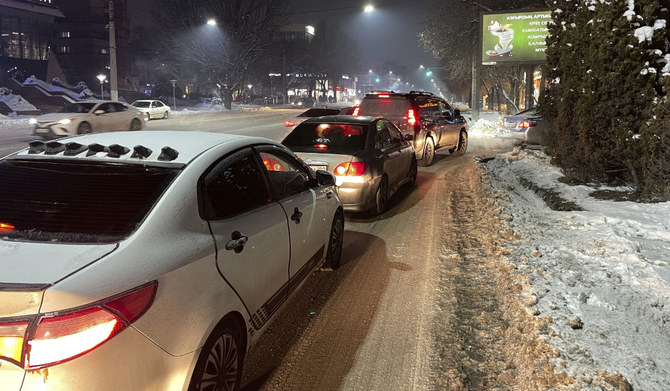
People sit inside their cars parked in a street after leaving their flats in apartment buildings after the earthquake in Almaty, Kazakhstan, Monday, Jan. 22, 2024. (AP)
Short Url
Updated 23 January 2024
Follow

7.1 earthquake strikes western China, but no casualties reported yet from sparsely populated area

  • The earthquake struck in a rural area populated mostly by Uyghurs, a Turkic ethnicity that is predominantly Muslim and has been the target of a state campaign of forced assimilation and mass detention in recent years

BEIJING: A magnitude 7.1 earthquake struck a sparsely populated part of China’s western Xinjiang region early Tuesday, downing power lines, destroying at least two homes and prompting authorities to suspend trains, local authorities and state media reported. No fatalities or injuries were immediately reported.
Xinhua News Agency cited the China Earthquake Networks Center as saying the quake rocked Uchturpan county (Wushi county in Mandarin) in Aksu prefecture shortly after 2 a.m.
Two houses collapsed, Aksu authorities said, and around 200 rescuers were dispatched to the epicenter, according to state broadcaster CCTV. The Xinjiang railway authority suspended dozens of trains and sealed off the affected sections, CCTV reported. The quake downed power lines but electricity was quickly restored to the region, Aksu authorities reported.
The US Geological Survey said the quake measured 7.0 magnitude and occurred in the Tian Shan mountain range, “a seismically active region, though earthquakes of this size occur somewhat infrequently.” It said the largest quake in the area in the past century was a 7.1-magnitude one in 1978 about 200 kilometers (124 miles) to the north of one early Tuesday.
State broadcaster CCTV said there were 14 aftershocks since the main quake, with two registering above 5 magnitude.
The earthquake struck in a rural area populated mostly by Uyghurs, a Turkic ethnicity that is predominantly Muslim and has been the target of a state campaign of forced assimilation and mass detention in recent years.
Uchturpan county at the quake’s epicenter is recording temperatures well below freezing, with lows down to negative 18 degrees C (just below zero F) forecast by the China Meteorological Administration this week. Parts of northern and central China have shivered under frigid cold snaps this winter, with authorities closing schools and highways several times due to snowstorms.
The tremors were felt hundreds of kilometers (miles) away. Ma Shengyi, a 30-year-old pet shop owner living in Tacheng, 600 kilometers (373 miles) from the epicenter, said her dogs started barking before she felt her apartment building shudder. The quake was so strong her neighbors ran downstairs. Ma rushed to her bathroom and started to cry.
“There’s no point in running away if it’s a big earthquake,” Ma said. “I was scared to death.”
Chandeliers swung, buildings were evacuated and a media office building near the epicenter shook for a full minute, Xinhua reported. A video posted by a Chinese Internet user on Weibo showed residents standing outside on the streets bundled in winter jackets, and a photo posted by CCTV showed a cracked wall with chunks fallen off.
Tremors were felt across the Xinjiang region and in the neighboring countries Kyrgyzstan and Kazakhstan. In the Kazakh capital of Almaty, people left their homes, the Russian news agency Tass reported.
Videos posted on the Telegram messaging platform showed people in Almaty running down the stairs of apartment blocks and standing outside in the street after they felt strong tremors. Some people appeared to have left their homes quickly and were pictured standing outside in freezing temperatures in shorts.
Earthquakes are common in western China, including in Gansu, Qinghai, Sichuan and Yunnan provinces, as well as the Xinjiang region and Tibet.
An earthquake that struck Gansu in December killed 151 people and was China’s deadliest earthquake in nine years.


Heavy shelling, explosions spark fear along Pakistan-Afghanistan border 

Updated 2 sec ago
Follow

Heavy shelling, explosions spark fear along Pakistan-Afghanistan border 

  • Residents fear for their safety amid border clashes
  • 1,500 Afghan families displaced ‌due to heavy shelling and explosions
  • Pakistan denies targeting civilians, says its strikes focus on militants

LAL PUR, Afghanistan/PESHAWAR, Pakistan: People living along Pakistan’s border with Afghanistan said they ​were considering fleeing their homes because of heavy shelling and explosions as fighting between troops from both sides entered a seventh day on Wednesday.
The South Asian allies-turned-foes have engaged in their worst fighting in years following Pakistani airstrikes on major Afghan cities last week, increasing volatility in a region also on edge over US and Israeli strikes on Iran.
Islamabad has said its airstrikes, which have at times directly targeted the Taliban government, are aimed at ending Afghan support for militants carrying out attacks on Pakistan. The Taliban has denied aiding militant groups.

SHELLING ‌STARTS AS VILLAGERS ‌ARE BREAKING RAMADAN FAST
Residents of towns and villages in ​Pakistan’s ‌northwest ⁠said fighting between ​border ⁠forces starts in the evenings, placing their homes in the line of fire, often at sunset when families are breaking their fast in the holy month of Ramadan.
“There is complete silence in the day, but the moment we sit for iftar dinner, the two sides start shelling,” Farid Khan Shinwari from Landi Kotal, a town near the Torkham border crossing, told Reuters.
“We open our fast in extremely difficult situations, as you never know when a shell can hit your house.”
Residents ⁠in the town and nearby villages said there had been heavy ‌shelling and some explosions heard in the past ‌few days, prompting many to flee their homes.
On the other ​side of the border, Afghans shared similar stories ‌of skirmishes and families fleeing their homes.
Hundreds had been displaced to an open ‌dirt field under makeshift tents, while others had no shelter at all. Officials say around 1,500 families have fled their homes.
Fighting along the 2,600-km (1,615-mile) border has ebbed and flowed over the week-long conflict, with both sides saying they have inflicted heavy losses on the other country and gained ground in the fighting.
Reuters ‌has been unable to verify these accounts.

TURKEY HAS OFFERED TO MEDIATE
Turkish President Recep Tayyip Erdogan told Pakistani Prime Minister Shehbaz Sharif that ⁠Ankara would help ⁠reinstate a ceasefire, the Turkish Presidency said on Tuesday, as other countries that had offered to mediate have since been hit by the conflict in the Gulf.
On Wednesday, both countries reported exchanges of heavy fire, with Afghanistan’s defense ministry saying Taliban forces shot down a Pakistani drone and captured seven border posts.
A spokesperson for the ministry said 110 civilians, including 65 women and children, had been killed since the fighting began and another 123 were wounded. The United Nations mission for Afghanistan has listed 42 deaths so far.
Pakistan’s Information Minister Attaullah Tarar disputed both figures, saying: “Pakistan exercises great care in only targeting terrorists and support infrastructure. No civilian structures have been targeted.”
On Saturday, Pakistan struck “ammunition and critical equipment” at the Bagram air base north ​of Kabul, Tarar said, a key American command ​center through the 20-year Afghan war.