

Condemnation from Pakistan as India’s Modi leads consecration of Ram temple in Ayodhya

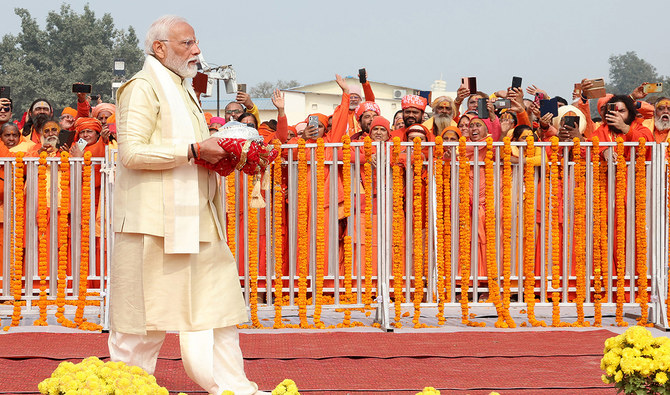
In this photograph taken on January 22, 2024 and released by Indian Press Information Bureau (PIB) India's Prime Minister Narendra Modi carries an offering as he walks towards the temple stairs to officially consecrate the Ram temple in Ayodhya in India's Uttar Pradesh state. (AFP)
Short Url
Updated 22 January 2024
Follow

Condemnation from Pakistan as India’s Modi leads consecration of Ram temple in Ayodhya

  • Pakistan says temple built on demolished mosque site to remain “blot on face of India’s democracy for times to come”
  • India’s Hindus say the site is birthplace of Lord Ram long before Muslim Mughals build the Babri Masjid in 1528

ISLAMABAD: Pakistan on Monday condemned the consecration of a grand temple to the Hindu god Lord Ram on a site believed to be his birthplace but where a 16th century mosque was demolished in 1992 in the Indian city of Ayodhya. 

The temple delivers on a key 35-year-old promise by Modi’s Hindu nationalist Bharatiya Janata Party (BJP), but it has been a contentious political issue that helped catapult the party to prominence and power.

For decades, the temple site was bitterly contested by Hindus and minority Muslims, leading to nationwide riots in 1992 that killed 2,000 people, mainly Muslims, after a Hindu mob destroyed a 16th-century mosque that had stood there.

India’s Hindus say the site is the birthplace of Lord Ram, and was holy to them long before Muslim Mughals razed a temple at the spot to build the Babri Masjid in 1528.

In 2019, the Supreme Court handed over the land to Hindus and ordered allotment of a separate plot to Muslims where construction of a new mosque is yet to begin.

“The developments of the last 31 years, leading to today’s consecration ceremony, are indicative of growing majoritarianism in India,” the Pakistani foreign office said, condemning Monday’s consecration. “These constitute an important facet of the ongoing efforts for social, economic and political marginalization of the Indian Muslims.”

A temple built on the site of a demolished mosque will remain “a blot on the face of India’s democracy for the times to come,” the statement added.

“Notably, there is a growing list of mosques, including the Gyanvapi Mosque in Varanasi and the Shahi Eidgah Mosque in Mathura, facing a similar threat of desecration and destruction,” the foreign office said. “The international community should take cognizance of the growing Islamophobia, hate speech and hate crimes in India.”

Nearly 8,000 people were invited to Monday’s ceremony, while more than 10,000 police personnel guarded the city of 3 million.

Security was also stepped up nationwide, especially in cities and towns that have suffered past Hindu-Muslim tension and strife.

The temple opens to the public on Tuesday and its management expects 100,000 visitors each day for the next few months.


Former spy chief Faiz Hameed appeals conviction by Pakistan military court

Updated 11 sec ago
Follow

Former spy chief Faiz Hameed appeals conviction by Pakistan military court

  • The ex-ISI chief was sentenced to 14 years in prison over engagement in political activities, misuse of authority
  • His conviction is highly unusual in a country where the military has ruled for almost half of its 78-year history

ISLAMABAD: Pakistan’s former intelligence chief Lt. Gen. (retired) Faiz Hameed has appealed his sentencing to 14 years in prison by a Pakistani military court, Hameed’s lawyer said on Sunday. 

Hameed was arrested in Aug. 2024 amid accusations he was involved in land grabbing and coercive seizures of property belonging to the owner of the Top City housing development near Islamabad. At the time, the military said multiple violations of the Pakistan Army Act after his retirement had also been established, prompting court martial proceedings.

On Dec. 11, Pakistan’s military announced that Hameed was found guilty of engaging in political activities, violating the Official Secrets Act and misusing authority and government resources as the chief of the Inter-Services Intelligence (ISI) agency.

“We have filed an appeal against the sentence handed down to Lt. Gen. Faiz Hameed by the military courts. The appeal was submitted to the Registrar Court of Appeals, AG Branch, Chief of Army Staff,” Hameed’s counsel Mian Ali Ashfaq told Arab News, without providing further details.

Hameed served as the ISI director-general from 2019 to 2021. His conviction is highly unusual in a country where the military has ruled for almost half of its history and continues to exert significant influence during civilian rule.

The Inter-Services Public Relations (ISPR), the military’s media wing, had said that Hameed was tried on four charges relating to political interference, breaches of the Official Secrets Act, misuse of authority and causing “wrongful loss to persons.”

“After lengthy and laborious legal proceedings, accused has been found guilty on all charges and sentenced to 14 years rigorous imprisonment by the Court which has been promulgated on 11 December 2025,” the ISPR said on Dec. 11.

Hameed was widely seen as close to Imran Khan when he was the prime minister and after his removal in a no-trust vote in 2022.

The military had previously accused Hameed of helping engineer political unrest during violent clashes on May 9, 2023, when Khan supporters rioted nationwide after his brief arrest on graft charges. Protesters were accused of torching government and military buildings “at the behest of and in collusion with vested political interests.” Khan, jailed since August 2023 on charges he says are politically motivated, denies ordering the attacks.

In its Dec. 11 statement, the military said the trial against Hameed complied with all legal requirements, adding that the former spy chief was given full rights, including the ability to choose his defense team, and retained the right to appeal “at the relevant forum.”

The ISPR also said his alleged role in “fomenting vested political agitation and instability in cahoots with political elements” was being handled separately, leading to speculation about more inquiries and legal cases.

Hameed, who retired in Dec. 2022, has long been a polarizing figure. The ruling Pakistan Muslim League-Nawaz (PML-N) also accuses him of helping engineer the 2017 removal of former premier Nawaz Sharif through court cases. Hameed denied the allegations.

“This is a landmark decision and I think the rule of law and accountability mechanism has been strengthened,” Information Minister Attaullah Tarar, who belongs to the PMLN-N, had told a Pakistani broadcaster after the announcement of the verdict against Hameed.